
Science and Culture Today Discovering Design in Nature
Topic

Stephen Barr

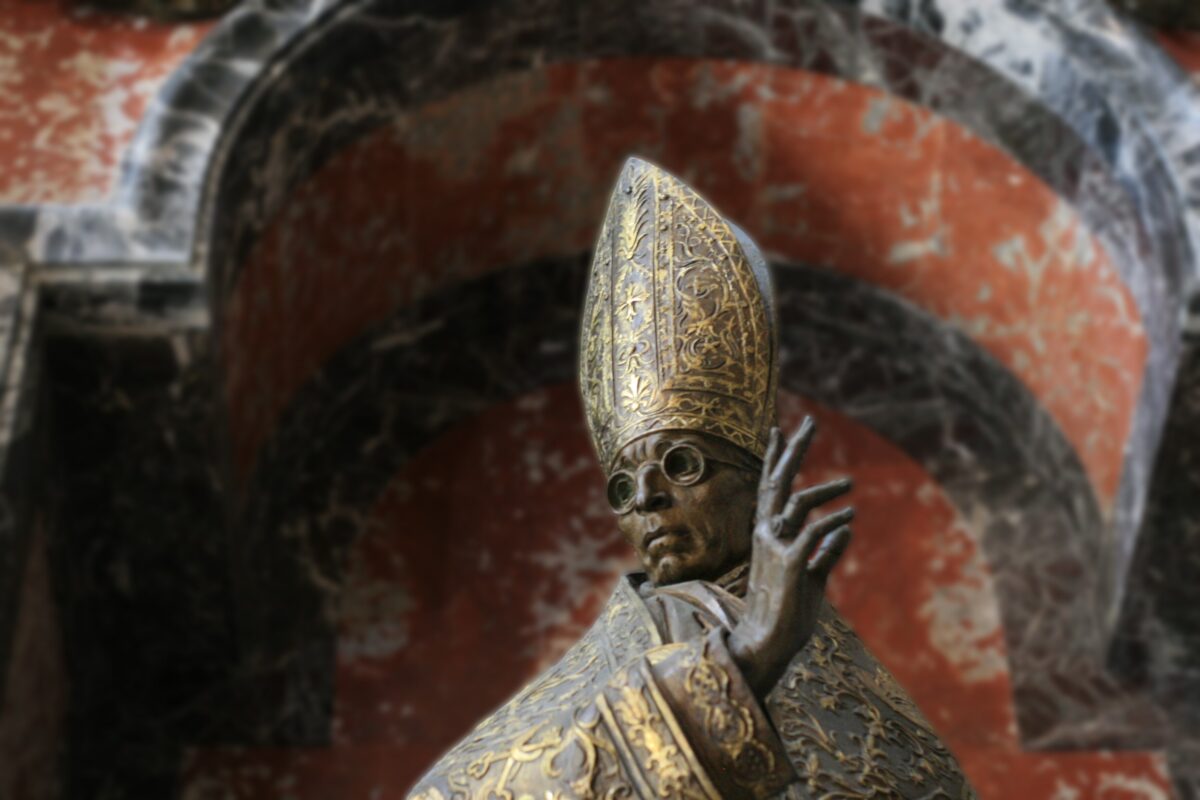
PopePiusXIIStatue
Image: Pope Pius XII, by INTVGene, CC BY-SA 2.0 <https://creativecommons.org/licenses/by-sa/2.0>, via Wikimedia Commons.

Catholicism and Evolution: A Response to Stephen Barr

These publications are far from telling, in Barr’s words, “the full story of how the Church did react to the theory of evolution.” Read More ›
wonderlane-vohu78p3X9U-unsplash
Image from unsplash.

Now, with Starships, Evolutionary Origins Become Still More Difficult

So it appears that self-contained gene transposon "packages" permit transfer of genes from one species to another Read More ›
Thomas Aquinas
Image: Thomas Aquinas, via Aquinas.Design.

Shall We Baptize Darwin? A Catholic Biologist Reflects

Theistic evolutionists are baptizing a theory first composed by Darwin as a substitute for the doctrine of special Creation. Read More ›

Waste Not, Want Not: Chimps Show the Way to Higher Development

Followers of news from the world of evolution research are abuzz over a new study, and it's only partly because of the opportunity for putting some mild potty talk in your headlines. Read More ›

Mainstream Media Now Picking up on Intelligent Design Discrimination Lawsuit Against NASA’s JPL

Last week we reported on a discrimination lawsuit filed on behalf of JPL employee David Coppedge. Over the weekend the San Gabriel Valley Tribune ran a lengthy story reporting on the suit. After Coppedge discussed intelligent design with JPL scientists, his supervisors told him to stop discussing religion. Last April Coppedge’s bosses demoted him. Coppedge had been a leader on the system administrator team for the Cassini mission, according to the suit. The paper also reports that after being ordered by his superiors at JPL to stop talking about intelligent design, Coppedge did just that. Even more interesting is this: Earlier this month Coppedge claims he met with his supervisors, who told him that the written warning was inappropriate and Read More ›

Responding to “Thomist” Critics of Intelligent Design

Preliminary Matters

I’m currently editing a volume called God and Evolution that deals with the general subject of theistic evolution (to be released by Discovery Institute this fall), and I am contributing a couple of chapters to the volume on Catholicism and ID. I’m also working on a book-length treatment of the same subject. As a result, over the last six months, I’ve been studying the relationship between Catholic theology and contemporary arguments for intelligent design.

Various “Catholic” assessments of ID have been appearing on for years, and no doubt will continue to do so. (See this 2007 article from the New Oxford Review, for instance.) But recently, a certain “meme” has begun to emerge that ID is somehow un-Catholic, contrary to the Catholic intellectual tradition, or some such. This seems to me to be a serious mistake that needs to be challenged directly. So one (though only one) of the purposes of the publications I’ve been working on is to respond to a cluster of criticisms of ID by some recent Catholic critics, including those by Ed Feser, Frank Beckwith, Michael Tkacz, and Stephen Barr. Some of these criticisms have taken place online, others in printed publications.

Unfortunately, the issues at stake are subtle and complicated, and often involve translations into somewhat different “conceptual schemes”; so it’s hard to deal with them adequately in the drive-by fashion appropriate to the blogosphere. Moreover, I don’t think that these gentlemen are all making exactly the same arguments, though their criticisms are related.

So there’s a danger of over-generalizing.

Since print publications have such a long gestation period, however, and the debate seems to be creating far more heat than light, I’ve decided to weigh in more promptly. My first response, to Stephen Barr, appeared several weeks ago. I’ll offer a few more responses here at Evolution News & Views, one at a time, over the next couple of months. (See also Vincent Torley’s response to Ed Feser over at Uncommon Descent, including the discussion in the comments section. Torley has promised more along these lines in coming weeks.)

Read More ›
charles-darwin-the-english-scientist-whose-theory-of-evolution-revolutionized-biology-stockpack-adobe-stock
Charles Darwin, the English scientist whose theory of evolution revolutionized biology
Image Credit: Microgen - Adobe Stock

The Need for Clear Thinking about Evolution: Three Questions for Stephen Barr

One of the most unfortunate aspects of the debate over Darwinian evolution and intelligent design is that so much of it is based on misunderstandings, caricatures, and an unwillingness to engage in genuine dialogue. Sadly, even those who claim to be for open dialogue often aren’t. Thus, Stephen Barr’s willingness to engage in a serious exchange of views on evolution, theism, and intelligent design is commendable — and refreshing. Even if we do not persuade each other about our respective positions, we may help illuminate the real points at issue, and that is certainly a positive result.

After Barr’s latest salvo, I can say that we agree on at least one thing: The need for “clear thought” when it comes to Darwinian evolution. Alas, we seem to differ on what clear thought entails. In an effort to promote the clarity we both desire, I’d like to pose three questions to Dr. Barr:

1. Since you reject the Darwinian idea that evolution is undirected, why not make that disagreement perfectly clear and call your version of evolution “teleological evolution” or “directed evolution,” rather than trying to conflate your view with the terms “Darwinism” or “Darwinian evolution,” which only adds confusion to the discussion?

Read More ›

God and Evolution: A Response to Stephen Barr (part 3)

This is the final installment of three posts responding to Stephen Barr. The first post can be found here, and the second post can be found here.

The Collins/Barr Approach: A God Who Misleads?

Stephen Barr identifies himself with the position of Francis Collins who argues that although evolution looks like “a random and undirected process,” it nevertheless could have been guided by God. “Evolution could appear to us to be driven by chance, but from God’s perspective the outcome would be entirely specified.” [Collins, The Language of God, p. 205.]

Barr takes me to task for highlighting Collins’ use of the word “could” because I implied that “Collins is not sure whether God did in fact know beforehand. Anyone who has read Collins’s book, however, should realize that Collins absolutely and unequivocally holds the belief that God knows all events from all eternity.” Really? In the same book that Collins says that God “could” have known and specified the outcome of evolution, he also claims that much of our DNA is basically junk that certainly was not the product of God’s intentional design. In particular, Collins goes on at length about “Ancient Repetitive Elements,” which he disparages as “genetic flotsam and jetsam” that make up “roughly 45 percent of the human genome.” Collins concedes that “some might argue that these are actually functional elements placed there by the Creator for a good reason, and our discounting of them as ‘junk DNA’ just betrays our current level of ignorance. And indeed, some small fraction of them may play important regulatory roles. But certain examples severely strain the credulity of that explanation.” [Language of God, p. 156, emphasis added] In other words, Collins rejects as credulous the idea that such DNA were planned by God for a reason. So much for the idea that God knew and specified the outcomes of evolution from eternity.

Read More ›

God and Evolution: A Response to Stephen Barr (part 2)

This is the second of three posts responding to Stephen Barr. The first post can be found here.

Mainstream Theistic Evolution: Directed or Undirected?

In the initial decades after Darwin proposed his theory, theistic evolution typically was presented as a form of guided evolution. Although Darwin himself rejected the idea that evolution was guided by God to accomplish particular ends, many of Darwin’s contemporaries (including those in the scientific community) rejected undirected natural selection as sufficient to explain all the major advances in the history of life. Instead, according to historian Peter Bowler, there was widespread acceptance of the idea “that evolution was an essentially purposeful process… The human mind and moral values were seen as the intended outcome of a process that was built into the very fabric of nature and that could thus be interpreted as the Creator’s plan.” [Bowler, Darwinism (1993), p. 6]

This view of evolution as a purposeful process began to disintegrate early in the twentieth century after Darwinian natural selection underwent a resurgence due to work in experimental genetics. Once Darwin’s theory of undirected evolution became the consensus of the scientific community, the task for mainstream theistic evolution became considerably harder: Now one had to reconcile theism not just with the idea of universal common ancestry, but with the idea that the development of life was driven by an undirected process based on random genetic mistakes. But how can God “direct” an “undirected” process? The answer of many leading theistic evolutionists is clear: God didn’t.

Read More ›

© Discovery Institute