






































Two recent books defend the view that the standard evolutionary model is compatible with Christian faith. The first is Darwin and Doctrine: The Compatibility of Evolution and Catholicism by biologist Daniel Kuebler, who teaches at Franciscan University. The second is Designer Science: A History of Intelligent Design in America by C. W. Howell, who is the Director of Academic Programs for the C. S. Lewis Foundation. Both authors embrace what can be called an accommodationist model for integrating science and faith, in which Christian theology, church history, and Scripture are reinterpreted to align with the prevailing assumption of scientific materialism.
Casey Luskin explained how the scientific arguments presented by Kuebler reflect the mainstream view of the evidence for evolution, which is almost entirely based on inaccurate science (here, here, here). Howell does not present a detailed scientific argument for evolution; however, he does present the discredited claim of atheist biologist Jerry Coyne that the recurrent laryngeal nerve reflects poor design (here, here). He also badly misrepresents the substantial progress made by the intelligent design research community in demonstrating that a design-based approach generates fruitful scientific research (here, here).
His errors were likely not deliberate. Since he embraced the accommodationist model, he had no choice but to repeat the party line about intelligent design research. Here I will describe how Howell, like Kuebler, also misrepresents Thomas Aquinas’ teaching to defend his compatibility thesis.
Misunderstanding Aquinas
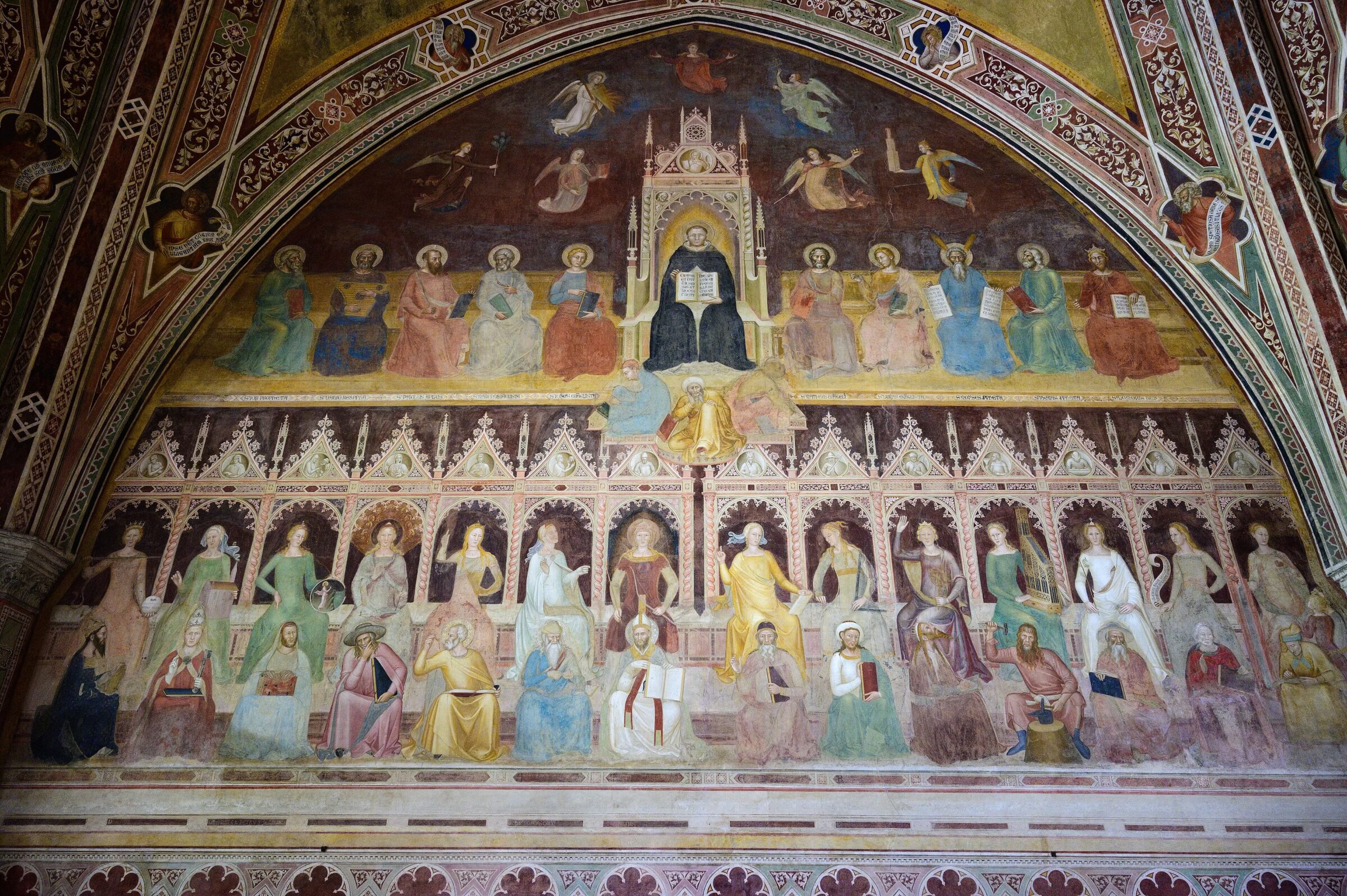
Thomas Aquinas (1225–1274) was a Catholic philosopher and theologian whose writings became a pillar of Western Christian thought. He is best known for reinterpreting Aristotle’s philosophy within a Christian framework, preserving the latter’s logical and metaphysical structure while grounding it in divine revelation, including the doctrine of creation. Aquinas’ views on the relationship between faith and science, understandably, carry tremendous weight.
Howell states that ID represents an “interventionist” view of God’s activity in the world, in which God directly shapes matter to create new organisms (also known as extrinsic design). This belief coincides with the view that the evidence of design in life is detectable. In contrast, Aquinas, according to Howell, believed that God acted only imperceptibly through physical processes (immanent design). This view coincides with the claim that evidence of design in life is not detectable:
ID usually takes an interventionist view of divine–nature relations, IDers dislike it when theistic evolutionists (of any stripe) conceive of God’s activity in nature as something secretive. But Thomists argue that one should see design (as Aristotle did and as Thomas did after him) as intrinsic to nature, an immanent teleology, rather than extrinsic to nature, impressed on inert matter by a deity existing in opposition to the mechanical world. (p. 148)
Unfortunately, Howell’s portrayal of Aquinas conflicts with what Aquinas actually believed:
- Aquinas affirmed, based on Scripture, that God directly created each distinct type of organism (ST 1.65.4).
- He rejected the materialist assumption that physical processes could produce fundamentally new kinds of creatures. Within his philosophical framework, only God, by direct creative action, could produce the essential nature or form of any organism — that is, what makes a bird a bird or a human a human. No organism could evolve into something fundamentally different (ST I.45.5 co).
- Far from denying that evidence of design can be perceived in living organisms, Aquinas formulated the teleological argument for God’s existence. This “Fifth Way” reasons that only a rational mind could account for the consistent, goal-directed order observed throughout nature, where even unintelligent entities act toward purposeful ends. He directly applied this argument to biology, using human machines as analogies to support the evidence of design in life (ST 1-2.13.2).
Each of these points is defended in detail by Thomistic scholars Logan Gage and Robert Koons in their article “St. Thomas Aquinas on Intelligent Design” and on Father Michael Chaberek’s website, aquinas.design.
Aquinas and Animal Development
Although Howell is aware of the arguments advanced by Gage, Koons, and Fr. Chaberek, he disregards the substantial textual evidence they draw from Aquinas’ own writings. Instead, he relies on scholars who share his misunderstanding of Aquinas’ metaphysics. For example, Howell asserts that Aquinas believed that novel organisms could originate through physical processes due to matter possessing an “intrinsic teleology”:
Thomas Aquinas speculated that intrinsic teleology allowed creatures to build themselves as though a ship might be imbued with powers to assemble itself… (p. 150)
[William] Dembski, [Edward] Feser contended, was looking for design in nature’s “deviation” from expectation, which is the last thing an Aristotelian Thomist should do; on the contrary, it is the regularity and expectation of nature that provides the strongest proof. (p. 153)
Such comments misconstrue Aquinas’ understanding of nature. In his Fifth Way, he argues that intelligence is recognized precisely because unintelligent entities achieve purposeful ends only when directed by an intelligence, just as an arrow reaches its target only when guided by an archer. An arrow reliably striking its mark is not what one would expect from natural forces like wind or earthquakes; rather, it testifies to purposeful direction. He applies this reasoning to animals, noting that their instinctive and goal-directed behaviors likewise manifest a purpose that originates in an intelligence (ST I–II.13.2).
Aquinas includes under such teleological behavior the development of an embryo into an offspring. Contrary to Howell’s claim, Aquinas did not believe that physical processes could enable creatures to “build themselves” into something entirely new. Instead, he taught that an animal’s body is animated by a soul that God directly created in the first pair of that type. The soul governs the creature’s growth and organization from conception to maturity according to its intended design (ST I.118.1). It never deviates from its target beyond tightly limited variations, which Aquinas classifies as accidental rather than substantial changes. Such deviations do not affect the animal’s essential form (ST I.77).
Aquinas and Intelligent Design
As Robert Koons explains in his analysis of Aquinas’ Fifth Way, the teleological argument gains its full force when viewed within Aquinas’ larger metaphysical framework, where it integrates with his broader teaching that form and purpose in creation ultimately reflect the direction of a divine intellect. Although Aquinas’ arguments differ from the empirical approach of modern intelligent design theorists such as William Dembski and Michael Behe, the two are complementary; Aquinas grounds the inference to design in the metaphysical reality of form and purpose, while ID research identifies it through empirical signatures of intelligent causation.
Many Thomists recognize that Aquinas’ metaphysics is incompatible with the theory of evolution. Yet, in an effort to reconcile his writings with naturalistic philosophy, some modify his framework to conform to the materialist assumptions underlying evolutionary theory. James R. Hofmann (2020) concedes, “Few scholars familiar with Aquinas’s original theology would conclude that it is directly compatible with evolution.” Still, he recommends adopting a “revised Thomistic framework” to bridge the divide. But such revisions dismantle the very metaphysical structure that defines Aquinas’ system. Reinterpreting Aquinas as if he embraced evolution and then appealing to that reconstructed version to defend the theory is as incongruous as reimagining Karl Marx as a libertarian and then appealing to the revisionist Marx to justify free-market capitalism.