






































In previous posts (here and here), I noted that a new book promoting theistic evolution by Daniel Kuebler, professor of biology at Franciscan University of Steubenville, uses some very bad scientific arguments. The book is titled Darwin and Doctrine: The Compatibility of Evolution and Catholicism, and while I won’t try to address it’s theological arguments, I am evaluating some of its scientific claims. We’ll start with an often-cited argument: chromosomal fusion.
Chromosomal Fusion
In his book, Kuebler mentions chromosomal fusion as evidence for human-ape common ancestry:
chromosome 2 in humans appears to have originated via the ancestral fusion of chromosomes 2a and 2b which are found in other primates. As a result, the order of genes on chimp chromosomes 2a and 2b is nearly identical to the order found on human chromosome 2. (p. 108)
Kuebler is correct that there are great structural similarities between chimp chromosomes 2a and 2b and human chromosome 2. Now as we’ve seen, these “syntenic” similarities could be functionally relevant, and thus these structural similarities might exist for good functional reasons and don’t necessarily tell you anything about common ancestry.
But let’s accept for the moment that there is some evidence for fusion in human chromosome 2. Does this demonstrate human-ape common ancestry? The answer is no — as I’ve explained many times (e.g., here, here, and here), all it shows is that human chromosome 2 experienced a fusion event somewhere in our lineage. Whether our lineage traces back to a common ancestor with apes is an entirely different question that isn’t settled by chromosomal fusion.
As I’ve always said, I’m open to there being evidence of fusion in human chromosome 2. But this entire question is complicated by the fact that the supposed fusion site is highly degenerate compared with what one would expect if it were a locus where two chromosomes were fused, end-to-end, and by very recent discoveries showing that the supposed fusion site actually contains functional genes — including DNA likely involved in our neural development.
Vitamin C Pseudogene
Of course no argument for common ancestry would be complete if it didn’t mention the GULO (or GLO) pseudogene. This is supposed to be a defunct gene — a pseudogene — which is shared by humans and other primates, supposedly testifying to our common ancestry. Kuebler explains the argument:
The most logical explanation for this arrangement is that sometime during primate evolution, the GLO gene became defective in a common ancestor and this defective version was subsequently inherited by a group of related primates, including humans. (p. 109)
There are many things to say in response. First of all, there is some evidence that the GULO pseudogene could be active in utero. Much more research is needed to establish this point but for some reason it’s always left out of the discussion.
Second, we have many examples of functional pseudogenes — so the idea that simply because something is classified as a “pseudogene” means it is therefore “defective” is simply no longer a tenable conclusion. I’ve written about this here, here, here, here, and here, for a few examples.
As I explained here, one poignant example of a pseudogene that turned out to be functional is the beta-globin pseudogene. It was claimed by Brown University biologist Kenneth Miller at the Dover trial to be “non-functional” and “broken” and therefore, he said, it “leads us to just one conclusion … that these three species [human, chimp, and gorilla] share a common ancestor.” Eugenie Scott of the National Center for Science Education later said the beta-globin pseudogene “isn’t going to do diddly. It’s just going to sit there” and “not do a thing.” She went on to say this pseudogene is “not going to function. It’s not going to do anything” because it is an “inert gene.” Yet a 2021 paper in Developmental Cell found that this pseudogene is “essential” for the development of red blood cells.
The point being: Evolutionists act supremely confidently that the GLO pseudogene is “defective” (Kuebler’s words) and therefore can only be evidence of human-ape common ancestry. But they show no scientific tentativeness, caution, or awareness that identical overconfident claims have been made by evolution-defenders about other pseudogenes that later turned out to be functional and very important. Again, see here for the story.
So I would urge a more cautious, tentative, careful, and scientific approach to the bold proclamations that evolution-defenders make about pseudogenes.
Unsophisticated Arguments Regarding the Fossil Record Generally
Now Kuebler doesn’t only cite genetic evidence for common ancestry. He also makes a relatively simplistic argument for evolution based upon the supposed finding that the fossil record shows “increasing morphological complexity” over time:
In general, more recent layers display forms with increasing morphological complexity and ecological specialization as compared to older layers. For instance, the Cambrian rocks contain the first animals with shells, while the more recent Devonian rocks lack most of these early animals but contina more complex animals such as the early tetrapods (four-limbed animals, such as amphibians, reptiles, and mammals) that the Cambrian lack. Likewise, the Cretaceous rocks, which are more recent than the Devonian, lack the early tetrapods but contain a diverse range of more advanced tetrapods, including dinosaurs and birds. It is remarkable that each layer contains uniquely identifiable groups of fossils and that the layers are ordered in a progressive temporal sequence. (p. 104)
Much of Kuebler’s book is devoted to defending universal common descent and the use of “chance” and natural selection in the history of life. But nothing that Kuebler says supports any of those ideas. There are multiple ways we can define evolution — (1) mere change over time, (2) common ancestry, or (3) standard blind evolutionary mechanisms like random mutation, natural selection, genetic drift, etc., generated the grand diversity of life. At most what Kuebler says supports the idea that there is change over time in the fossil record. But whether that change is consistent with universal common descent or seems to be caused by blind evolutionary mechanisms is a different question.
Thus, the fact that life has “changed over time” doesn’t bother proponents of intelligent design — but the fact that reptiles, birds, and mammals don’t appear until after the Cambrian period could be a major problem for the standard evolutionary account if, whenever these groups do appear, they do so in an abrupt fashion that fails the predictions of neo-Darwinian common ancestry. Many of these sub-groups of animals, again, appear abruptly, in patterns of explosions. We’ve discussed this many times, but one of the best examples came from our old friend paleontologist Dr. Günter Bechly, who in 2024 wrote the fantastic article: “Fossil Friday: Discontinuities in the Fossil Record — A Problem for Neo-Darwinism.”
Tiktaalik and other Tetrapod Non-Transitional Forms
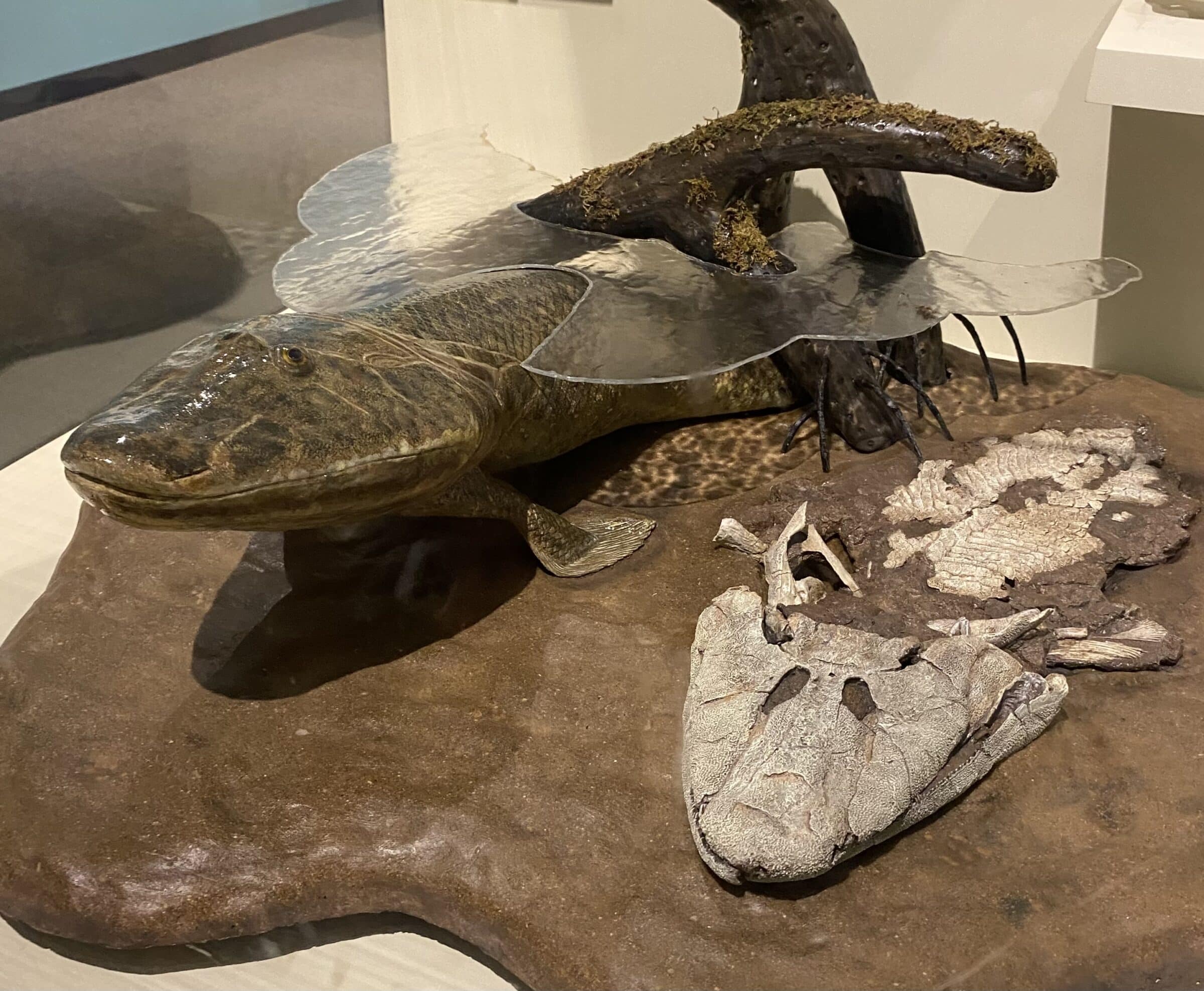
Professor Kuebler doesn’t acknowledge this pattern of explosions in the fossil record, but he does cite the supposed transitional form “Tiktaalik.” Here’s what he says:
The early tetrapod fossil Tiktaalik (375 MYA) looks like a mix between a fish and a crocodile and may have only been able to lift its head out of water to eat on the banks of streams and rivers. Likewise, the tetrapod fossil form Ichthyostega (365 MYA) most likely moved very inefficiently, undulating like a seal across the landscape. Eventually these forms were replaced by more advanced tetrapods, ones that could fully support their body weight outside of water and locomoted in a manner more akin to modern amphibians.
Of course, just finding these fossils doesn’t prove naturalistic evolution, but finding these intermediate fossils in this particular temporal sequence, less adapted forms emerging before more adapted ones, is consistent with natural process honing the tetrapod over time. (p. 120-121)
As I explained here, tracks of true tetrapods are now known from Poland at about 397 MYA. These tetrapods had true digits and were far more “advanced” (to use Kuebler’s term) than Tiktaalik, even though they came 18 million years earlier. So the nice tidy story he tells — about tetrapod evolution progressing neatly through the fossil record and making Tiktaalik a potential true transitional form — simply isn’t correct.
Return of the Evo-Devo Fish Story
Kuebler then turns to another argument for tetrapod evolution, claiming that laboratory work has shown how limbs evolved from primitive fish:
In addition, recent laboratory work has supported the idea that selection could work on genetic and environmental modifications that have been shown by researchers to alter the limbs of aquatic species. For example, experiments have been done in zebrafish that show a single mutation in a developmental gene could give rise to the emergence of new bones and musculature in the limb, generating a limb that is remarkably similar to a primitive tetrapod limb. (p. 121)
Theistic evolutionist biologist Darrell Falk made the same argument a few years ago in response to Stephen Meyer’s book Return of the God Hypothesis and I answered it here. As I explained, “Nowhere does the Cell paper claim that these two bones produced by mutating fish developmental genes are the equivalent of the radius and ulna in tetrapod limbs. Rather, the authors acknowledge that these newly constructed ‘bones’ lack clear homologues real tetrapod limb.” The story is far from compelling. It’s an interesting study, but what it created is not “remarkably similar to a primitive tetrapod limb.”
Human Genetic Diversity: A Long-Refuted Argument
Lastly, Kuebler cites one of the classic arguments for human evolution that we’ve seen from the theistic evolution camp over the last decade or so: human genetic diversity. He writes:
When it comes to the emergence of humans, the scientific evidence suggests that they emerged in a similar fashion: as a distinct population that evolved from other related hominins. … The most compelling [evidence] has to do with the amount of genetic diversity that exists in the current human population. It turns out that there is more genetic variability in the modern human population than one would expect if all humans were descended from an original couple that lived in the relatively recent past. (p. 226)
Once again, the evolutionary story is wrong. Kuebler doesn’t mention the robust study performed by Ann Gauger and Ola Hössjer showing that in fact human genetic diversity can be accounted for from a single pair, and it is not at all the case that humans must have evolved “as a distinct population.” Three papers they published in BIO-Complexity (here, here, and here) showed that an initially designed original pair of human beings that lived as recently as 500,000 years ago could explain human genetic diversity.
Again, this means Kuebler is simply incorrect to say that the evidence requires or even shows that humanity emerged “as a distinct population that evolved from other related hominins.” As for his claim that Adam and Eve could not have lived recently, some other creative modeling has shown that if Adam and Eve had diversity built into not just their genomes but also their gametes, then Adam and Eve could have even lived much more recently.
Icons of Theistic Evolution
Professor Kuebler’s book cites example after example of classic arguments used by theistic evolutionists. From the universality of the genetic code, to the idea that synteny is functionally meaningless, to chromosome 2 fusion, to pseudogenes, to Tiktaalik and the fossil record, to human genetic diversity, he is simply wrong or leaves out huge amounts of data and arguments that point in the other direction. If Christian believers are going to accept evolution, at least do it because of good evidence — not because of long-refuted icons of theistic evolution.