






































A couple years ago I reported on some of Jim Tour’s debates and how they raise the question of how non-experts can determine who is right during complex scientific debates. As I explained, a few years ago,
I received an email from an Internet questioner with the subject “War of Words.” This person expressed concerns that there is so much back and forth between experts in the debate over the origin and evolution of life and intelligent design, that it can sometimes be difficult for a non-expert to determine who is right.
My answer at that time was that a non-expert can look at the rhetorical styles of the people involved in the debate to determine who has the better argument. For example, you could ask the following questions to determine who has the better argument:
- Does one side focus more on discussing the evidence, while the other side focuses on attacking people or making moral accusations?
- Does one side cite evidence that we know exists right now, while the other makes more promissory notes about what will be discovered in the future?
- Does one side directly answer the substantive questions posed by the other side, while the other side tries to dodge or deflect from answering relevant questions?
Do you see the theme — you should always ask, Is the focus on the evidence and the substantive questions or is it on something else?
Criteria for Assessing Good Scientific Claims
Today, we’ve released a new Long Story Short video, ‘Tell-Tale Signs of Bogus Science about the Origin of Life,” which further tries to answer this question: How can a non-expert assess who is right in a complex scientific debate — specifically on the question “How did life begin?”
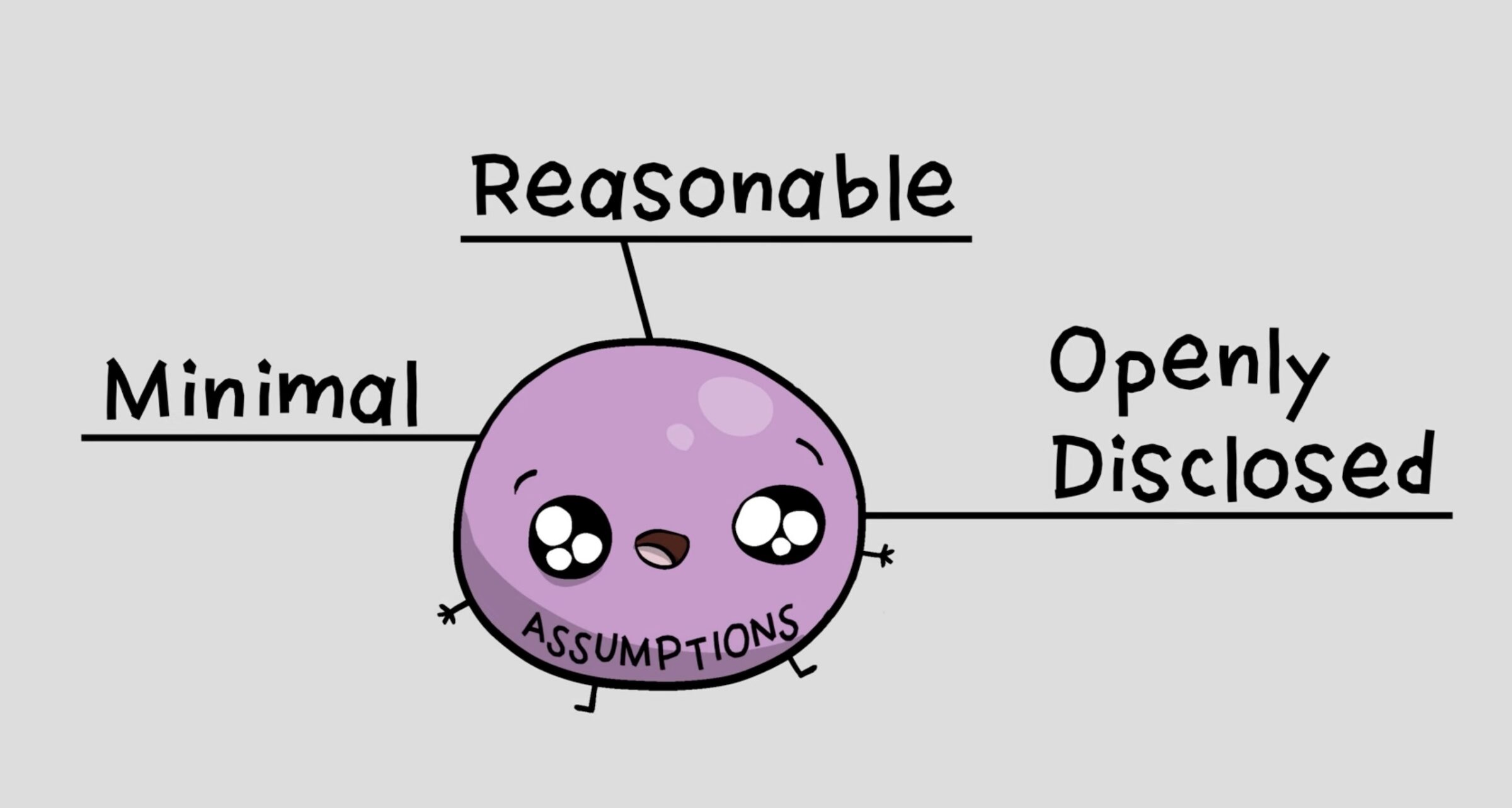
The video proposes three main criteria to look at:
- Look at the biases of the researchers
- Look at the assumptions made by the researchers — do they at least disclose the assumptions they are making?
- Are they making reasonable claims that are justified in light of the research findings, or is there hype?
Biases and Absolute Commitments
I have to be honest that initially I kind of bristled at their first criterion — “Are the scientists biased?” The reason is because everyone has a bias and I don’t think you can rule out an argument simply because the proponents are “biased.”
That said, biases come in different degrees, and people have different degrees of open-mindedness to new ideas. Sometimes a person (or a field) is so biased that it can be hard to trust that the evidence is being evaluate objectively. The sort of overt bias that is so great that it ought to raise red flags is expressed by the late Harvard evolutionary biologist Richard Lewontin in his famous quote:
We take the side of science in spite of the patent absurdity of some of its constructs, in spite of its failure to fulfill many of its extravagant promises of health and life, in spite of the tolerance of the scientific community for unsubstantiated just-so stories, because we have a prior commitment, a commitment to materialism. It is not that the methods and institutions of science somehow compel us to accept a material explanation of the phenomenal world, but, on the contrary, that we are forced by our a priori adherence to material causes to create an apparatus of investigation and a set of concepts that produce material explanations, no matter how counter-intuitive, no matter how mystifying to the uninitiated. Moreover, that materialism is absolute, for we cannot allow a Divine Foot in the door.
In other words, he’s got such a strong bias — a “prior commitment … to materialism” that is “absolute” — that he’s going to disallow non-materialist (e.g., ID-based) explanations “no matter how counter-intuitive, no matter how mystifying…” This kind of materialistic bias is extremely common in fields like evolutionary biology or origin of life research, and it’s precisely the kind of bias that ought to raise a major red flag.
Yet intelligent design (ID) isn’t anything like this. ID isn’t bothered at all when material explanations are discovered. It may be part of the designed fabric of reality, after all. But ID is also open to the possibility that material causes can’t always get the job done.
In other words, ID is a far more philosophically open and tolerant mode of doing science compared to evolutionary materialism. Evolutionary materialism always entails a bias that material causes — and only material causes — can get the job done. ID entails a bias that both material or non-material explanations are possible, and we should simply let the evidence decide these questions on a case-by-case basis. and follow it where it leads. I much prefer ID’s bias!
Assumptions and Unreasonable Assumptions
Much like biases, everyone also makes assumptions. Nearly all scientific models make assumptions — so it’s not inherently bad to make assumptions when doing science. But are those assumptions being disclosed? And are they reasonable assumptions? These are key questions to ask.
The video makes some great points that much origin of life research makes wildly unreasonable assumptions that large amounts of high quality, pure chemical ingredients would be available on the early earth. The origin of life is a field filled with unreasonable assumptions that are rarely disclosed. The video helps demystify some of these assumptions.
Reasonable Claims and Hype
In our age of soundbites and social media, it’s easy for anyone — even scientists — to succumb to the temptation to hype their claims. This again is human nature. But how much hype should raise a red flag? Well, how about when you make a devastating critique of someone else’s model, only to promote a model that has the same problem. Watch the video for a curious example of this from origin of life theorists attempting to produce self-replicating molecules.
This new video is a great guide to help non-experts evaluate technical scientific debates. And the reality is, even if you are an expert in one field (or a few field), you’re still a non-expert in many others. So this video should be helpful for anyone who wants to dip their toe into investigating complex fields where scientists disagree.