






































Editor’s note: The following is an excerpt from the new book Endowed by Our Creator: The Bible, Science, and the Battle for America’s Soul by John G. West, which explores the enduring truths of the Declaration of Independence as America celebrates its 250th birthday this year.
The majority of Americans today believe in expansive government. According to surveys done for the How Americans View the American Founding report, more than 80 percent say that “the purposes of government should change over time based on the evolving needs of society.” Nearly 70 percent believe the government should guarantee “education, medical care, and an adequate income for everyone.” New York City mayor Zohran Mamdani expressed the view of a growing number of Americans when upon his election he declared, “We will prove that there is no problem too large for government to solve, and no concern too small for it to care about.”
By contrast, the Declaration of Independence articulates the unchanging purpose of government as securing people’s unalienable rights to life, liberty, and the pursuit of happiness. This basically means establishing a society where people can pursue their own goals based on their own efforts within the confines of the laws of Nature and Nature’s God. In such a society, people are free to produce goods and services, raise crops and livestock, create art and music, pursue scientific discovery, invent new devices, debate ideas, raise their families, and worship God according to the dictates of their own consciences.
 Image credit: Discovery Institute Press.
The Founders did not think that the purposes of government included providing everyone with the same income, guaranteeing everyone a healthy body, protecting people from the vicissitudes of daily life, or securing for them eternal salvation. The Declaration called for limited government, and the Founders established one in the Constitution of 1787.
A Radically New Conception
However, by the end of the 19th century, a radically new conception of government and political society had taken hold in America, one at odds with the ideas of the Founders.
Columbia University professor John Burgess helped develop the discipline of political science in the United States. He exemplified the new vision of government and politics. In 1890, he defined “the universal human purpose of the state” as “the perfection of humanity; the civilization of the world; the perfect development of the human reason, and its attainment to universal command over individualism; the apotheosis of man.”
The word “apotheosis” literally means to change someone into a god. So, according to Burgess, the end of the state is to turn man into a god. For Burgess, state meant more than just government, but the distinction was soon lost by others.
The new view of politics repudiated the natural rights philosophy of America’s Founders. University of Chicago political scientist Charles Merriam (1874–1953) was especially influential. In 1920 he noted that among recent thinkers “the idea that men possess inherent and inalienable rights of a political or quasi-political character which are independent of the state, has been generally given up.” The result has been “a decided tendency away from many doctrines that were held by the men of 1776.” In particular, “Revolutionary doctrines” such as “natural rights” and “the idea that the function of the government is limited to the protection of person and property… none of these finds wide acceptance among the [new] leaders in the development of political science.”
The Meaning of “Nature”
At the time of the American Founders, “nature” meant the inherent order of things ordained by God and reason. It represented a permanent standard of right across time and place. But for the new political scientists, “nature” was simply the physical natural world, and the law of nature applicable to humans was Darwin’s law of the jungle. In the words of historian Carl Becker in 1922, “When so much the greater part of the universe showed itself amenable to the reign of a purely material natural law, it was difficult to suppose that man (a creature in many respects astonishingly like the higher forms of apes) could have been permitted to live under a special dispensation. It was much simpler to assume one origin for all life and one law for all growth.” That meant we should think of humanity’s history “as only a more subtly negotiated struggle for existence and survival.” Or as political scientist Westel Willoughby at Johns Hopkins University put it in 1896, the laws of nature were simply “the natural instincts of all living beings, men and brutes alike, to maintain their own existences, and to satisfy the desires that their own natures give rise to. Under such a regime… an unmitigated and pitiless struggle for existence must prevail.”
In this new view of politics, liberty was no longer regarded as “a natural right which belongs to every human being without regard to the state or society under which he lives.” Instead, liberty is a privilege bestowed by the state and “is dependent upon the degree of civilization reached by the given people.” Moreover, “the inseparable connection between political liberty and political capacity is strongly emphasized.”
An Unequal Capacity for Liberty
There was a racist tinge to the new view of malleable rights. According to Merriam, the Teutonic (white European) race had the most capacity for liberty. Hence, in nations with multiple nationalities, wrote Merriam, “the Teutonic element should never surrender the balance of power to the others.” The “Teutonic race can never regard the exercise of political power as a right of man, but it must always be their policy to condition the exercise of political rights on the possession of political capacity.”
On the view of such thinkers, because there are no natural or God-given rights that governments must always respect, the powers of government are no longer inherently limited. “The determination of just what powers shall be assumed by the State, is solely one of expediency… This is practically the rule followed by all modern civilized States.” In sum, the powers and scope of government were no longer static. They evolved according to what a people needed in order to survive and flourish.
The ultimate roots of this progressive idea of political evolution were likely supplied by Hegel and the political science of the German administrative state. But Charles Darwin was honored for showing that the truths preached by the political philosophers had been substantiated by biological science.
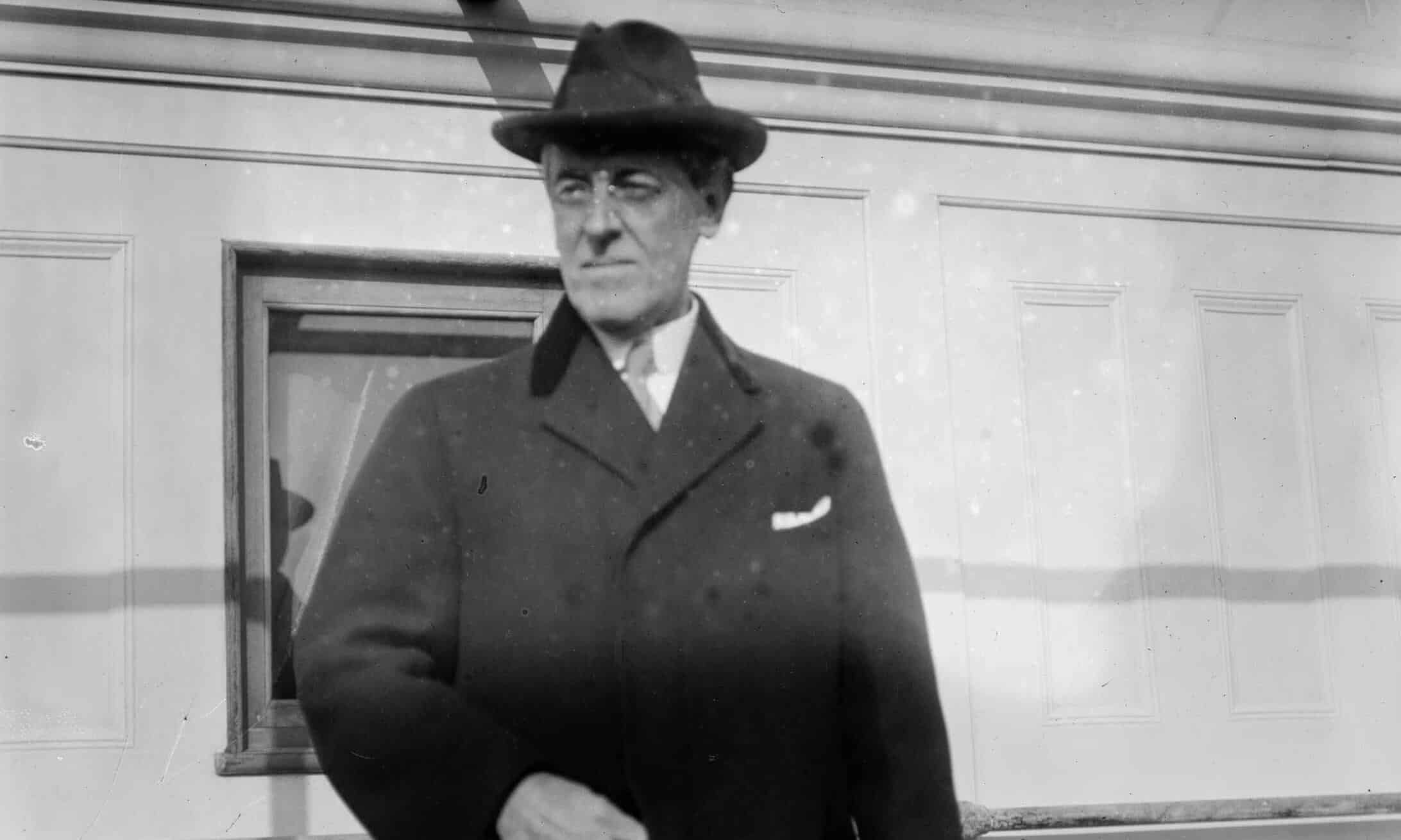
One of the most articulate spokesmen for the new view was a political scientist from New Jersey, who argued that “in our own day, whenever we discuss the structure or development of anything… we consciously or unconsciously follow Mr. Darwin.” The political scientist was Woodrow Wilson, then president of Princeton, soon to be Governor of New Jersey and eventually President of the United States. During the presidential election campaign of 1912, Wilson explicitly invoked Darwin to justify an evolutionary understanding of the U.S. Constitution that would allow the federal government to dramatically expand its powers over the economy.
“Darwinian in Structure and in Practice”
On Wilson’s view, the problem with the original Constitution was that it betrayed the Founders’ “Newtonian” view that government was built on unchanging laws like “the law of gravitation.” In truth, however, government “falls, not under the theory of the universe, but under the theory of organic life. It is accountable to Darwin, not to Newton. It is modified by its environment, necessitated by its tasks, shaped to its functions by the sheer pressure of life.” Hence, “living political constitutions must be Darwinian in structure and in practice. Society is a living organism and must obey the laws of life… it must develop.” According to Wilson, “All that progressives ask or desire is permission — in an era when ‘development,’ ‘evolution,’ is the scientific word — to interpret the Constitution according to the Darwinian principle.”
The doctrine of the evolving Constitution articulated by Wilson and other progressives opened the door to much greater regulation of business and the economy, eventually paving the way for the New Deal, the Great Society, and the nearly unlimited government of our own era.