






































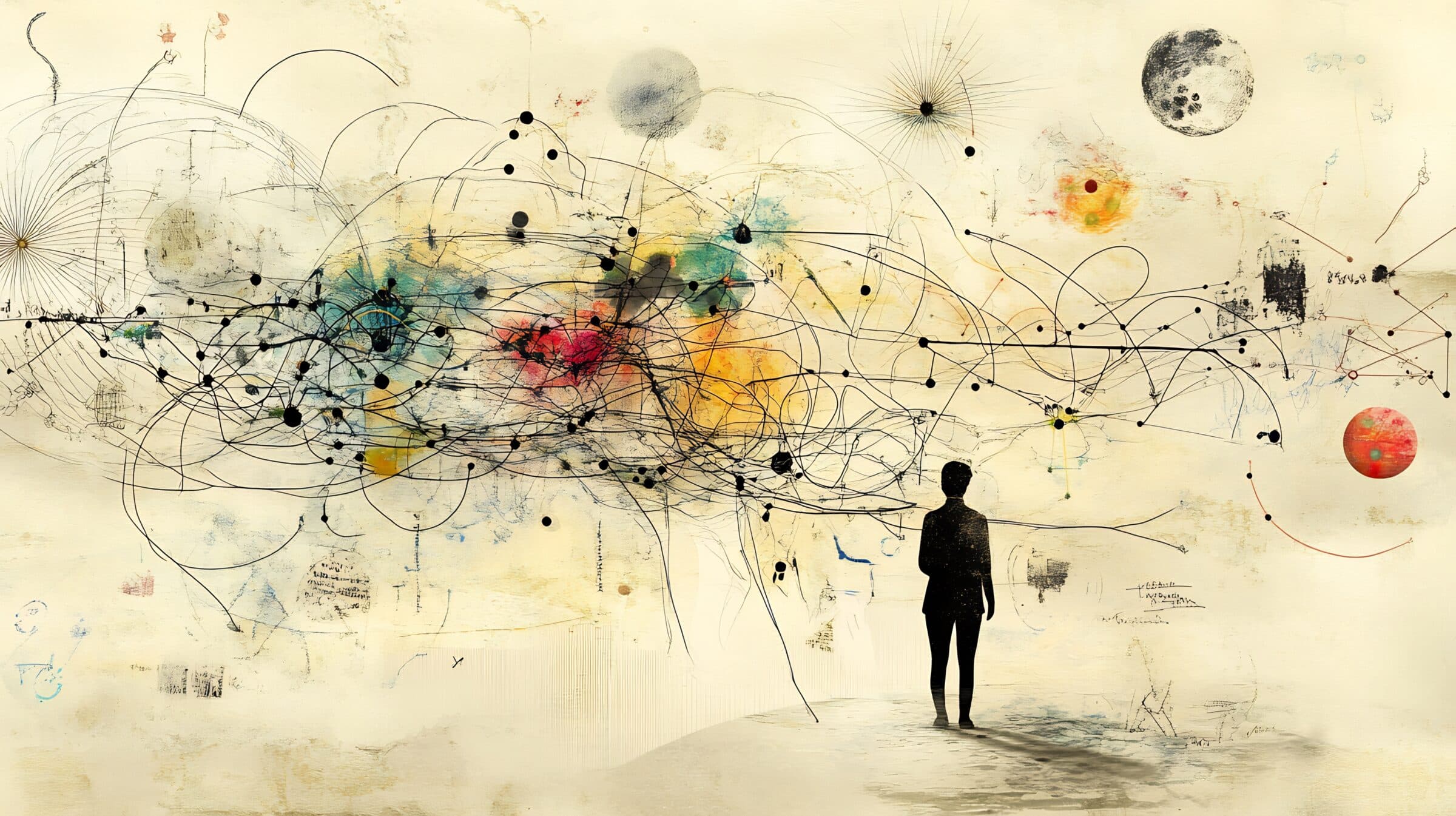
One of the most significant figures reshaping evolutionary theory is Tufts biologist and biomedical engineer Michael Levin. I have written previously about how he argues that the organization of living beings cannot be entirely explained by genetics and environment (here). Instead, biological designs are determined by repositories of information in a mathematical realm analogous to Platonic ideas. That understanding, or a form of it, was anticipated by intelligent design biologist Richard Sternberg.
Levin wishes to explain life in terms of design without appealing to a personal designer. Yet such attempts to explain design by appealing to “Platonic patterns” — but, again, without a designer — fail much as multiverse fine-tuning explanations do. Levin faces a measure problem analogous to that in cosmology (here, here) resulting from the optimality of biological designs, as highlighted in Stuart Burgess’s new book, Ultimate Engineering: An Engineer Investigates the Biomechanics of the Human Body (here, here).
Immaterial “Minds”
Levin proposes that life taps into immaterial “minds” that manifest during biological development and direct the construction of an organism. He has explained his iconoclastic views most recently in “Platonic space: where cognitive and morphological patterns come from (besides genetics and environment)”:
Mathematicians are already very comfortable with this — the old idea (Plato, Pythagoras, etc.) that there is a non-physical space of truths which we discover, not invent, and that this space has a structure that enables exploration. I make the conjecture that this space contains not only low-agency forms like facts about triangles and the truths of number theory, but also a very wide variety of high-agency patterns that we call kinds of minds. On this view, physical bodies don’t create, or even connect to (and thus have) minds — instead, minds are the patterns, with their ingressions into the physical world enabled by the pointers of natural or synthetic bodies. In other words, whenever anything is built — machines, AI’s, biobots, hybrots, embryos, etc. — it acts as an interface to numerous patterns from this space of forms … which guide its form and behavior beyond what any algorithm or material architecture explicitly provides.
Levin never appeals to a personal agent but, instead, describes the immaterial patterns as possessing a type of intelligence:
Why couldn’t Platonic space contain patterns that are intelligent and active to some degree, like the specific kinds of network structures that have been shown to have the simple goal-directedness of attractors and self-assembly capabilities or even capacity for Pavlovian conditioning? What if some of the Platonic patterns that matter for biology are, themselves, intelligent to a degree?
The Platonic Measure Problem
The challenge Levin faces is explaining why the Platonic patterns yield only optimal designs rather than defective ones. This problem parallels the challenge of explaining why our universe, by chance in a multiverse, not only supports life but also appears ancient and designed for scientific investigation (here, here). A similar challenge exists for explaining why our planet appears optimally designed, without appealing to a designer, to allow for life from the equator to the poles and to support scientific investigation and technological development (here, here). If our universe and planet support life as the result of our having won a cosmic lottery, they should be a typical life-permitting universe and a common life-permitting planet. In contrast, they are extraordinary even if only considering those that support life.
Similarly, the only explanation for why life is so optimally designed, even assuming the existence of Platonic patterns, is that a mind deliberately designed life to display ultimate engineering. Levin is exercising rare courage in following the evidence of design to such an extent. He only needs to read Ultimate Engineering and take the last unavoidable step to recognize the designer behind the design.