






































Science and Culture Today Discovering Design in Nature
Topic

genome

cancer cells
Photo: Cancer cells, by National Cancer Institute.

Is the INK4a/ARF Overlap a Settled Example of Poor Design?

Dr. DeBenedictis’s basic argument is that there is a section of the human genome where two genes overlap, both of which are important for suppressing tumors. Read More ›
reel-to-reel
Photo credit: Gelpgim22, CC BY-SA 3.0 <https://creativecommons.org/licenses/by-sa/3.0>, via Wikimedia Commons.

Cells Use Loop Extrusion to Keep DNA Optimized

A paper illustrates the action of DNA loop extrusion processes, which serve multiple functions to maintain the genome, with an interesting graphic: gears. Read More ›
chimp
Photo credit: Daniel Hansen via Unsplash.

Another “Junk DNA” Icon Bites the Dust
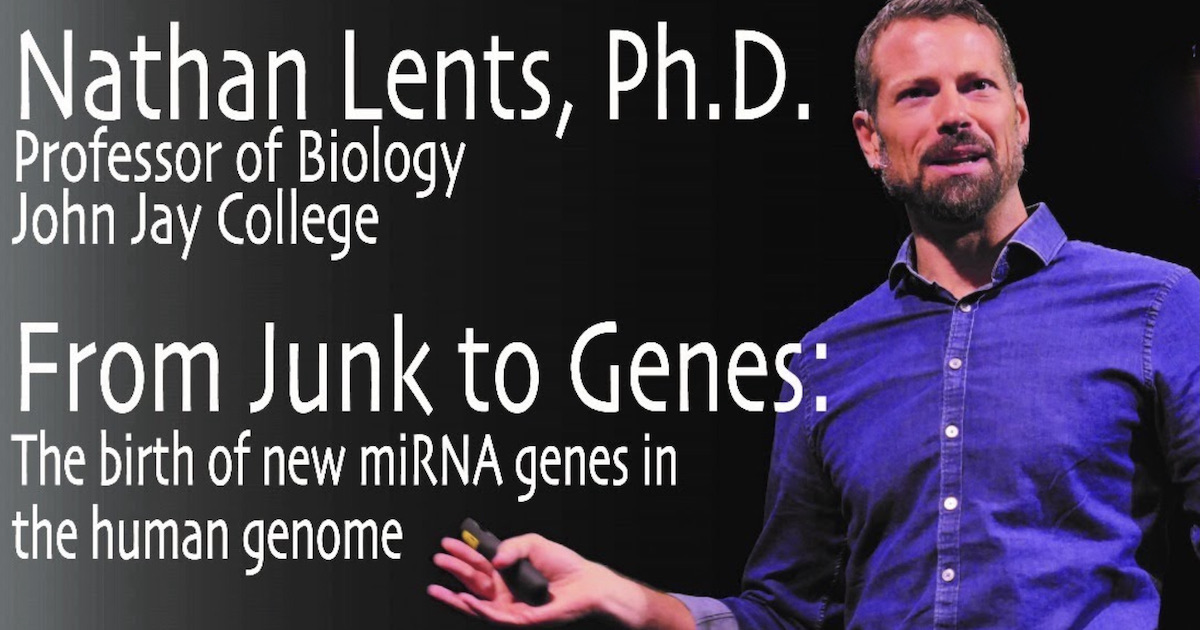
Casey Luskin examines a paper which argues that the famous beta-globin pseudogene is functional. Why is this pseudogene famous? Read More ›
Nathan Lents
Image: Nathan Lents, via YouTube.

Human Orphan Genes — Interesting YouTube Talk Tonight by Nathan Lents

A couple of years ago, Professor Lents became fascinated by orphan genes, and went looking for them in the human genome. Read More ›
MOLO RNA world
Image credit: Brian Gage.

RNA World: Repeated Downfalls, Repeated Resurrections

Alexander Oparin’s 1924 prediction that origin-of-life research would be solved “very, very soon” hasn’t quite turned out right. Read More ›
Henry_at_Invercargill
Photo credit: KeresH / CC BY (https://creativecommons.org/licenses/by/3.0).

“Living Fossil”? Maybe. Tuatara Genome Is Now Sequenced and Published

The tuatara genome is 5GB, making it enormous relative to other vertebrates — and full of surprises. Read More ›
climbing-Everest

Behe Vindicated Again: Sherpas Climb Everest Easier, Because Darwin Devolves
How can Tibetans survive high altitudes that leave lowlanders gasping? The answer is found in broken genes. Read More ›
Lenski's_12_long-term_lines_of_E._coli_on_25_June_2008

New Papers Explore the Utility of Active Information

William Dembski and Robert J. Marks developed the concept of active information to measure the extent to which a search function appears pre-programmed to find some target. Read More ›
Origin_of_Life_-_Dark_Ride_-_Science_Exploration_Hall_-_Science_City_-_Kolkata_2016-02-22_0315

Inference Article Demonstrates Implausibility of Natural Processes for Explaining the Origin of Life

The piece is highly technical and mathematical, but the basic argument can be quickly summarized with only a marginal loss of technical accuracy.   Read More ›
DNA

Paper Shows that “Mutational Load” Arguments Don’t Refute ENCODE

Perhaps one of ENCODE’s staunchest critics has been Dan Graur, a molecular evolutionary biologist at the University of Houston. Read More ›

© Discovery Institute