






































Science and Culture Today Discovering Design in Nature
Nathan Lents
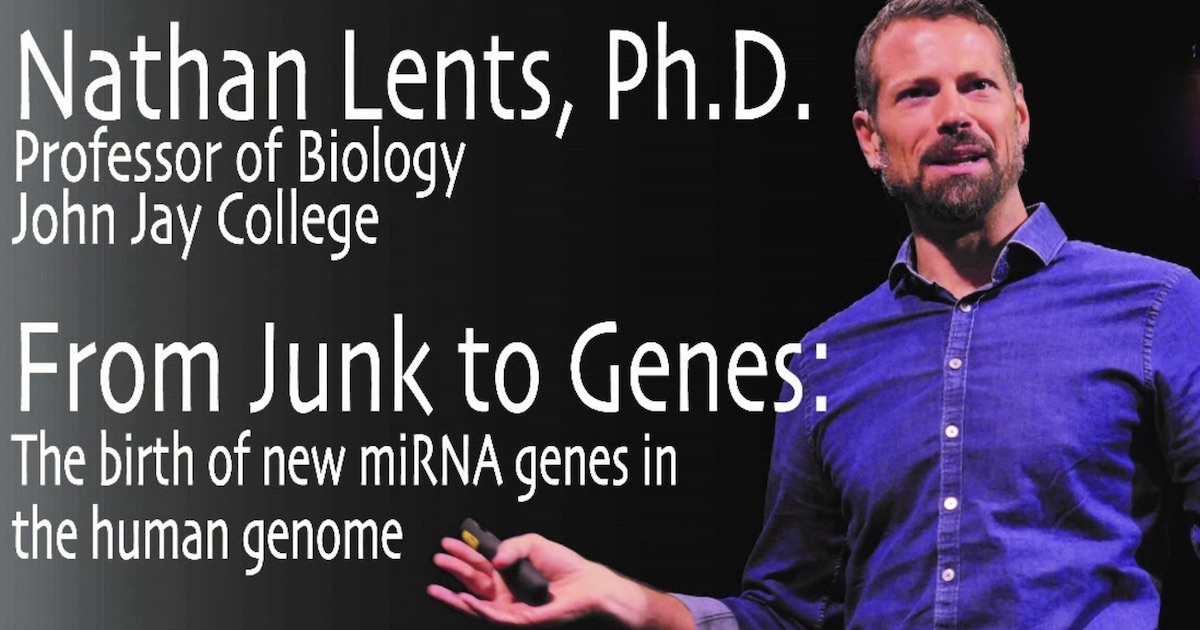
Image: Nathan Lents, via YouTube.
Latest

Human Orphan Genes — Interesting YouTube Talk Tonight by Nathan Lents

Categories
Evolution
Share
Facebook
Twitter/X
LinkedIn
Flipboard
Print
Email

Nathan Lents, the speaker, has often been at odds with ID people, and published a book a couple of years ago, Human Errors, arguing that human biology could best be understood as the product of undirected evolution, because our form and function were so demonstrably imperfect. 

But, a couple of years ago, Lents became fascinated by orphan genes, and went looking for them in the human genome. This talk tonight at 7:30 is (to my knowledge) his first public statement about what he’s found. I’ll be interested to see what he discovered, and, in particular, the proposed evolutionary mechanisms he offers to explain their origin.

Incidentally, when “orphan gene” was originally coined as a term in 1996, by the French researcher Bernard Dujon, at the Institut Pasteur, commenting on the yeast genome results, Dujon spelled the term as “orphan.” The term “ORFan” was devised later, as a pun employing the acronym for open reading frame (ORF).

Paul Nelson

Senior Fellow, Center for Science and Culture
Paul A. Nelson is currently a Senior Fellow of Discovery Institute’s Center for Science and Culture and Adjunct Professor in the Master of Arts Program in Science & Religion at Biola University. He is a philosopher of biology who has been involved in the intelligent design debate internationally for three decades. His grandfather, Byron C. Nelson (1893-1972), a theologian and author, was an influential mid-20th century dissenter from Darwinian evolution. After Paul received his BA in philosophy with a minor in evolutionary biology from the University of Pittsburgh, he entered the University of Chicago, where he received his PhD (1998) in the philosophy of biology and evolutionary theory.
Benefiting from Science & Culture Today?
Support the Center for Science and Culture and ensure that we can continue to publish counter-cultural commentary and original reporting and analysis on scientific research, evolution, neuroscience, bioethics, and intelligent design.

© Discovery Institute