






































Darwinism
At National Review Online, Berlinski Skewers Darwinism as “a String of Wet Sponges on a Clothesline”

John Lennon, Darwin Doubter

Four Nails in Darwin’s Coffin
More than a century ago, Charles Darwin thought he had explained away the evidence for intelligent design in biology. But now new evidence from molecular biology, genetics, and related fields are raising four important challenges to the claim that complex biological life is the result of an undirected process of natural selection acting on random mutations. Learn about these “4 nails in Darwin’s coffin” at this FREE event. Bring your questions! Sponsored by PULSE and Victory Campus Ministries, SMU.
Wired Science: One Long Bluff
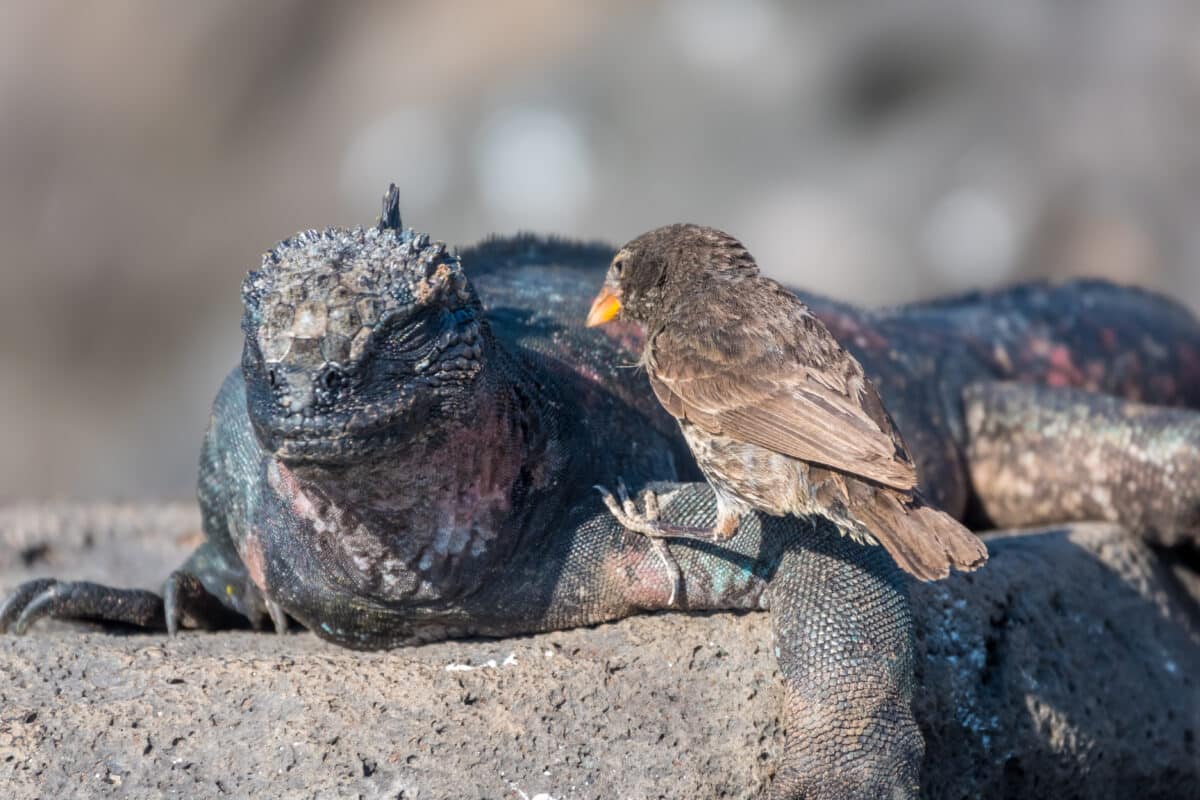
According to a recent online report from Wired Science, “On one of the Galápagos islands whose finches shaped the theories of a young Charles Darwin, biologists have witnessed that elusive moment when a single species splits in two.” If it were true, this would be very important news. Evolutionary biologists have long recognized that Charles Darwin (despite the title of his most famous book) failed to solve what he called “the mystery of mysteries,” — the origin of species. Darwin argued that it happens by natural selection acting on small variations, but no one has ever observed the origin of a new species (“speciation”) by this process. Evolutionary biologist Keith Stewart Thomson wrote in 1997 that “a matter of unfinished Read More ›
God and Evolution: A Response to Stephen Barr (part 2)
This is the second of three posts responding to Stephen Barr. The first post can be found here.
Mainstream Theistic Evolution: Directed or Undirected?
In the initial decades after Darwin proposed his theory, theistic evolution typically was presented as a form of guided evolution. Although Darwin himself rejected the idea that evolution was guided by God to accomplish particular ends, many of Darwin’s contemporaries (including those in the scientific community) rejected undirected natural selection as sufficient to explain all the major advances in the history of life. Instead, according to historian Peter Bowler, there was widespread acceptance of the idea “that evolution was an essentially purposeful process… The human mind and moral values were seen as the intended outcome of a process that was built into the very fabric of nature and that could thus be interpreted as the Creator’s plan.” [Bowler, Darwinism (1993), p. 6]
This view of evolution as a purposeful process began to disintegrate early in the twentieth century after Darwinian natural selection underwent a resurgence due to work in experimental genetics. Once Darwin’s theory of undirected evolution became the consensus of the scientific community, the task for mainstream theistic evolution became considerably harder: Now one had to reconcile theism not just with the idea of universal common ancestry, but with the idea that the development of life was driven by an undirected process based on random genetic mistakes. But how can God “direct” an “undirected” process? The answer of many leading theistic evolutionists is clear: God didn’t.
Read More ›Lemur Monkey Falls From the Sky, Robbing Man of Sleep
If they weren’t atheists, you’d think the scientists raising the ballyhoo over Ida were hailing the second coming. Here is yet another icon of evolution. Every time one of these discoveries is made, there’s a huge PR snow job from the Darwin lobby to make it seem like it answers all the questions and objections. I thought Tiktaalik did that. Or maybe Archaeopteryx. It goes at least as far back as Proconsul. Each time the Darwinists seem to forget they already found the missing link — the one fossil to rule them all — and re-find it all over again. At least CBS News was a bit more skeptical than Sky News when they reported it on Friday. While the Read More ›
Alister McGrath on Augustine and Darwinism
Scientist and theologian Alister McGrath has a new essay over at Christianity Today, “Augustine’s Origin of Species.” Knowing how Augustine has often been co-opted by Darwinians as a proto-Darwinist, I came to this article rather skeptical. But I was delightfully surprised. McGrath notes that Augustine’s dominant image of the natural world’s relation to God is that of a “dormant seed.” As McGrath explains: God creates seeds, which will grow and develop at the right time. Using more technical language, Augustine asks his readers to think of the created order as containing divinely embedded causalities that emerge or evolve at a later stage. Yet Augustine has no time for any notion of random or arbitrary changes within creation. The development of Read More ›
Jerry Coyne vs. NCSE, AAAS, & NAS
In a recent blog post titled “Truckling to the Faithful: A Spoonful of Jesus Helps Darwin Go Down,” University of Chicago biologist Jerry Coyne firmly and publicly rejects the attempts by Darwin-lobbying organizations like the National Center for Science Education (NCSE) to convince the American public that Darwinism and Christian faith are compatible. In case these organizations really want to know my opinion, I’m on Jerry’s side. Except that I’m only mostly on his side. You see Jerry is spot on when he writes But his other over-generalizations about Science and Religion being incompatible are, of course, extremely over-simplified. If only Science (capital S) and Religion (capital R) actually existed as such abstractions, Jerry would have the beginnings of an Read More ›

Making Hash of Evolutionary Psychology
Stuart Derbyshire, senior lecturer in psychology at the University of Birmingham, has an absolutely scathing review (at Spiked) of the latest nonsense emanating from evolutionary psychologists. As Derbyshire has it in the first line: Sex and War: How Biology Explains Warfare and Terrorism and Offers a Path to a Safer World is an unbearably stupid book. The authors, Malcolm Potts and Thomas Hayden, ‘explain’ war and violence by treating human beings as machines programmed by evolution to grab resources, form in-groups and pass on their genes. Women, according to the authors, are naturally more passive because they must invest more effort into rearing offspring, and men are naturally more aggressive because they can produce lots of offspring by being dominant. Read More ›