






































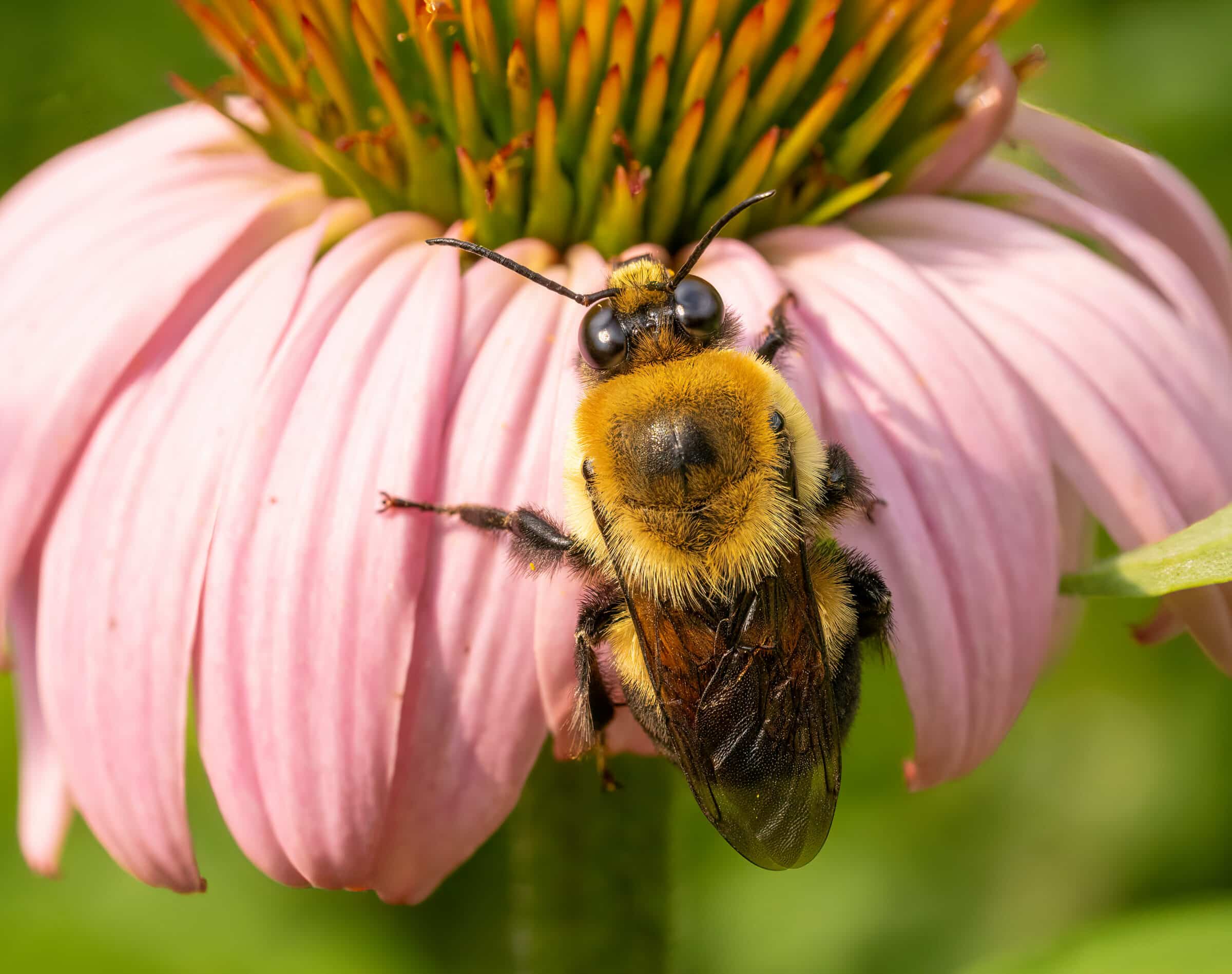
A paper published in the journal Science by a group of scientists in Finland provides new evidence for innovative behavior by bees.1 There has not been significant evidence of problem solving and innovative behavior in insects. This experiment tested whether bumblebees could move a ball to a position where it would enable gaining access to a reward. To achieve this a bee first had to roll the ball into a pit underneath a flower and then climb onto it to access the reward (sucrose). The bee had to recognize that moving the ball underneath the flower was necessary to reach it. The experiment had several different configurations such that the bee was unlikely to be successful by simply moving the ball randomly, but rather involved a level of problem solving.
Solutions Without Training
One goal of the experiment was to determine if bees can exhibit problem solving without explicit training because, “Problem-solving using novel solutions without explicit training is often considered a hallmark of cognitive flexibility.”2 Therefore, in the experiment different groups of bees had either no training or some level of pretraining. In the latter case bees were taught that the flower signaled a reward and that the ball was movable.
The authors write that the experiment,
Provides a unique demonstration that spontaneous problem-solving can emerge in an invertebrate without any preexisting repertoire that resembles the correct solution. Our results suggest that although prior associations influence performance, they do not diminish the bees’ ability to generate novel solutions, pointing to a more complex cognitive capacity in insects than was previously known…and provides the clearest evidence to date that bumble bees are capable of generating novel, goal-directed solutions.3
The caveat mentioned above quote concerns the “pretraining” included in the experiment. The results found that providing familiarization with the balls and flowers was necessary for the bees to be successful (approximately 75 per cent of the time). The bees that did not receive the “pretraining” were successful in receiving the reward at a much lower rate.
Previous Bee Experiments
Previous experiments have shown that bees can easily roll balls, and that they can engage with balls as a form of “play.” One study determined that the seemingly functionless ball-rolling activity is analogous to well-studied cases of solitary object play in mammals such as stone handling in macaques and “rock juggling” in various species of otters.4 Other experiments have demonstrated that bees can even learn complex novel tasks, including ones not associated with normal behaviors such as foraging for nectar. In one such experiment bees were specifically trained through observing a demonstration to move a ball to a particular location to obtain a reward. The conclusion of this study was that, “Bees solved this novel, complex goal-directed problem — and solved it via observation and using a better strategy than originally demonstrated — shows an unprecedented degree of behavioral flexibility in an insect.”5
Bees typically live for only a few weeks, and therefore do not have much time to gain experience and learn behaviors. And yet, despite this and the small brains with only about one million neurons, bees (and other insects) are capable of a surprising amount of learning, rather than being limited to stereotypical behaviors. Another example is that bees can learn how to manipulate flowers in order to gain access to nectar and pollen. The conclusion of one study found that honeybees, “Exhibit complex, non-elemental forms of learning, such as contextual learning, categorization and learning of abstract rules.”6
Behavior and Consciousness
While the behavior documented in this latest research is provocative, it is questionable whether it should be considered truly innovative. It does not appear to be a significant leap beyond bee behaviors previously documented, as described above.
The authors of the paper state that the results indicate that the behavior of the bees is “goal-directed.” If that’s true, it raises a number of questions. One is it means animals with very small brains, in this case insects, can engage in purposeful directed behavior. In other words, the behavior is teleological. There is a fundamental distinction between Pavlovian (stimulus-response) types of behaviors and those that involve a goal, “In contrast to habitual action, goal-directed behavior is rational and intelligent.”7
Bee scientist Lars Chittka describes the brains of bees, “These elegantly miniaturized brains are much more than input-output devices; they are biological prediction machines, exploring possibilities.”8 Chittka further explains, “The study of bee brains has taught us that brains, even very small ones, are wired for cognition, for exploring the environment and extracting rules from it, for predicting the future, and for efficient information storage and retrieval.”9 Chittka takes it a step further regarding the “mind” of bees,
On balance, the evidence for at least a simple form of consciousness in bees is mounting. If we apply the same behavioral and cognitive criteria as we do to much larger-brained vertebrates, then bees qualify as conscious agents with no less certainty than dogs or cats.10
More Evidence Needed
There needs to be much more evidence provided to support the hypothesis that bees have a form of consciousness. However, in addition to the results of the research on individual bee behavior, many other experiments indicate that bees exhibit goal-directed teleological behavior, particularly social group behaviors.
A key question is: What is the origin of these capabilities? Is it the result of millions of years of random variation and natural selection, or some other process? The behaviors are complex and require the design of brains that support sufficient cognitive capability. The design of organisms that have sufficient brain complexity and that produce these goal-directed behaviors requires an intelligent agent. Therefore, the best explanation for the origin is intelligent design.
Notes
- Akshaye A. Bhambore, et al., “Spontaneous problem-solving in bees,” Science, 4 June 2026.
- Bhambore, et al., “Spontaneous problem-solving in bees.”
- Bhambore, et al., “Spontaneous problem-solving in bees.”
- Hiruni Samadi Galpayage Dona, et al., “Do bumble bees play?” Animal Behaviour 194 (2022) 239-251.
- Olli J. Loukola, et al., “Bumblebees show cognitive flexibility by improving on an observed complex behavior,” Science, Vol. 355, 24 February 2017, 833-836.
- Martin Giurfa, “Cognitive neuroethology: Dissecting non-elemental learning in a honeybee brain,” Current Opinion in Neurobiology, 2003, 13:726-735.
- Amanda Seed, et al., “Planning, Memory, and Decision Making,” in Animal Thinking, ed. Randolf Menzel and Julia Fischer (Cambridge, MA: MIT Press, 2011), 121.
- Lars Chittka, The Mind of a Bee (Princeton, Princeton U. Press: 2022), 3.
- Chittka, The Mind of a Bee, 163.
- Chittka, The Mind of a Bee, 208.