






































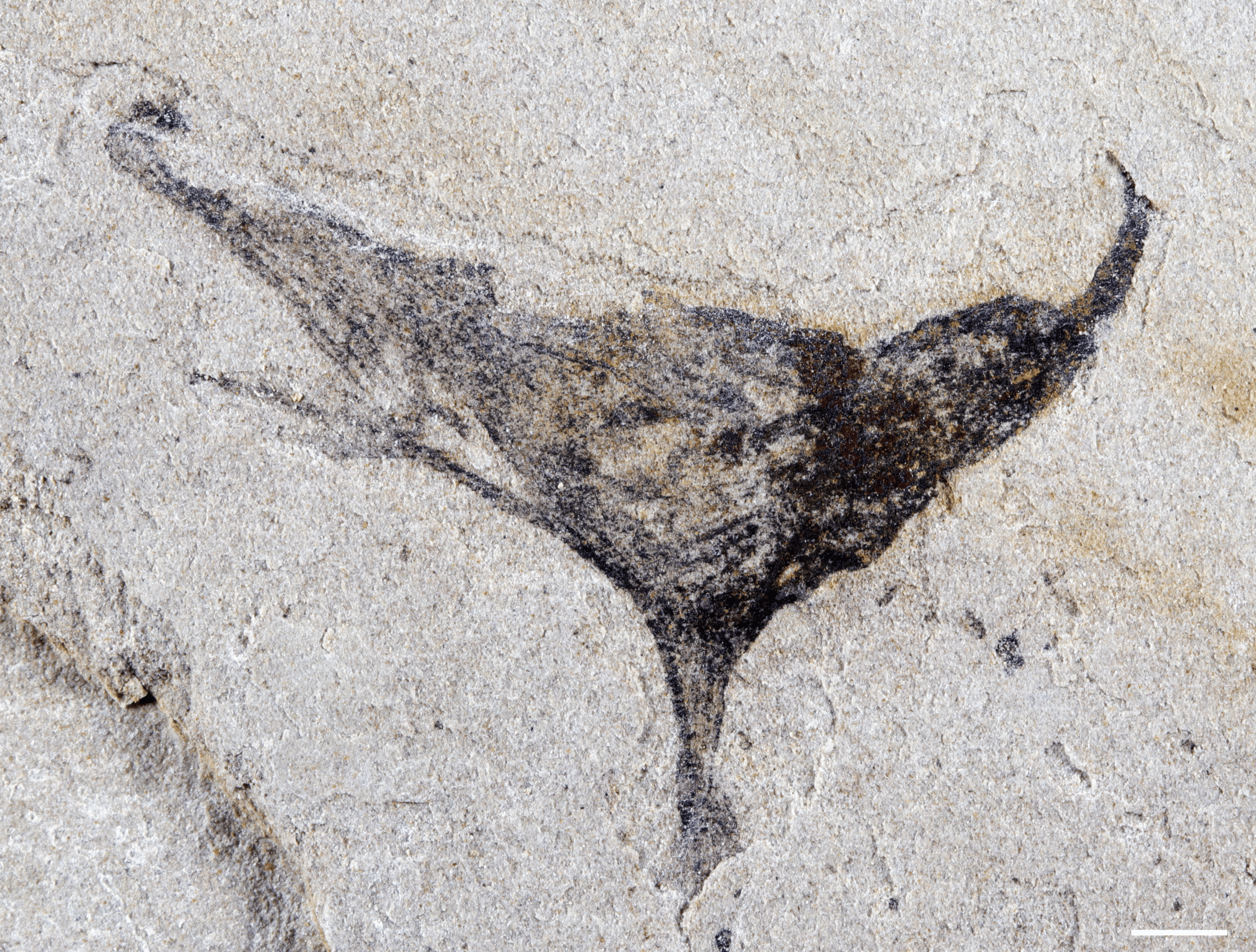
Over some prior posts (see here and here), I’ve been discussing a new paper in Science which claims to reveal Precambrian fossils from the Ediacaran period in China that represent bilaterian animals — i.e., animals with left and right-sided symmetry. Scientific American claims these newly discovered fossils show “the Cambrian explosion may have been less explosive than scientists once believed.” An article at The Conversation puts it more artfully: “Diverse complex animal life has a more ancient heritage than the Cambrian explosion.” As we’ve seen, there are good reasons to doubt a lot of the claims of Precambrian bilaterian animal fossils. But even if we accept all of the paper’s claims at face value, the Cambrian explosion is not diminished in any non-trivial way.
At Most Two or Three Cambrian Phyla
Let’s consider the fossils the paper identifies as appearing in the Ediacaran but that belong to phyla previously known to appear first in the Cambrian. Based upon what the paper itself reports, the number is two: Ctenophora and Hemichordata. The paper also claims to find “stem-group ambulacrarian cambroernids” but that again would include hemichordates and possibly echinoderms. These are said to be stem group members of those groups, but we can be generous and say that at most the paper identifies three phyla previously known to appear in the Cambrian.
However, the assignment with known bilaterian phyla has problems. As noted in my previous post, the hemichordate interpretation is highly inferential and the direct evidence of this fossil should not even qualify it as a bilaterian. As for the assignment of another fossil they discovered to “stem-group ambulacrarians,” as my previous post explained, these fossils were ancestral to no modern Cambrian animal phyla, and the phylogenetic association with ambulacrarians is highly tenuous due to large amounts of homoplasy (convergent gain and loss of traits) in the deuterostome tree. It’s far from a clear association.
What this means is that arguably this paper has added only one additional Cambrian animal phylum to the Precambrian world: Ctenophora. But Science paper notes this is unsurprising since ctenophores are non-bilaterians and multiple other non-bilaterian animal phyla are already known from the Ediacaran fossil record:
Beyond bilaterians, the discovery of a ctenophore is consistent with Ediacaran occurrences of other nonbilaterian animals, including cnidarians, sponges, and the putative placozoan-grade of some Ediacaran taxa.
So it seems that the clearest contribution of this paper is additional evidence confirming something we already knew: various nonbilaterian animals arose in the Precambrian.
Another likely finding of this study is the presence of some Precambrian bilaterians. That’s cool, but they belong to enigmatic groups and don’t seem to be ancestral to any major Cambrian animal groups.
Twenty Still Remain
Even if we take all of this paper’s claims at face value, the Cambrian explosion still represents the sudden appearance of about 20 animal phyla. That the Cambrian explosion remains robust in light of this paper is attested to by the first line of the Editor’s summary of the new paper at Science. It uses the word “explosion” to describe what we see in the Cambrian period:
The Cambrian period is well known for its explosion of forms, notably many that represent the ancestral versions of modern phyla.
Indeed, the Editor’s summary suggests that we may be seeing two separate explosions of different types of organisms:
The period before the Cambrian, the Ediacaran, also saw an explosion of forms, in this case the emergence of larger bodied, multicellular life.
The picture I’m seeing is that the Ediacaran explosion includes some strange enigmatic organisms that are hard to map to Cambrian animals, plus some major non-bilaterian animal phyla (Cnidaria, Porifera, and Ctenophora). This new paper adds that there were probably also a limited number of bilaterians, but they too are hard to clearly map to modern animals. Apart from some of the major non-bilaterian animals (e.g., jellyfish, sponges, and ctenophores), the Ediacaran fauna appear to be a group of strange organisms that went extinct — just as we previously thought.
Günter Bechly Predicted This Day
As I said, none of this negates the rapid appearance of about 20 major animal phyla in the Cambrian period. To make this point, here are some prescient words from our old friend the late paleontologist Günter Bechly, with an assist from that most famous of contemporary evolutionists:
Even if some relatives of sponges, cnidarians, stem (eu)metazoans, and maybe even stem bilaterians should be present in the Ediacaran, this would do absolutely nothing to explain the sudden appearance of the many different bilaterian animal body plans in the Cambrian explosion. They do appear as if out of nowhere, and that is not just a claim by Stephen Meyer. Here is what the great apostle of Darwinism, Richard Dawkins, has said: “The Cambrian strata of rocks, vintage about 600 million years, are the oldest in which we find most of the major invertebrate groups. And we find many of them already in an advanced state of evolution, the very first time they appear. It is as though they were just planted there, without any evolutionary history.”
This new paper in Science does not overturn these interpretations of the Cambrian explosion.
Standard Evolutionary Mechanisms Still Have a Major Problem
Others will claim that this paper shows the Cambrian explosion was far longer than 5 or 10 million years. As I’ve shown, compared to what we knew previously, this new study only makes the Cambrian explosion slightly less explosive in a way that we probably could have predicted.
But what if the Cambrian explosion really was tens of millions of years in length? Again, Dr. Bechly anticipated these claims. He further explained why the exact length of the Cambrian explosion is immaterial compared to what neo-Darwinian mechanisms are up against to produce:
Well, I actually agree that the total length of the Cambrian Explosion, as documented by the fossil record, may have been about 25 million years. But this point is immaterial because many experts also agree that the main pulse was much shorter and precisely in the range given by Meyer (see the numerous studies quoted in review articles by Luskin 2013 and CSC 2019). Here are just two prominent examples:
- Bowring et al. (1993) concluded that the “period of exponential increase of diversification lasted only 5 to 6 m.y. … it is unlikely to have exceeded 10 m.y.”
- In the standard textbook on the Cambrian explosion, the renowned experts Erwin and Valentine (2013: p. 5) (yes, that’s the same Douglas Erwin who was lead author of the study quoted by [Dave] Farina) dated the main diversification to a “geologically brief interval between about 530 to 520 Ma.” That’s 10 million years, exactly as stated by Meyer. Even the older Erwin et al. (2011) paper quoted by Farina found 13 bilaterian animal phyla originating in the Lower Cambrian Stage 3 (see his Supplementary Information), which lasted about 7 million years and includes the famous Sirius Passet and Chengjiang biota.
… [I]t does not make a significant difference for the problem of the Cambrian explosion whether it lasted 5 million years or 25 million years, because even the latter range would be orders of magnitude too short to accommodate the origin and spreading of the required genetic changes, based on standard population genetics (see further on for this waiting time problem).
And there’s the rub: The rapidity of the appearance of these diverse animal phyla — whether over 5 million years, 10 million years, 25 million years, or even 50 million years — still required the origin of thousands of new genes — and that genetic information is beyond the reach of the neo-Darwinian and other known blind evolutionary mechanisms. The inability of standard evolutionary mechanisms to account for the biological information was the central point of Meyer’s 2013 book Darwin’s Doubt, and it remains unsolved in light of this new paper in Science.