






















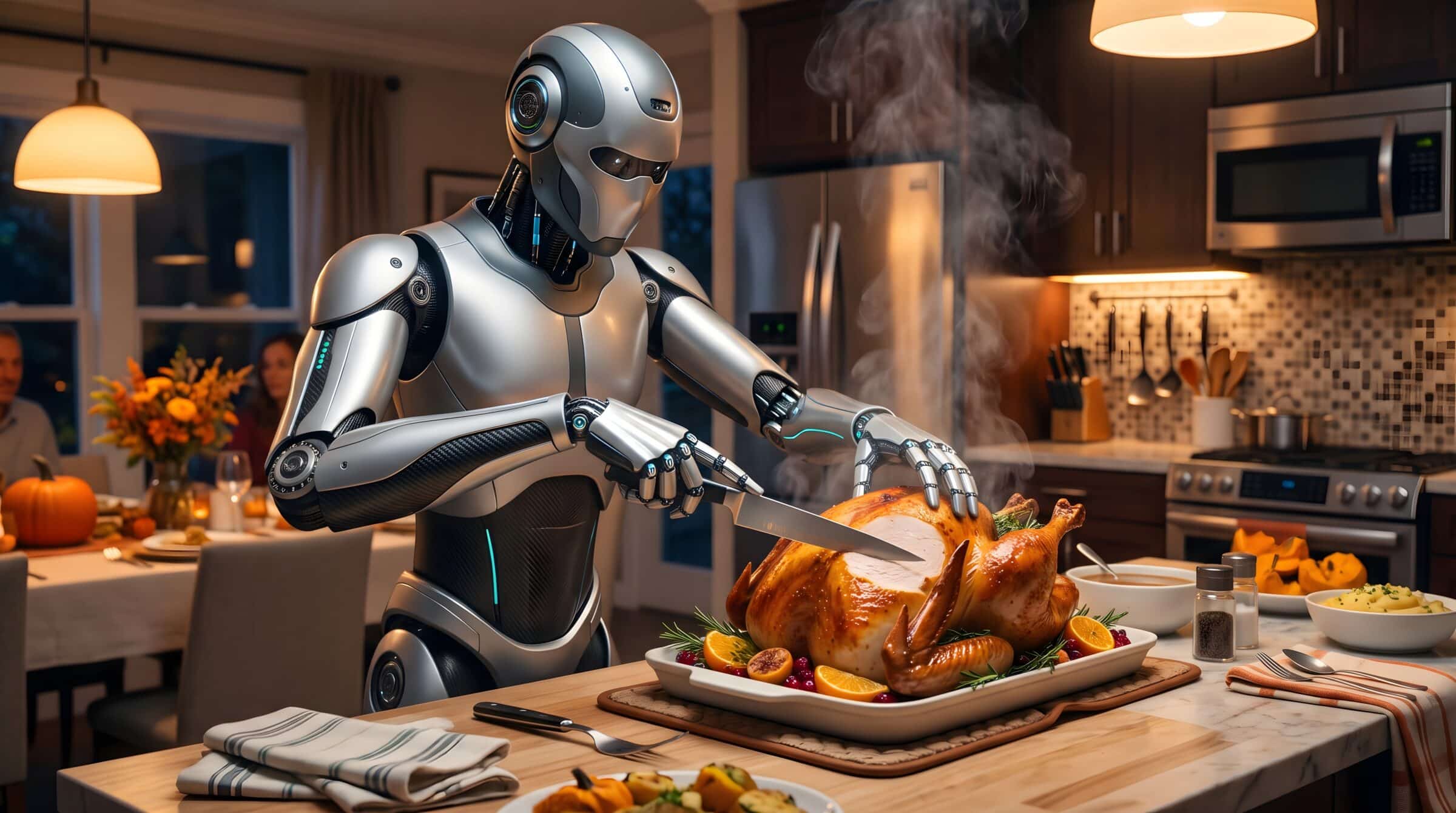
As we gather for Thanksgiving, we give thanks with family and friends for material blessings, but even more so, one hopes, for spiritual ones. The spiritual realm includes faith but also the range of other human gifts: for creating beauty, for example, and appreciating it in the world; for discovering truths through the study of science, philosophy, history, literature, and much more. Life without all this would be an impoverished affair.
Ingeniously Constructed Robots?
Our inheritance as humans blends the spiritual and the material. In the Bible, the blessings received from Isaac by Jacob and Esau represent the two. Wouldn’t it be ironic if in thanking the Creator for the spiritual bounty, we were in reality nothing more than material if cleverly contrived… machines? Say, meat robots, however ingenious the design?
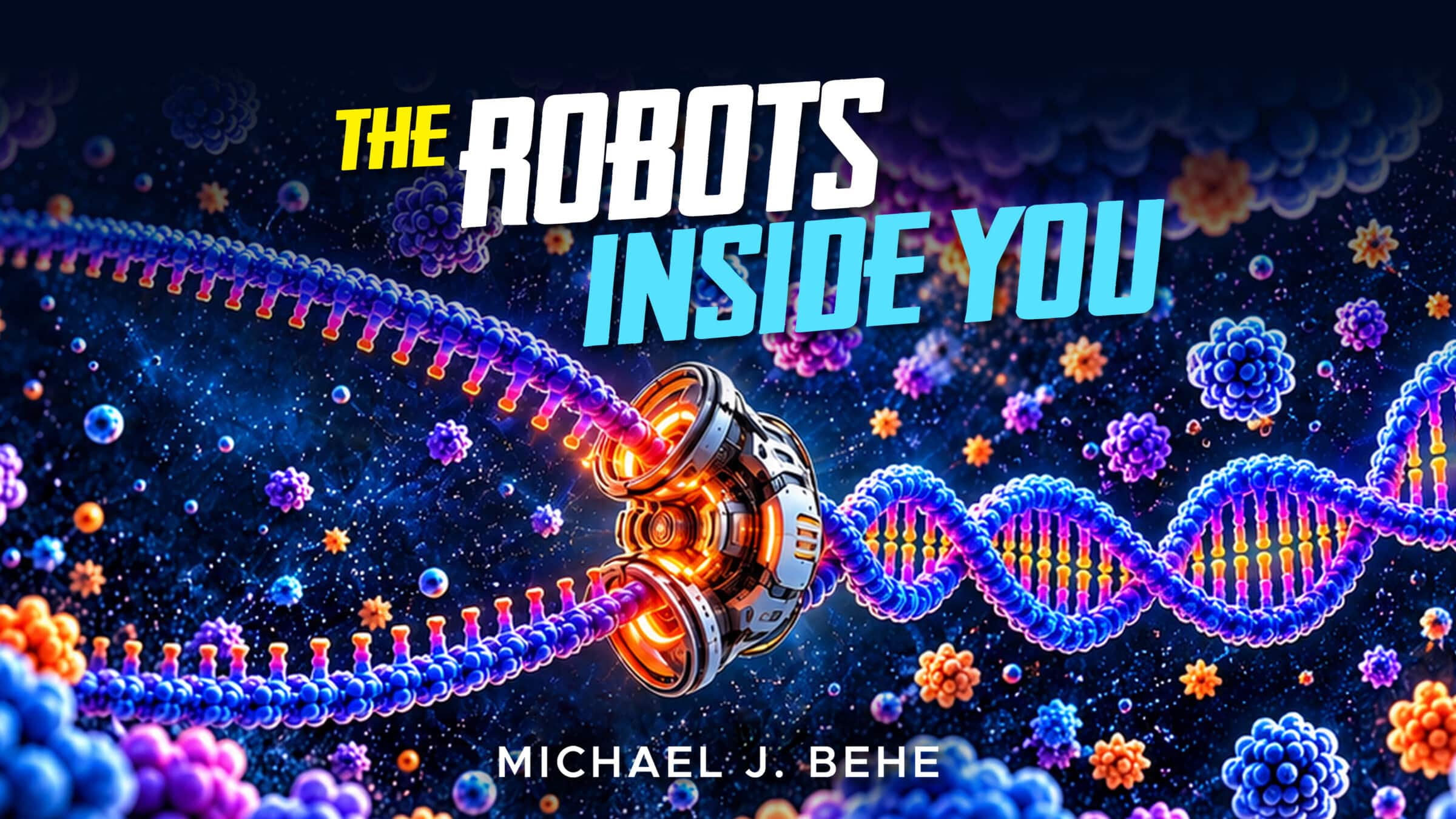
In his new book, intended mainly for younger people, The Robots Inside You, biochemist Michael Behe addresses just that concern. He writes,
At this point, I think it’s important to say something about machines made by humans versus machines found in humans. Clearly, our bodies contain an assembly of many sophisticated mechanical parts. These clever devices fit the ordinary definition of a machine that can be found in any good dictionary — a complex arrangement of parts for doing a job. So, if our bodies contain a lot of machines, does that mean you and I are just machines? No, of course not. That’s an error in logic — imagining that what holds for individual parts must also hold for the whole. Think of a house made of bricks. It doesn’t follow that the house is a brick.
If we look at the purpose of a machine, one key difference between us and them becomes clear. Machines are purposeful arrangements of parts that can be used for a task. They exist purely for the good of something else. But people and other living things exist, at least in part, for their own good and for their own purposes. We are the creatures for whose good the machines within our cells work.
Even the nanobots in our cells, although machines in the ordinary dictionary sense of the term, are different in important ways from man-made machines. I have been calling these biological machines nanobots in order to impress upon you just how high-tech they are, and I stand by that term. But even our best robots — big or small — cannot build themselves in the way that a cell’s bacterial flagellum motor can. And that’s only scratching the surface of the differences. Biological machines are next-level.
The key sentence there to note is, “We are the creatures for whose good the machines within our cells work.” We are not machines.
An Immaterial Genome
The full extent to which living beings are not machines is revealed in my book about the thought of biologist Richard Sternberg, Plato’s Revenge: The New Science of the Immaterial Genome. A true machine (your lawnmower, for example) would contain within itself all the information it needs to run. Our existence as biological beings is driven by information outside us, apparently outside the material universe.
That’s not a machine. We can join each other at Thanksgiving as material and spiritual creatures. I hope you enjoy yours!