






































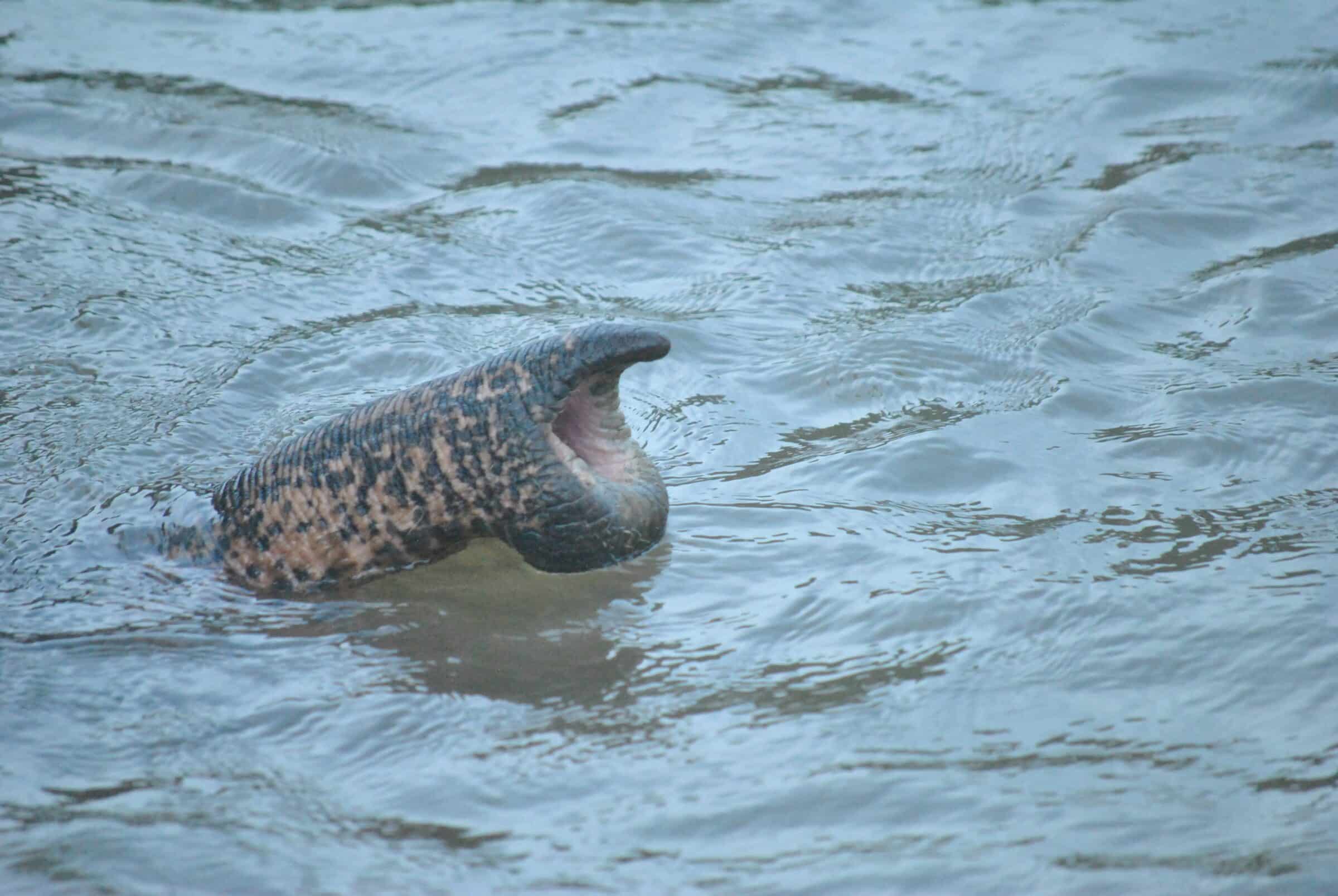
It must have been fun and enlightening for researchers at the Max Planck Institute to test the touch sensitivity of Asian elephants. Watching with amazement at their subjects’ ability to smell, lift, and transport a delicate potato chip without breaking it, they started asking questions. How does the animal do it? Paying attention to the little whisker hairs in the tip of the trunk, they wondered if they work the same way as whiskers on rats or other animals. Answer: their whisker hairs are more like those of cats than rats. In this short video they discuss what they found:
Material Intelligence and Functional Gradients
They call the design of the whisker hairs an example of “material intelligence” — the ability to extract useful information from the type of material in a sensor. Unlike rat whiskers, which are stiff all the way down, elephant tactile hairs (and those of cats) exhibit a “stiffness gradient,” stiff at the base but transitioning to a soft rubber-like tip. A rat’s stiff hairs work for the rodent, because those animals actively “whisk” their whiskers from side to side in the dark to extract information at the follicle, whereas elephant hairs do not move by muscular action. Their method receives tactile information from the amount of bending upon contact.
Known as a functional gradient, this stiff-to-soft transition allows elephants and cats to brush past objects with ease, helps prevent whisker breakage, and provides unique contact encoding along the whisker’s length. The researchers think this unusual stiffness gradient helps elephants know precisely where contact occurs along each of their 1000 trunk whiskers so they can perform feats like picking up a tortilla chip without breaking it or precisely grabbing a peanut. [Emphasis added.]
Led by postdoctoral researcher Andrew Schultz, an elephant biomechanics expert, the team included a robotics specialist in haptics (touch sensory mechanisms) and specialists in biology, engineering, materials, neuroscience, and medical devices. The specialists from five disciplines spent three years working on this project.
Schulz and his colleagues used an array of biological, materials science, and engineering techniques to image and characterize 5-cm-long whiskers from elephants and cats down to the length scale of one nanometer, which is 1 billionth of a meter.
The team was surprised to find that the functional gradient was only present in trunk hairs, not other hairs on the body, head, and tail. The trunk hairs also showed resilience: the ability to pop back into the original shape after being depressed.
Embodied Intelligence
Professor Katherine Kuchenbecker, Schulz’s mentor, tested a large model of a trunk hair Schulz had made that possessed a similar stiffness gradient. As she walked through the building, touching rails and pillars with the model, she could sense the distance and type of material the wand was touching simply by feel.
“It’s pretty amazing! The stiffness gradient provides a map to allow elephants to detect where contact occurs along each whisker. This property helps them know how close or how far their trunk is from an object…all baked into the geometry, porosity, and stiffness of the whisker. Engineers call this natural phenomenon embodied intelligence.” Excitingly, domestic cat whiskers show the same kind of stiffness gradient.
Gaining this kind of information close to the contact of a food or material is very helpful to the elephant. Their eyesight is not particularly keen, and their eyes are far from the object being touched. The “intelligence” is “embodied” where it is needed. “This combination of structure and form helps magnify the signals transmitted to the trunk,” says Marc S. Lavine in the Editor’s Summary of the published paper in Science.
Following the Signal Path
This information would be useless, of course, without receptors to capture and transmit it. Information collected from whiskers impinges on mechanosensors in the hair follicle.
A whisker’s follicle has four primary mechanosensory structures, including lanceolate endings, club-like endings, and two types of Merkel cells. Typically, rats whisk at frequencies between 5 and 15 Hz; physical contact causes whisker vibrations that can be felt up to 1 kHz. Specifically, the mechanoreceptors respond to a product of the frequency and amplitude: the power of the oscillating deformation at the whisker base.
While elephants lack the follicle muscles rats possess that permit active whisking, they have 16 times more whiskers than rats with comparable areal density. Plus, their 90,000 trunk muscles give them almost infinite degrees of freedom for moving those hairs across materials. Additionally, elephant hairs have an elongated ellipsoidal cross section, tapering at the tips, that permits omnidirectional proximity sensing. In short, elephants are well endowed for tactile finesse. The authors write,
Finite element analysis (FEA) of functionally graded cross section, porosity, and stiffness demonstrated how elephant whisker morphology and composition augment what is felt by the sensory neurons at the whisker base, providing a physically intelligent sensing solution for the nonactuated whiskers that cover the dexterous elephant trunk.
The stiffness gradient in the trunk hair sends extra information to the follicle even for objects outside the line of sight. The authors compare this to the audible signal from springy “curb feelers” on early cars. And that’s not all. Increased porosity at the base of each hair provides impact resistance and fracture control with 33 percent less peak stress than homogeneous material, as well as amplification of the tactile signal. This is important for an animal that can live 60 years.
We conclude that the horn-like porosity of the whisker base gives the elephant trunk an array of lightweight sensory probes that resist damage from impact while communicating clear vibrations to the mechanoreceptors in their follicles.
Impressive Specs
Proof of good engineering is found in performance. An elephant can use the same trunk to load a large pile of vegetation or a tiny peanut into its mouth. “Elastomer-tipped elephant whiskers tolerate loads and encode contact location,” reads one sectional subtitle.
Whiskers extend the sensory capabilities of the elephant trunk, assisting with precision manipulation of widely varying items, including hundreds of kilograms of food daily.
The end of the signal path is, of course, the brain. Without a brain to interpret the signals, nothing would be gained by these elegant hairs and follicles. The brain must “see” by means of touch what is often beyond eyesight. And as we learned from interoception, communication between brain and organ is bidirectional. The brain receives the information and sends signals back to the trunk, directing how it should respond.
A Phenomenon Worth Imitating
Engineers studied these trunk hairs with envy. From what they observed and measured, their thoughts turned to biomimetics.
Biological functionally graded material composites such as Asian elephant whiskers and domestic cat whiskers can inspire engineered devices that use functional gradients to achieve specific capabilities that range from fatigue reduction to signal power increases.
What about evolution? That subject was passed by with a brief narrative gloss: “Animals have evolved a diverse array of sensing systems,” they say, quickly focusing instead on the wondrous design of their subject matter.
This work showed that elephant whiskers are functionally graded in all three independent variables: geometry, porosity, and stiffness. The porosity and stiffness gradients of elephant trunk whiskers directly influence the frequency, amplitude, and power of the vibrotactile signals felt by mechanoreceptors in the follicle upon mechanical stimulation. Shifting from a stiff base to a soft tip amplifies the change in the signal power connected to the firing of sensory neurons, potentially improving the animal’s ability to perceive the location of contact along each whisker, which would aid navigation and manipulation.
Who would have thought that a squiggly little hair at the tip of an elephant’s trunk had just the right properties to embody intelligence? It’s another example of what is so true throughout biology: the closer one looks, the more design becomes apparent.