






































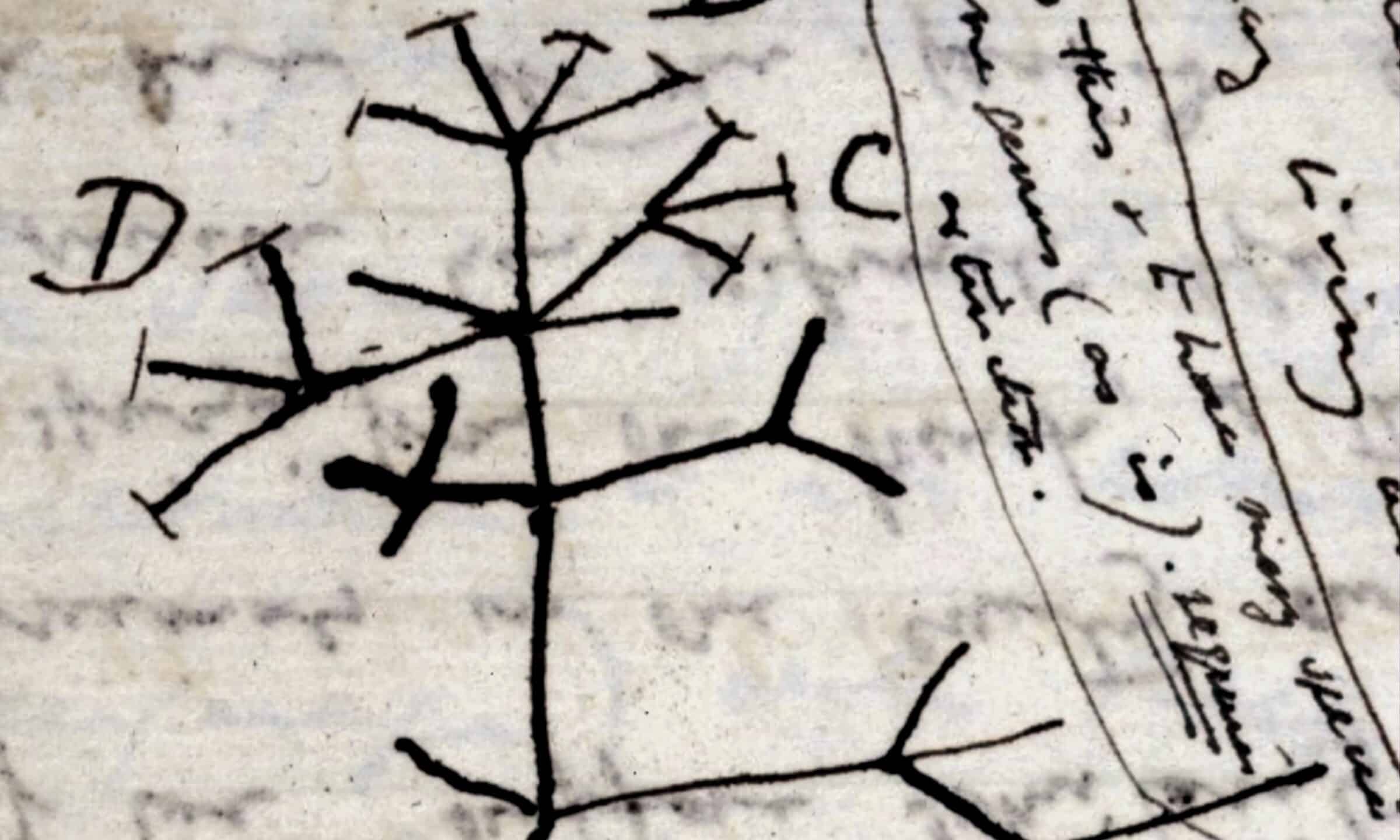
It is commonly known that Charles Darwin in the last decade of his life began to have second thoughts about his own theory of natural selection. He eventually agreed with Sir Charles Lyell and other colleagues that “natural preservation” would be a more accurate term than his own natural selection, that is, a process which passively preserves what is already there. Natural preservation is obviously unable to actively produce new body parts and plans in the way that the theory of natural selection postulates. This concession was of course fatal to his theory — a fact rather too blithely skated over by today’s über-Darwinists who seem to will natural selection to be true, evidence notwithstanding. Darwin on the other hand was less dogmatic, being prepared to reconsider his views. In 1879 he could even claim that his (mistitled) theory was not irreconcilable with theism. Neal Gillespie suggested that Darwin’s “epistemological double-vision” stemmed from the fact that that “earlier in his career he largely dropped theology from his science but not from his world view.”1 But the duality of Darwin’s thinking might also be glossed as a reflection of the habit of mind of a genuine philosopher, committed to exploring existential questions and refusing ready-made solutions to life’s recalcitrant cruxes.
Darwin, it would appear, liked to keep his options open: a quality of character which most (if not all) people would commend. Indeed, Darwin’s philosophical thinking is of a piece with the scientific ideal of research which is driven by the urge to interrogate the natural environment rather than trying to impose an over-arching answer upon everything.
Deconstructing Grand Narratives and Absolute Truths
Against the tendency to be reductive and simplistic in assessing Darwin’s views, it would be more fitting to acknowledge the integrity of the man who subjected his Origin of Species to five major revisions at the suggestion of sundry colleague-advisers. I hazarded the suggestion in my recent False Messiah2 that Darwin’s flexible state of mind, which prevented ideas from ossifying into dogmas, might give him the appearance of being a de facto Pyrrhonist3, Pyrrho having been the ancient Greek philosopher who doubted whether mankind had adequate grounds for claiming any knowledge with absolute certainty. What link (if any) might there be between Darwin and such a strand of ancient thought?
The Influence of Pyrrhonism on European Thought
In terming Darwin a Pyrrhonist I did not for a moment mean to imply that Darwin possessed the requisite Classical scholarship to know of the ancient thinker’s (now largely lost) work at first hand. In any case Pyrrho’s thought could hardly be termed an esoteric or hard-to-grasp philosophy and it may well have emerged spontaneously in a number of different cultures by processes of “polygenesis” (to use a term from anthropology). Some might even call it a “meme”! But directly or indirectly, it went on to influence European thinking in a variety of philosophical epochs right up to and including the postmodernist era. In the post-Renaissance era Montaigne, Pierre Bayle, and David Hume have been cited as Pyrrhonian legatees4 as well as Charles Sanders Peirce, William James, John Dewey, Kierkegaard, Nietzsche, Heidegger, and even Sartre — for as Pons Malleus points out, “At the heart of existentialist philosophy lies a deep-seated skepticism towards metaphysical certainties and objective truths,”5 a trend aligning with Pyrrho’s “dubitative” approach to unsubstantiated truth-claims.
In order to throw further light on the affinities between Pyrrho’s thinking and that of later ages, a brief historico-philosophical excursus might be useful here. Pyrrho himself is thought to have been born in the fourth century BCE in the Greek town of Elis and, as fate would have it, could have been lost to history had his work not been preserved by a later philosopher, Sextus Empiricus (AD 160-210), under the title of Outlines of Pyrrhonism.6 From Sextus we know that Pyrrho wrote a number of works against what he termed the dogmatists (by which he meant logicians, physicists, and ethicists), together with another group of writings entitled Against the Professors, by which he meant grammarians, rhetors, geometers, arithmeticians, astrologers, and even musicians — a truly all-encompassing list of targets!
Even religion was not off limits to his critique, at least in the way it was commonly understood in his day. Millenia before the publication of Ludwig Feuerbach’s Das Wesen des Christentums (1845),7 he used what we would consider quintessentially Feuerbachian language when claiming that “our ideas about the gods are more about human concerns than about divine reality.”8 One may also imagine Pyrrho nodding in assent to the 13th-century St. Thomas Aquinas’ contention that “God, as a transcendent being, stands beyond the limits of human knowledge” or to the 11th-century St. Anselm of Canterbury’s essentially “negative theology” to the effect that God belonged to a transcendent order of reality, being “something greater than can be thought.”9 On the subject of God’s unknowability it is also easy to imagine Pyrrho supporting Kant’s famous binary of the phenomenal world, which reveals itself to our senses and cognition, over against the “noumenal” world — of which we can say nothing.
Yet Sextus is at pains to point out that Pyrrho was no hide-bond nihilist but rather a skeptic in the original Greek sense of the term, meaning an enquirer or investigator. When such a skeptic/enquirer comes across a logical impasse or crux, then his reaction should not be to chance his arm with arbitrary theories plucked out of thin air (or from an overactive imagination) but rather to enquire further in the hope that enlightenment might come at a later date — or even not at all: an outcome which the enquirer must accept with equanimity. For it was only by admitting the incomprehensibility of certain aspects of the human condition that we can attain the condition of ataraxia, that is, equanimity: a mind not plagued by the insolubility of imponderables and therefore not prone to bicker with coevals, much less fight wars against them.
The watchword for the Pyrrhonian philosophy was epoché — the ability to suspend judgement (that which the English poet Coleridge was much later to term “negative capability”). In Sextus’ rendition of Pyrrhonian thought, he reported that human knowledge was contingent upon our sensory faculties and cognitive processes, here anticipating Kant’s questioning of the very foundation of our (claimed) knowledge in his Critique of Pure Reason. It was in contradiction to such philosophic acceptance that Sextus’ editor, J. B. Bury, made the disobliging comparison with “the dreamer, the drunkard, the madman [who] have illusions of the truth of which they are convinced.”10 If a little levity be permitted here, no Pyrrhonist would ever have chosen to title a book Why Evolution Is True as did Professor Jerry Coyne. In Pyrrho’s terminology, Coyne’s formulation would have lumped him together with the dogmatists who “claimed to have found the truth already and no longer needed to enquire.”11 Pyrrho’s standard advice to such ancient dogmatists was (anticipating Wittgenstein’s famous mot millennia later)12 to practice aphasia, that is, non-speech, silence.
Darwin’s Misgivings
In his biography of Darwin, British novelist and biographer A. N. Wilson once compared Darwin with Shakespeare’s figure of Hamlet. Not a bad analogy, methinks. For Darwin too was plagued by misgivings. Could such a creative process as evolution, Darwin mused, have really been set in train by such a non-dynamic phenomenon as “natural selection” (recte preservation)? Here it may be pertinent to consider that others have shared his reservations. The late polymath Arthur Koestler was moved to flirt with Lamarckian ideas out of a dissatisfaction with Darwinism as a defensible evolutionary pathway. Koestler felt that Darwinian mechanisms could be at the very best only part of the picture, claiming rather like Darwin in his later years that “there must be other principles and forces at work on the vast canvas of evolutionary phenomena.”13
Even Darwin’s proverbial bulldog, Thomas Huxley, whilst supporting the theory of evolution, regarded natural selection as, using a term from Scottish law, “unproven” (which is popularly taken to imply “guilty but we just can’t prove it”). Meanwhile Sir Charles Lyell objected point blank that such a process as natural selection was impossible in nature. It was therefore hardly surprising that Darwin in later life began to cast around for supplementary theories to bolster natural selection. At this later stage of his life he was to appeal to the once excoriated Lamarckian/Erasmian idea of the relative use/disuse of organs as a co-determinant of biological development. This was exemplified when in his Descent of Man (1871) he tried to explain how the human faculty of speech had developed. How could speech, which depends on the interdependent agency of the brain linking to the specialized organs of vocal articulation, have developed by the unguided processes of natural selection? It is particularly telling that Darwin found that putative synchronization so difficult to imagine that he was forced back on Lamarckian ideas of evolution, claiming,
The mental powers in some early progenitor of man must have been more highly developed than in any existing ape, before even the most imperfect form of speech could have come into use but we may confidently believe that the continued use and advancement of this power would have reacted on the mind itself, by enabling and encouraging it to carry on long trains of thought.14
The idea of the use/disuse of organs as drivers of evolutionary processes is of course unabashed Lamarckism — from which we are left to deduce that Darwin’s trumpet was giving forth a far less certain sound in 1871 than it had done in 1859 in his Origin where he bruited the virtues of natural selection with a considerably more audible fanfare.
A Philosophic Earthquake
We know that Darwin’s grandfather, Erasmus, was a quintessential legatee of Enlightenment prepossessions. The 17th-century discoveries of Sir Isaac Newton were in the course of Western intellectual history to become distilled into a cosmic worldview that set the pattern for each and every area of intellectual endeavor. But more recently we have had considerable reason to doubt whether that mechanistic framework tells the whole story.15 The last century of decidedly counter-intuitive scientific discoveries has prompted many to acknowledge that the Enlightenment dream of encompassing the whole of reality in some grand materialist theory of everything was overly ambitious.
The Enlightenment world view might well have continued to carry conviction in the period circa 1860-1927, but scientific developments in the late 1920s and mid 1940s came together to challenge Newtonian assumptions of what reality really is. As a corollary, we have been prompted to seriously question what place Darwinian theory has within an emergingscientific paradigm that has fatally undermined older scientific certainties. Today our profound ignorance of what Lucretius aptly termed the true nature of things has been unsparingly revealed in the work of pioneering 20th-century scientists such as Max Planck, Albert Einstein, Niels Bohr, Werner Heisenberg, Carlo Rovelli, and others, leaving deep fissures in the Newtonian/Enlightenment paradigm. Werner Heisenberg, who introduced the famous Uncertainty Principle in 1927, was the first to demonstrate the fact that the regularities of the larger Newtonian universe simply did not apply to the subatomic world.16 As geneticist J. B. S. Haldane put it, “The universe is not only queerer than we suppose, but queerer than we can suppose.”17
Hence, we now find ourselves in the position of having to acknowledge that the picture of the world we gain from classical Newtonian physics has so little in common with what quantum physics tells us is the underlying reality of things that they could be describing two different universes rather than the same one. It might even be suggested that the trend to separate off the quantum world from direct consideration as if it were a thing apart is perhaps the primary reason for the limited impact that the findings of quantum physics have had on the modern materialist mindset.18 Yet, the 20th-century British scientist Sir Arthur Eddington recognized early on that the time was right to revisit the subject of reality itself. We were, Eddington recorded, dependent on powers far beyond our present comprehension with the result that religion became eminently possible for a reasonable scientific person in the year 1927 (which was of course the year of the promulgation of Heisenberg’s Uncertainty Principle). Whether consciously or not, Eddington was here echoing the contention of another ancient philosopher, Chrysippus, who argued that “If there is something man cannot build then the one who builds it is superior to man.”19
The definition of reality, in other words, is being regularly curtailed or perhaps even distorted in order to support a superseded world picture in the service of a new form of obscurantism favored by that group of persons known as the New Atheists.20 In many respects Charles Darwin thus appears to us more modern than his present-day disciples, whose unbending materialism comes closer to that of Erasmus Darwin than it does to that of Charles himself.
Notes
- Neal Gillespie, Charles Darwin and the Problem of Creation (Chicago: Chicago UP, 1979), p. 125.
- Neil Thomas, False Messiah: Darwinism as the God that Failed (Seattle: Discovery Institute Press, 2025),
- Darwin certainly evidenced a Pyrrhonist streak when he felt moved to question whether his own reasoning, which in his opinion had descended from lowly and unreliable baboon ancestry, could be a dependable guide to truth at all!
- Bury, Outlines of Pyrrhonism (Cambridge Mass., Harvard UP, 1933), Introduction, p. 28.
- Pons Malleus, Pyrrhonism. A Note on the Philosophical School (Milton Keynes: Ingram Content Group, 2025), p. 78.
- Edited and translated by J. B. Bury as in note 4.
- Translated into English in 1854 by George Eliot as The Essence of Christianity.
- Pons Malleus, Pyrrhonism, p. 107. Feuerbach claimed that images of the divine were projections of the hopes and fears of humanity.
- See on this point Robin Le Poidevin, Agnosticism: A Very Short Introduction (Oxford: OUP, 2010), p. 11.
- Bury, Outlines of Pyrrhonism, Introduction, p. xxxiv.
- See on this point Philip P. Halie, Sextus Empiricus: Selections from the Major Writings on Scepticism, Man, and God edited by Hallie and translated from the Greek by Sanford G. Etheridge (Cambridge (Mass.): Avatar Books, 1985), Introduction.
- “That about which we know nothing we should stay silent.”
- Arthur Koestler, The Case of the Midwife Toad (London: Hutchinson, 1971), p. 129.
- Charles Darwin, The Descent of Man and Selection in Relation to Sex [1871], ed. James Moore and Adrian Desmond (London: Penguin, 2004), p. 110.
- See on this point mathematician Marcus du Sautoy’s What We Cannot Know: From Consciousness to the Cosmos (London; Fourth Estate, 2017) and Carlo Rovelli, Reality Is Not What It Seems: The Journey to Quantum Gravity (London: Penguin, 2018).
- It is not possible in the world of the very small to measure the position of an object and its momentum at one and the same time. Newtonian logic has a strictly limited applicability in a realm where only approximate knowledge can be achieved and where the new watchword of probabilism reigns supreme.
- Haldane, Possible Worlds and Other Essays (London: Chatto and Windus, 1927), p. 286.
- See on this point Steve Taylor, Spiritual Science (London: Watkins, 2018), p. 215.
- Philip P. Hallie, Sextus Empiricus: Selections from the Major Writings on Scepticism, Man and God, p. 21.
- See Stephen Fry, editor, The Four Horsemen: The Discussion that Sparked an Atheist Revolution (London: Bantam, 2019).