Science and Culture Today Discovering Design in Nature
Topic

demarcation criteria
PrincetownAUPortCampbellNationalParkTwelveApostle
Photo credit: Dietmar Rabich / Wikimedia Commons / “Princetown (AU), Port Campbell National Park, Twelve Apostles -- 2019 -- 0930” / CC BY-SA 4.0For print products: Dietmar Rabich / https://commons.wikimedia.org/wiki/File:Princetown_(AU),_Port_Campbell_National_Park,_Twelve_Apostles_--_2019_--_0930.jpg / https://creativecommons.org/licenses/by-sa/4.0/- Alternatively: Dietmar Rabich / https://w.wiki/Ar3m / https://creativecommons.org/licenses/by-sa/4.0/https://w.wiki/Ar3m, https://w.wiki/_sBzG (Shortlink).

The Divide Between Science and Non-Science

The most commonly heard charge against ID is that it “isn’t science” and therefore can’t even be evaluated as a scientific alternative to Darwinian evolution. Read More ›
Richard-Dawkins
Photo: Richard Dawkins, by Anders Hesselbom, Public domain, via Wikimedia Commons.

Dawkins: Intelligent Design Is a Scientific Hypothesis

"The idea that the universe was actually created by a supernatural intelligence is a dramatic, important idea." Read More ›
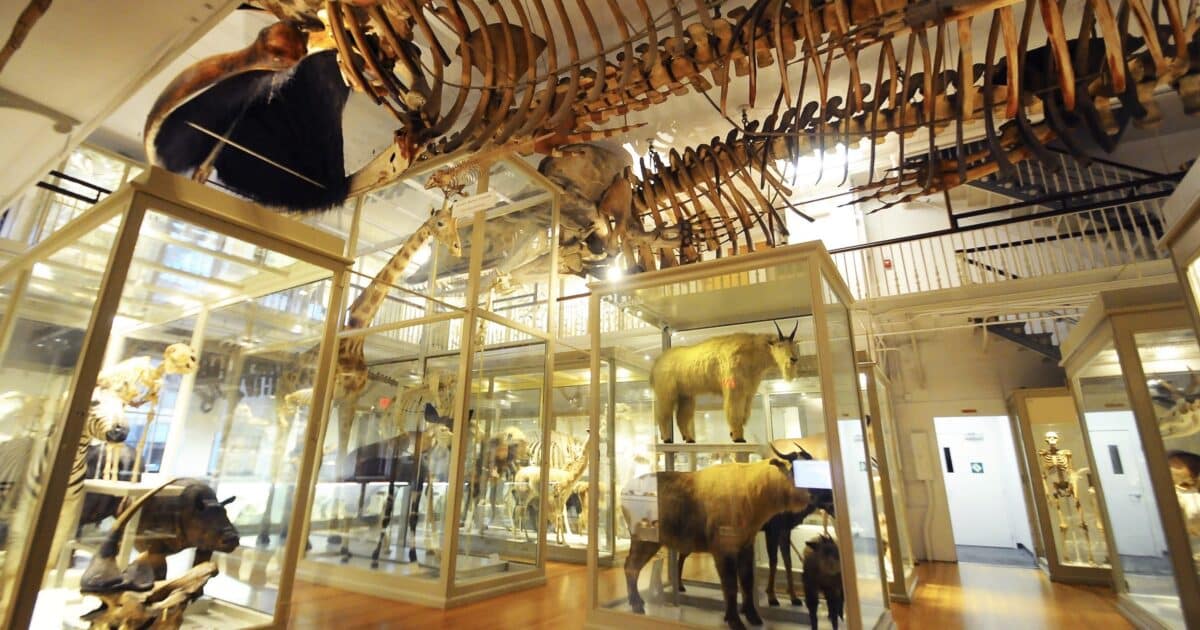
Harvard Museum of Natural History
Photo: Harvard Museum of Natural History, by Massachusetts Office Of Travel & Tourism, via Flickr (cropped).

Let’s Help Harvard Understand Intelligent Design
It was disappointing to see the inaccurate representation of ID, along with the poor scientific epistemology. Read More ›
Sisyphus
Image: Sisyphus forever pushing the rock up the hill, by Titian, Public domain, via Wikimedia Commons.

Is Intelligent Design a Science Stopper?

Consider a box with an internal divider such that the box is divided into two separate compartments, A and B. Read More ›
Stephen Meyer

Watch: Stephen Meyer Expertly Punctures the Rule of Methodological Naturalism

The rule, as he explains, is arbitrary. True, the designing agent inferred by ID theory is not directly observable, but neither are the elementary particles. Read More ›

Foundational Question: Is Intelligent Design Science?

It's long been said that the path to the right answers lies in asking the right questions. Read More ›
terabytes-of-binary-code-data-flying-in-a-stream-of-informat-457358220-stockpack-adobestock
Terabytes of binary code data flying in a stream of information. Wavy field of coded blockchains. Neural network, points and numbers 3D illustration
Image Credit: Siarhei - Adobe Stock

More on How We Can Know Intelligent Design Is Science

Philosophers of science have long debated the precise definition of science. Read More ›
book-pile-blank-booklist-and-cup-of-coffee-stockpack-adobe-s-89272554-stockpack-adobestock
Book pile, blank booklist and cup of coffee
Image Credit: Heike Rau - Adobe Stock

Why Intelligent Design Is Science: A Reading List

The scientific method is commonly described as a four-step process involving observations, hypothesis, experiments, and conclusion. Read More ›
delimited lines
Marquage et délimitations au sol
Image Credit: walain - Adobe Stock

Pseudoscience, Eugenics, and Demarcation

Look here: A physicist who seems to understand the demarcation problem proceeds to demarcate “pseudoscience” on his own authority. Alex Wellerstein reviewed a book on pseudoscience that explicitly warns about the challenge of differentiating between science and pseudoscience. Wellerstein, of the Center for the History of Physics, American Institute of Physics in Maryland, wrote in the Oct. 12 issue of Science this summary of what Michael D. Gordin said about the “demarcation problem” in his new book, The Pseudoscience Wars: Immanuel Velikovsky and the Birth of the Modern Fringe. Velikovsky’s cosmic catastrophism is, for Gordin, also a case study on the famously intractable demarcation problem, the difficulty of coming up with firm criteria for what separates science from nonscience, or Read More ›

aerial-of-sunset-in-princeton-new-jersey-stockpack-adobe-sto-223720420-stockpack-adobestock
Aerial of Sunset in Princeton New Jersey
Image Credit: Jin - Adobe Stock

Princeton Historian: Falsifiability Not a Requirement of Science

"The renowned philosopher Karl Popper coined the term 'demarcation problem' to describe the quest to distinguish science from pseudoscience. He also proposed a solution." Read More ›

© Discovery Institute