






































Editor’s note: We are delighted to present a new series by William Dembski, adapted from his Substack. This is the 12th post. Find the full series so far here, “My Personal History with Information.”
The challenge for me was to examine computational systems that seemed to be generating information in the form of successful search for free and show where the information had in fact been smuggled in. With Dawkins’s METHINKS IT IS LIKE A WEASEL, seeing where the information was smuggled in was straightforward. But with other examples, such as Thomas Schneider’s ev program, Adami et al.’s Avida program, and David Thomas’s Steiner Tree program, finding where the smuggling (displacement) occurred took more effort. It also helped to have the expertise of computer scientists to deconstruct these programs and show where exactly the information supposedly gotten for free had in fact been illicitly inputted.
One person early on whom I was able to enlist to deconstruct Schneider’s ev program was a UK programmer named Iain Strachan. He offered his deconstruction in an article that remains of historical interest from a now defunct journal. It is available through the Web Archive: “An Evaluation of ‘Ev’.” But his was a one-shot effort, and so I was looking to recruit others. Enter Robert J. Marks II, a distinguished professor of engineering at Baylor University, and students of his that he set to work on this project of deconstruction through his Evolutionary Informatics Lab (EvoInfo.org).
A Cottage Industry
And so, in the mid to late 2000s, it became a cottage industry for my colleagues and me at the Evolutionary Informatics Lab to take examples from the evolutionary computing literature that claimed it produced information for free (in analogy with Darwinian evolution) and show how, with a closer audit, the information had not been properly paid for. George Montañez and Winston Ewert did most of the heavy lifting in writing the programs and simulations to expose the illicit insertions of information in evolutionary computing programs that were supposed to generate them for free or from scratch, but in fact did nothing of the sort. All of their work in this area remains available at EvoInfo.org, and specifically on the Research Tools page. Showing where the illicit information was inserted into such evolutionary computing programs played an important role in defending intelligent design and establishing its credibility in the 2000s. For instance, in 2003, Nature published “The Evolutionary Origins of Complex Features,” listing as authors Richard E. Lenski, Charles Ofria, Robert T. Pennock, and Christoph Adami. Pennock at the time was one of the most vocal critics of intelligent design. Even though that Nature paper studiously avoided citing Michael Behe, in his expert witness testimony in the Kitzmiller v. Dover case, Pennock made a point of saying that the Avida program, which was the subject of that Nature paper, refuted Behe’s claims about complex systems arising by Darwinian evolution.
Cooked from the Start
In fact, the Nature paper did nothing of the sort, and it was cooked from the start to reward complexity for complexity’s own sake (moreover, the complexity was generic and not specifically irreducible complexity). The Avida program was thoroughly deconstructed at EvoInfo.org: see the article and simulation at https://www.evoinfo.org/minivida.
To get a flavor of how we deconstructed evolutionary algorithms that were used to argue for Darwinism, the case of physicist David Thomas is instructive. Thomas offered a Darwinian program for constructing Steiner trees (a type of graph that in some optimal way connects various vertices). He then posed the following challenge: “If you contend that this algorithm works only by sneaking in the answer (the Steiner shape) into the fitness test, please identify the precise code snippet where this frontloading is being performed.”
We found several such code snippets, but the most glaring is one that included the incriminating comment “over-ride!!!”:
x = (double)rand() / (double)RAND_MAX;
num = (int)((double)(m_varbnodes*x);
num = m_varbnodes; // over-ride!!!
As Winston Ewert, Bob Marks, and I pointed out on the EvoInfo.org website (https://evoinfo.org/papers/steiner.pdf):
The claim that no design was involved in the production of this algorithm is very hard to maintain given this section of code. The code picks a random count for the number of interchanges; however, immediately afterwards it throws away the randomly calculated value and replaces it with the maximum possible, in this case, 4. The code is marked with the comment “override!!!,” indicating that this was the intent of Thomas. It is the equivalent of saying “go east” and a moment later changing your mind and saying “go west.” The most likely occurrence is that Thomas was unhappy with the initial performance of his algorithm and thus had to tweak it.
Auditing Darwin’s Books
The Evolutionary Informatics Lab thus became the go-to place to audit the books of the Darwinian evolutionary computing industry. In its wake, you nowadays find a lot less enthusiasm among Darwinists in touting the wonderworking evolutionary powers of algorithms in mimicking natural selection. This has all been to the good. But it also proved unsatisfying in the sense that our approach invited constantly new challenges from evolutionary algorithms that could become ever more clever and opaque at misrepresenting the information that was being outputted as though it had been created for free when in fact it had been surreptitiously inputted.
The situation was similar to people constructing ever more elaborate machines supposedly capable of perpetual motion and then the responsibility falling on patent examiners of having to show where they failed (such as by showing where they draw from solar energy to which they were not supposed to have access). The USPTO no longer accepts patents for perpetual motion machines because the second law says it can’t be done. We were looking for something like this for evolutionary search and indeed search in general.
My Revelation in Denmark
The challenge was therefore not merely to show, in case after case and without exception, that displacement was happening but that there were principled quantitative reasons for why information outputted could not exceed information inputted in the same way that the second law of thermodynamics provided principled quantitative reasons for precluding perpetual motion machines. The breakthrough for me came unexpectedly in 2004 in a whirlwind tour of academic institutions in Denmark.
Jakob Wolf, a professor of theology at the University of Copenhagen, had written a pro-ID book in Danish that was published in 2004: Rosens råb. Intelligent design i naturen. Opgør med darwinismen. (In English: The Rose’s Cry: Intelligent Design in Nature: A Clash with Darwinism.) Enthusiastic about advancing intelligent design in Denmark, he invited me to speak at a number of universities and meet with various faculty in more intimate settings. He also showed me some of the sites. I’m particularly grateful to him for showing me the Karen Blixen (Isak Dinesen) Museum.
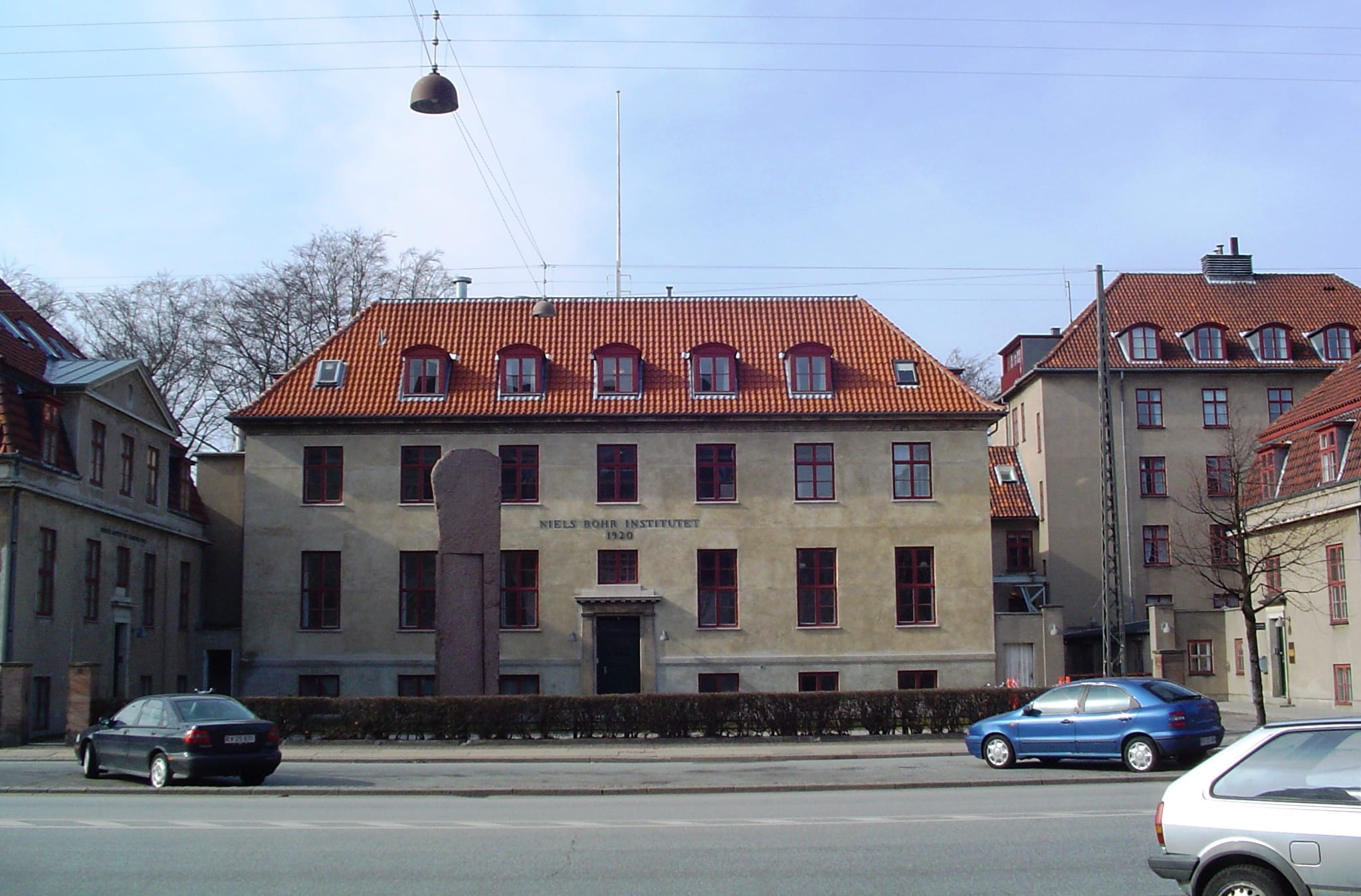
The most significant stop for me in Denmark, however, was a lecture that Jakob Wolf arranged for me to give at the Niels Bohr Institute (pictured at the top). Interestingly, this was the very institute where my physics advisor, Leo Kadanoff, had done his first postdoc after getting his PhD in physics from Harvard in 1960 — Bohr would have been alive at the time, not passing away until 1962.
In my lecture at the Niels Bohr Institute, I was going to do my usual presentation on displacement, arguing as a practical matter that highly improbable search output always required a corresponding input of information. But my argument in the past had been more case-by-case and qualitative. The night before my lecture it struck me that by representing search using probability measures, the relation between information out and information in could be made mathematically precise, with the amount of information out never exceeding the amount of information in.
All the pieces suddenly fell into place for me. In the actual lecture, I overpromised a bit, needing later to get out pencil and paper and calculate all the numbers precisely to confirm all that I was promising. But I knew I had made a major advance. And once I worked out the details, everything I said in the lecture proved true.
Next, “Searching Large Spaces: The Mathematical Details.”