





































Editor’s note: We are delighted to present a new series by William Dembski, adapted from his Substack. This is the 16th post. Find the full series so far here, “My Personal History with Information.”
Besides my scientific work on information, in 2013 I began to write a book on the metaphysics of information. The background for this book goes back to 1998–99, when I applied for and received one of six Templeton Foundation book awards in science and religion, each worth $100,000. In applying for the award, I had to submit a detailed book proposal. Specifically, I proposed to write a book on the science and metaphysics of information. I decided to turn this into two books, one on the science of information, which appeared in 2002, titled No Free Lunch, and the other on the metaphysics of information, titled Being as Communion.
An Informational Realism
I kept delaying the latter book because it was meant to bridge information theory with evidence of purpose in nature, and that connection required intense preliminary research by me on the scientific underpinnings of information, research that came to fruition with colleagues at the Evolutionary Informatics Lab (described earlier in this series). Only with the science firmly in place did I feel justified pursuing its metaphysical implications. Thus, I finally felt in a position to write Being as Communion in 2013, wrote it in about 12 months, and then published it with Ashgate’s science and religion series in 2014. Being as Communion, many years overdue, finally made good on my Templeton award.In this book, I present an informational realism in which the fundamental stuff of the world is information. Specifically, what demonstrates something’s reality is its ability to exchange information with other things. The ontology here is relational, but not purely relational in the sense of making relations more real than the things related. The things exchanging information are fundamental, but they make their reality felt through information.
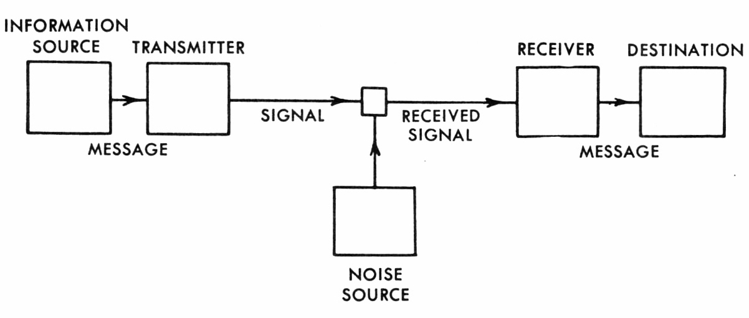
My approach was neither Aristotelian nor Platonic. Contra Aristotle, I do not treat matter as an independent co-principle in which form inheres. Contra Plato, I do not posit a separate realm of static forms of which particulars are shadows. I take as my point of departure what Claude Shannon, in his classic 1949 book The Mathematical Theory of Communication called the “schematic diagram of a general communication system.”A diagram there is usually confined to humans sending signals across electronic communication channels. Nonetheless, it suggests a very general approach to information creation. According to Shannon’s diagram, information creation is essentially a speech act in which an intelligence, to advance a purpose, articulates an item of information and then broadcasts it. We obviously see this mode of creation in human speech acts. Nonetheless, speech acts, broadly construed, are able to characterize how intelligences create information quite generally.
A Flavor of the Ontology
As I remark in chapter 20 of Being as Communion:
In our experience, information is created in any number of ways. Painters create information by applying dabs of paint to canvas, sculptors by chiseling away at stone, musicians by writing notes on lined sheets of paper, engineers by drawing up blueprints, etc. Yet, in general, all such acts of information creation can be represented in language. For instance, a sufficiently elaborate set of instructions from a natural language can, with arbitrary precision, tell the painter where to apply the colors, the sculptor how to chisel the stone, the musician where to place the notes, the engineer how to draw up the blueprints, etc. Language, conceived as a speech act, in this way becomes the universal medium for creating information and thereby bringing purposes to realization. This is a linguistic picture of teleology. In this picture, purposes remain inert, ineffective, in limbo until appropriate items of information that advance the purpose are articulated and broadcast. Only in this way do purposes move from potentiality to actuality.
I’m giving a flavor of the ontology I develop in Being as Communion. Ultimately, I relate this ontology to the Trinitarian God, who becomes the source of all reality by forming intentions (as Father), concretizes these intentions in words (as the Son or Logos), and then empowers them through breath (as the Holy Spirit). In 2022, I applied this ontology to the mind-body problem in a chapter titled “How Informational Realism Dissolves the Mind-Body Problem,” which I contributed to the collection Minding the Brain: Models of the Mind, Information, and Empirical Science, edited by Angus Menuge, Brian Krouse, and Bob Marks.
Next, “A Second Edition for The Design Inference.”