






































Editor’s note: To mark the 20th anniversary of the publication of Richard Dawkins’s bestseller The God Delusion, Stephen Meyer took to the pages of The Telegraph. His essay prompted 2,100+ reader responses. A recurrent challenge was the “God of the gaps” objection. Below, adapted from Return of the God Hypothesis, Dr. Meyer replies. Find the original article here.
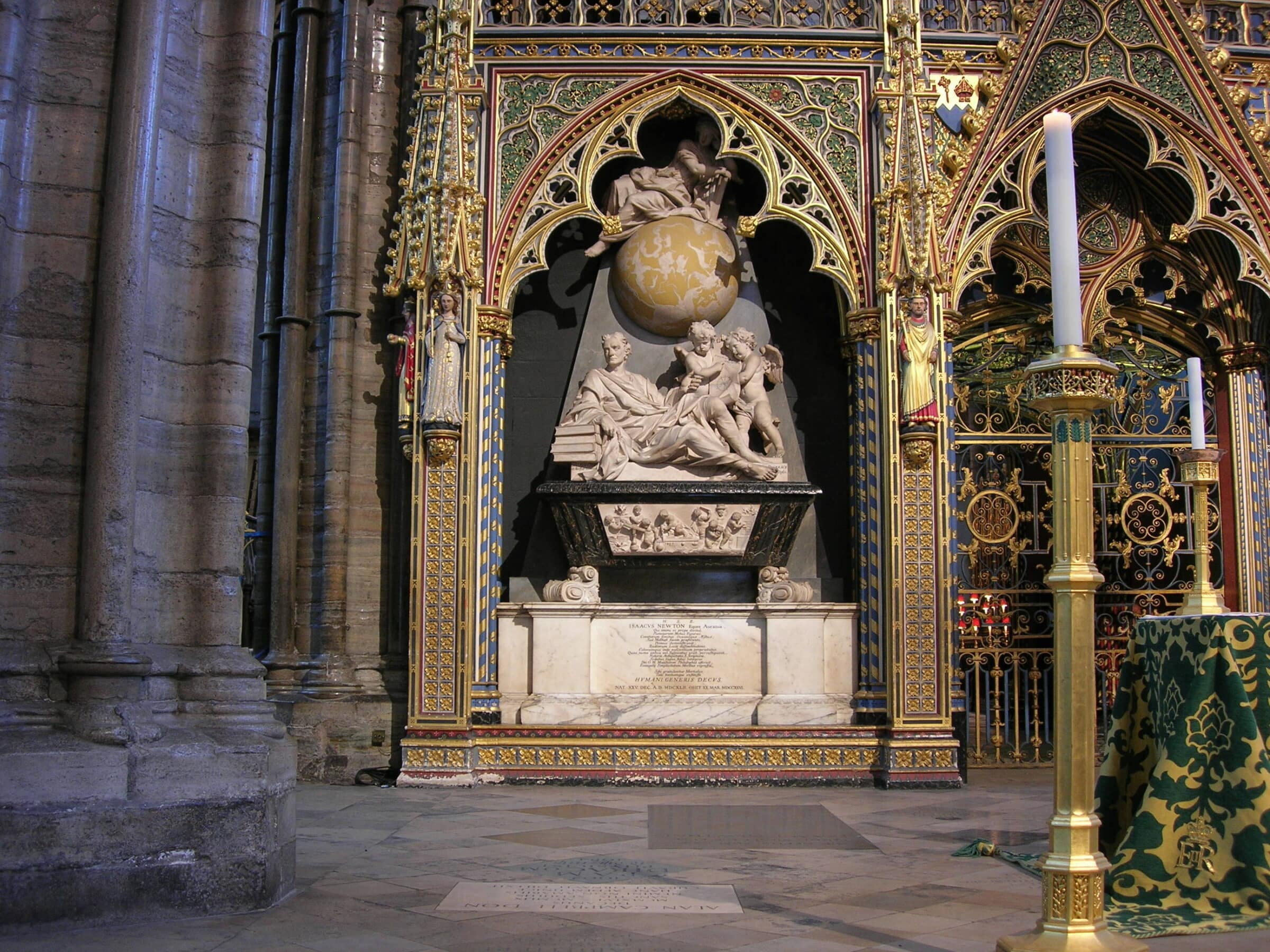
A common objection to Isaac Newton’s view of the relationship between science and theistic belief is known as the God-of-the-gaps objection (hereafter, the GOTG objection). According to those who pose this objection, the GOTG fallacy occurs whenever someone invokes the activity of a creative intelligence or God to explain phenomena or events in the natural world. Such postulations, critics argue, stifle scientific advance by using God (or intelligence) to explain events that scientists would eventually explain, once they discovered new laws of nature or material processes. Allowing God or creative intelligence as an explanation thus only serves to prevent, impede, or distract scientists from discovering the true explanation for such events.
Some religious scientists also worry that positing God as an explanation for natural phenomena or events in natural history will inevitably bring disrepute to belief in God, once scientists discover new laws or processes that make the God hypothesis unnecessary. Some theists also find it theologically and aesthetically unappealing, and even demeaning of the divine person, to think of God as having to intervene periodically in nature to fix some aspect of the original design of the universe that, presumably, was not properly designed in the first place.
BioLogos, an influential Christian group that advocates theistic evolution and opposes intelligent design,1 explains the GOTG objection this way:
God-of-the-gaps arguments use gaps in scientific explanation as indicators, or even proof, of God’s action and therefore of God’s existence. Such arguments propose divine acts in place of natural, scientific causes for phenomena that science cannot yet explain. The assumption is that if science cannot explain how something happened, then God must be the explanation. But . . .[w]ith the continuing advancement of science, God-of-the-gaps explanations often get replaced by natural mechanisms. Therefore, when such arguments are used as apologetic tools, scientific research can unnecessarily be placed at odds with belief in God.2
Critics of intelligent design or science-based theistic arguments often cite Newton as the prime example of a scientist3 who made the GOTG blunder. As the story is often told, after Newton successfully used his universal law of gravity to describe the motion of the planets in the solar system, he discovered that the orbits of the outer planets did not conform precisely to the trajectories he had calculated based upon his law. Further, he apparently realized that the mutual gravitational attraction between the outer planets would make the solar system unstable. As a result, he allegedly posited episodic interventions of God or — in some versions of the story — angels to put the planets back onto correct orbits. Later, when the French physicist Pierre-Simon Laplace showed how Newton’s own laws could account for the observed anomalies, he showed (voila!) Newton’s postulation of divine action — his “God of the gaps” — to be unnecessary and Newton’s God went into permanent retreat. Or so the story goes.4
Opponents of the theory intelligent design frequently characterize it as a GOTG argument or “an argument from ignorance,” often comparing the intelligent design hypothesis to Newton’s supposed postulation of divine action to fix the solar system. According to this criticism anyone who infers design from the specified information in living cells uses current ignorance or gaps in our knowledge of a adequate materialistic cause of such information to justify that inference. Since, the objection goes, design advocates can’t imagine a natural process that can produce specified biological information, they resort to invoking the mysterious notion of intelligent design. In this view, intelligent design functions not as an explanation, but as a placeholder for ignorance, one that proponents of intelligent design fill by postulating the activity of a creative intelligence, a “God of the gaps.” Since critics have charged that argument for intelligent design in the history of life constitutes a fallacious argument from ignorance (and a GOTG argument), it follows that extending that argument to support an explicitly theistic argument or God hypothesis would do so as well.
But does it?
Not an Argument from Ignorance
Let’s look first at whether the argument for intelligent design in biology — which by itself does not attempt to identify the designing intelligence responsible for life — commits this fallacy. Arguments from ignorance occur when evidence against one proposition is offered as the sole grounds for accepting an alternative. Thus, they have the following form:
Premise: Cause A cannot produce or explain evidence E.
Conclusion: Therefore, cause B produced or explains E.
Arguments of this form commit an obvious logical error. They do not include a premise providing affirmative support for the preferred conclusion. Instead, such arguments only present evidence against the adequacy of some other possible cause or alternative explanation. For example, if someone were to argue that an injury to a particular racehorse (say, “Seattle Slew II”), means that another horse (“Justify Junior,” for example) will necessarily win the Kentucky Derby, that argument would commit a fallacy. To justify the conclusion, the person making the argument needs to provide affirmative evidence demonstrating that their favored horse has shown itself to be faster than other horses in the field.
Does the argument for the intelligent design of life commit a similar fallacy? It does not. True, that argument for intelligent design does depend in part upon critical assessments of the causal adequacy of materialistic explanations for the origin of specified information in DNA. Nevertheless, the “specified complexity” or “specified information” of DNA implicates a prior intelligent cause, not only because (as I have argued) materialistic origin-of-life scenarios fail to explain the ultimate origin of such information, but also because we know that intelligent agents can and do produce information of this kind. We have positive experience-based knowledge of an alternative cause sufficient to produce such effects, namely, intelligent agency or mind.
To depict proponents of the theory of intelligent design as committing the GOTG fallacy, critics of the theory must misrepresent the case for it. For example, as Michael Shermer claims, “Intelligent design . . . argues that life is too specifically complex (complex structures like DNA) . . . to have evolved by natural forces. Therefore, life must have been created by . . . an intelligent designer.” In short, he claims that proponents of intelligent design argue as follows:
Premise: Material causes cannot produce or explain specified information.
Conclusion: Therefore, an intelligent cause produced the specified information in life.
In fact, the case for the intelligent design of life doesn’t rely on such logic. Instead, the argument takes the following significantly different form:
Premise One: Despite a thorough search, no material causes have been discovered with power to produce large amounts of specified information.
Premise Two: Intelligent causes have demonstrated the power to produce large amounts of specified information.
Conclusion: Intelligent design constitutes the best, most causally adequate, explanation for the origin of the specified information in the cell.
Clearly, in addition to a premise about how material causes lack demonstrated causal adequacy, the argument for intelligent design as the best explanation affirms the demonstrated causal adequacy of an alternative cause, namely, intelligent agency. The argument as stated does not fail to provide a premise affirming positive evidence for an alternative cause. The argument specifically includes such a premise. Therefore, it does not appeal to ignorance or commit the “gaps” fallacy.
Instead, contemporary ID proponents employ the standard uniformitarian method of reasoning used in the historical sciences. That such arguments for intelligent design necessarily include critical evaluations of the causal adequacy of competing hypotheses is entirely appropriate. Historical scientists must compare the causal adequacy of competing hypotheses to judge which of several hypotheses qualifies as best. Yet, we would not say, for example, that an archeologist had committed a “scribe of the gaps” fallacy simply because — after rejecting the hypothesis that an ancient hieroglyphic inscription was caused by a sandstorm — he went on to conclude that the inscription had been produced by an intelligent scribe. Instead, the archeologist made an inference based upon his experience-based knowledge that information-rich inscriptions invariably arise from intelligent causes. He did not base his inference solely on his judgement that no suitably efficacious natural cause could explain the inscription.
Moreover, what we know from our uniform and repeated experience about the cause of specified information (especially when we find it in a digital form), allows us to treat the presence of such information as a distinctive hallmark, an affirmative indicator or signature, of intelligence. In all cases where we know the causal origin of specified information, experience has shown that intelligent design played a causal role. Thus, when we encounter such information in the bio-macromolecules necessary to life, we may infer or retrodict — based upon our knowledge of established cause-effect relationships (i.e., our knowledge of “causes now in operation”) — that an intelligent cause operated to produce the information necessary for life’s origin.
Is the God Hypothesis a “God of the Gaps” Argument?
The argument for intelligent design presented in my books certainly does not commit a “God of the gaps” fallacy for another obvious reason. Initially, that argument didn’t identify God as the designing intelligence responsible for the information present in living systems.
But what about the argument for a God hypothesis based upon evidence from physics and cosmology as well as the evidence of design in living systems? Is that argument an argument-from-ignorance?
Again, it is not. Though the argument presented here does concern events that confront materialistic accounts of the origin of the universe and life with causal discontinuities (or gaps), it does not affirm the existence or activity of God solely on the basis of such gaps. Instead, it uses straightforward considerations of causal adequacy (and, in some cases, parsimony and other theoretical virtues)5 to assess the explanatory power of competing metaphysical hypotheses.
Critiquing the Causal Adequacy of Materialism
In assessing competing explanations for the origin of the universe, I have, of course, critiqued many different materialistic theories, including the steady state and oscillating universe theories. I also showed that quantum cosmology — advanced by scientific materialists as an alternative to the God hypothesis — turns out to have unintended theistic implications. I showed that it too failed to provide a causally adequate materialistic explanation for the origin of the universe.
More fundamentally, I argued that all materialistic theories of the origin of the material universe face a similar problem. Before matter and energy exist, they cannot cause, or be invoked to explain, the origin of the material universe. Instead, positing a materialistic process to explain the origin of matter and energy assumes the existence of the very entities — matter and energy — the origin of which materialists seek to explain. No truly materialistic explanation can close this particular causal discontinuity or gap — the gap between nothing or a pre-existing immaterial or mathematical reality, on the one hand, and the origin of a material universe, on the other.
Nor do appeals to the laws of nature solve this problem. Instead, Stephen Hawking’s generic claim that the “laws of science” or “the law of gravity” can explain “why there is something rather than nothing,” betrayed a deep philosophical confusion (a category error) about what the laws of physics can do. Laws of nature describe how nature operates; they don’t produce the natural world in the first place. This suggests the futility of waiting for the discovery of some new law of nature, or a “theory of everything.” No law of nature can close the causal discontinuity or gap between nothing and the origin of nature itself.
Similarly, I have argued against the causal adequacy of proposed naturalistic explanations — such as the Weak and Strong Anthropic Principles and the Multiverse idea — for the fine-tuning of the universe. I showed, more fundamentally, that the laws of physics cannot explain their own fine-tuning or the fine-tuning of the initial configurations of mass-energy at the beginning of the universe. We saw that, in order to describe the behavior of a physical system, all known laws of physics require extrinsic inputs of information about the initial and boundary conditions of the system in question and about the values of their own constants of proportionality. By “extrinsic,” I mean that the information about such conditions comes from beyond the laws of physics themselves. But the initial conditions of the universe and the constants of physics are exquisitely finely tuned. It follows that the laws of physics themselves do not — and cannot — explain the origin of this fine-tuning.
This suggests yet another gap that the laws of nature cannot in principle close.6 In recognition of this, even BioLogos, the group that has most strenuously marshalled the GOTG objection to design arguments in biology, acknowledges that the objection does not apply to the fine-tuning (and, perhaps, the origin of) the universe itself. As they explain,
Some critics charge that invoking God as the fine-tuner is a return to the God-of-the-gaps. But there does not seem to be any way to explain the detailed properties of the laws of nature from within science.7
Positive Arguments for the Causal Adequacy of the God Hypothesis
Even so, the argument presented here does not leap straight from critiquing materialistic explanations, to concluding that a transcendent and intelligent agent originated the universe. Instead, I offed a positive rationale for affirming the causal adequacy of such an agent, to demonstrate the superior explanatory power of the God hypothesis. In other words, I offered good reasons to affirm the God hypothesis as acausally adequate — indeed, the only causally adequate — explanation for the origin and fine-tuning of the universe.
First, I’ve argued that any cause capable of explaining the origin of the universe (and the fine-tuning present from the beginning) must in some way stand separate from the universe or, in philosophical terms, transcend matter, space, time and energy. Materialists themselves have subtly conceded the need for a transcendent explanatory entity by positing universes beyond our universe and abstract non-material mathematical entities (such as those posited in quantum cosmology) as explanations for the origin of the universe and its fundamental attributes.
As previously explained, these either fail as materialistic explanations or they have science-destroying consequences. Nevertheless, God, as conceived by theists, possesses the attribute of transcendence and, therefore, qualifies — on that basis — as a more causally adequate explanation for material universe, than any explanation expressing a materialistic or pantheistic worldview.
There is another aspect to this. I have explained how positing the action of a free agent could resolve the otherwise seemingly intractable dilemma for naturalism posed by the beginning of the material universe. We saw how positing a volitional act as the cause of the abrupt change of state represented by the beginning of the universe can explain it. Positing the choice of an intelligent agent made it possible to explain the origin of the universe without positing either an uncaused material event (in violation of the principles of sufficient reason and causality) or an infinite regress of material causes at odds with observations about the universe having a beginning. Following philosophers J. P. Moreland and William Lane Craig, I argued that positing an act of free agency resolves this dilemma. Why? Because we know that conscious agents such as ourselves have the power to produce abrupt changes of state. And, though we also know that material causes can sometimes produce abrupt changes of state, positing such material causes when the change of state in question involves the sudden origin of the material universe itself generates either absurdities or contradictions with observations.8
For our present purposes the important point is this: theists conceive of God as a free agent. By highlighting the causal powers of agents with free will and the ability to generate abrupt changes of state — without also generating absurdities or contradictions — I have justified the causal adequacy of the God hypothesis. Moreover, since only a transcendent cause (separate from the material universe) can function as the cause of the abrupt change of state that brought the material universe itself into existence, I have presented a positive argument forthe adequacy of a transcendent and intelligent, conscious agent with free will — also known as God — as the cause of the origin of the universe.
I have explained how the fine-tuning of the universe exhibits two properties — extreme improbability and functional specificity — that we routinely associate with the activity of intelligent agents. Based upon our uniform and repeated experience, we have often observed intelligent agents producing highly improbable functionally significant outcomes such as finely tuned Swiss watches, digital computers, engines, recipes and coded messages. Consequently, we have empirical evidence of the sufficiency of intelligent agency or design as the cause of finely tuned systems. Moreover, since that fine-tuning originated at the beginning of the universe itself, this class of evidence requires a transcendent intelligence to most adequately explain it.
Theoretical Justifications of Causal Adequacy
Of course, as David Hume famously fretted, we do not have “uniform and repeated” experience of God creating universes.9 So we cannot certify the causal adequacy of the God hypothesis in exactly the same way as we would a generic intelligent design hypothesis or many other historical scientific hypotheses. Nevertheless, architects of the method of inference to the best explanation and historical scientific reasoning (“reconstructive causal analysis”) allow that, absent the ability to observe cause and effect relationships directly, we may have “theoretical reasons” for regarding a postulated cause as “causally adequate.” For example, a particle physicist might postulate the existence of a particle with certain attributes (of spin, mass, momentum and/or charge, for example) and corresponding causal powers, thus providing a “theoretical justification” for the causal adequacy of that entity with respect to certain expected observable phenomena. The physicist might then infer the particle’s actual existence upon observing those expected phenomena. If she, further, observes other phenomena expected on the basis of the presence of the postulated particle, those observations would provide additional confirmation of the particle’s existence. (The method of inference to the best explanation does not require us to know in advance that a posited entity actually exists. Instead, using the method of IBE scientists and philosophers infer that cause among a group of possible causes that would, if true, existent or actual, best explain the evidence in question.)
In much the same way, philosophers or scientists who postulate the existence of God understand God to have certain attributes (for example, transcendence, intelligence, omnipresence or free will) and corresponding causal powers that would allow God to produce certain kinds of effects — such as the ability to generate abrupt changes of state, finely-tuned or information-rich systems or even to create a universe from nothing a finite time ago. In other words, the concept of God as advanced by philosophers and theologians, or as revealed in Scripture, has inherent in it particular attributes and corresponding causal powers. By articulating those attributes and powers, philosophers can provide a theoretical rationale for affirming the causal adequacy of God with respect to specific observable phenomena or kinds of events. This in turns allowed us to formulate a God hypothesis with empirical expectations about the world. Since scientists have evidence confirming those expectations in, for example, the discovery of the fine-tuning and temporal beginning of the universe, evidence from the world can provide confirmation of the theistic hypothesis.
In addition, historical scientists often justify the causal adequacy of a postulated entity by extrapolating from the effects produced by a relevantly similar entity. Darwin, for example, saw that artificial selection could produce modest changes in organisms over a short period of time and he extrapolated from those effects to propose that natural selection and random variation operating over a long period of time could produce fundamental transformations in the morphology of organisms. In this way, he sought to establish that natural selection qualified as a vera causa (or causally adequate explanation) of morphological innovation.
Proponents of a theistic design hypothesis can, in a similar way, extrapolate from the creative power of human agents. Since human agents generate abrupt changes in state and they create new structures by arranging pre-existing matter and energy, we might reasonably postulate an omnipotent divine agent as the cause of the abrupt change of state that resulted in the creation of matter and energy in the first place.10 Similarly, theists might reasonably extrapolate from the known abilities of intelligent human agents to produce finely-tuned terrestrial artifacts and systems to posit a “super-mind” or “super-intellect” as an adequate cause of the fine-tuning of the universe as a whole. Indeed, the concept of God has inherent in it precisely those attributes or qualities — transcendence, omnipotence, creative power, intelligence — that confirm its adequacy as a cause of both the origin of the universe and its fine-tuning. God as conceived by theists would, if existent, provide a more causally adequate explanation for the origin of the universe and fine-tuning than any entity affirmed in competing worldviews (such as materialism or pantheism) that deny a transcendent reality and intelligent agent separate from the material universe.
In any case, a genuine GOTG argument exemplifies a specific type of argument from ignorance — one in which the evidence against a proposed material cause leads immediately to the affirmation of a God hypothesis without any presentation of positive reasons for affirming the causal adequacy of that hypothesis. Since the argument presented here does offer positive reasons for affirming the causal adequacy of God, along with its critique of materialistic alternatives, it represents an inference to the best explanation, not an argument from ignorance. Since it isn’t an argument from ignorance, it can’t be a GOTG argument — even if it does offer an explanation for a gap or causal discontinuity in materialistic accounts of the origin of the universe.
A Prohibition and a Circular Justification
The origin of the material universe, like the origin of the fine-tuning and the origin of novel forms of life, is an indicator of some kind of past causal action. The question in each case is: what kind? What kind of cause best explains the events in question? By rejecting all explanations that posit a transcendent and/or intelligent agent as fallacious GOTG arguments, scientific materialists and theistic evolutionists effectively require scientists and philosophers to explain all events in natural history materialistically.
Of course, those concerned about the God-of-the-gaps fallacy have their reasons for limiting acceptable explanations in this way. They assume that some material entity or process or some law of nature will eventually provide an adequate explanation of every event in the history of the universe. But do we really know this?
We’ve already seen that neither the origin of the universe, nor the fine-tuning of the laws of physics and initial conditions of the universe, are the kind of events that laws of nature or materialistic process are likely to, or can in principle, explain. Similarly, the origin of complex specified information cannot in principle be explained by laws of physics or chemistry. Such considerations alone might alert us to a problem with the idea that all events can be explained by natural laws or materialistic processes.
Yet, there is a deeper logical problem with the blanket prohibition against agency as an explanation in natural history. Whether motivated by concerns about “gaps” or by a commitment to methodological materialism, the prohibition against explanations involving creative intelligence ends up assuming the very point at issue in the debate about origins.
To see why, consider the following illustration.11 Imagine someone mistakenly enters an art gallery expecting to find croissants on sale. That is, he thinks the gallery is actually a fancy bakery. Such a person may think that he has encountered a “gap” in the services provided by the gallery. Observing the absence of pastries and rolls, he may even think that he has encountered a gap in the knowledge of what must definitely be present somewhere in the museum. Based on his assumptions, the visitor may then stubbornly cling to his perception of a gap, badgering the gallery staff to “bring out the croissants already,” until with exasperation they show him to the exit.
The moral of this vignette? The gallery visitor’s perception of a gap in service, or in knowledge of the location of the croissants, derives from a false assumption about the nature of this establishment, or about art galleries in general, and what they typically offer to visitors.
In a similar way, perceived gaps in our knowledge of the natural or materialistic processes responsible for key events in natural history are based on our background assumption about the kind of processes or entities that ought to have been working in nature. In the debate about biological origins, for example, theistic evolutionists and mainstream evolutionary biologists alike assume that all living systems necessarily were produced by some materialistic process, and that their origin will, thus, ultimately have a completely materialistic explanation.The background assumption implicit in, for instance, the question “What chemical processes first produced life?” implies a gap in our scientific knowledge when it becomes apparent (as it has) that no materialistic chemical process has been discovered that can generate the information necessary to produce the first living cells. Nevertheless, our present lack of knowledge of any such chemical process entails a “gap” in our knowledge of the actual process by which life arose only if some such materialistic chemical evolutionary process actually did produce the first life.
Yet if life did not arise via a strictly materialistic evolutionary process, but was, for example, intelligently designed, then our absence of knowledge of a strictly materialistic process responsible for life does not represent “a gap” in knowledge of an actual process. It only represents a gap in materialistic accounts of the origin of life. In that case, the perceived gap in our knowledge would merely reflect a false assumption about what must have happened, or about the existence of a certain kind of process — a materialistic one — with the creative power to generate life. Where are those croissants?
But what if such a materialistic process did not produce either the first life or the universe and its fine-tuning? Then our assumption about the ultimate sufficiency of materialistic explanations would be false. Consequently, prohibitions against explanations invoking creative intelligence, based upon an aversion to explaining events that generate such “gaps” in materialistic accounts, might cause us to miss the true cause and best explanation for the event (or discontinuities) in question.
Consequently, a more intellectually rigorous approach to the challenge of explaining crucial events in the history of life and the universe would permit scientists and philosophers to consider competing possible explanations even if they invoke creative intelligence. The critical question is not “Which materialistic or naturalistic explanation best explains the origin of life and the universe?” but rather, “What actually caused life and the universe with its fine-tuning to arise?”
Seen in this light, the GOTG objection fades into insignificance. To make their case, defenders of an exclusively materialist explanations in science and philosophy must first show that perceived gaps in our knowledge of the causes of new forms of life are real — i.e., that we have genuine grounds for thinking that these “gaps” will be filled with knowledge of an actual natural process or materialistic mechanism capable of producing the events in question. But this is exactly what scientific materialists have failed to do. Indeed, if scientific materialists had discovered materialistic processes with the demonstrated creative power to explain the origin of life and the universe, they would not need to invoke the God-of-the-gaps objection to challenge intelligent design arguments or the God hypothesis.
On the other hand, if there are positive reasons to consider creative intelligence as a crucial causal factor, and if, in addition to evidence against competing materialistic explanations, those reasons suggest creative intelligence as a vera causa or best explanation for the events in question, then so be it. Let the evidence, and standard methods of scientific reasoning based on metaphysically neutral criteria for assessing hypotheses, determine the conclusion of the investigation, not a question-begging prohibition that smuggles in the answer to the question at issue from the outset.
Yet, currently that is precisely how scientific materialists and others use the God-of-the-gaps objection. To justify a prohibition against invoking creative intelligence, they assume that appeals to creative intelligence in natural history will prove unnecessary sincewholly materialistic explanations for the origin of biological information and life, the fine-tuning and the universe will be forthcoming.
But the justification of that assumption depends upon a circular reasoning. Critics of intelligent design or theistic arguments assert that scientists shouldn’t invoke creative intelligence to explain events that leave gaps in our materialistic accounts of the origin of life and the universe. Why? Because we know (or assume) that natural laws or materialistic process will eventually explain those events and close those gaps. How do we know that materialistic processes will eventually explain those events, considering that such processes haven’t yet explained them and look unlikely to do so? Because the only alternative to explaining such events materialistically would be to invoke creative intelligence and that would commit . . .you guessed it . . . a GOTG fallacy. More succinctly: we cannot allow God as an explanation for events that leave gaps in our materialistic accounts of the origin of life and the universe because we know that scientists will eventually develop adequate materialistic explanations of those events. How do we know that that? Because the only alternatives to materialistic explanations commit the God-of-the-gaps fallacy.
And around and around we go.
Notes
- Not all scholars who have written for the BioLogos website oppose intelligent design. For example, historian of science Ted Davis neither supports nor opposes intelligent design. Even so, the most prominent leaders of BioLogos have strenuously opposed and critiques intelligent design. See, for example:Francis Collins, The Language of God: A Scientist Presents Evidence for Belief (New York: Free Press, 2006), 181-196; Darrell Falk, “Thoughts on Darwin’s Doubt, Part 1,” BioLogos, September 9, 2014, accessed July 30, 2019, http://biologos.org/blogs/archive/thoughts-on-darwin’s-doubt-reviewing-darwin’s-doubt-darrel-falk-part-1; Darrell Falk, “Further Thoughts on ‘Darwin’s Doubt’ after Reading Bishop’s Review,” Bio-Logos, September 11, 2014, accessed July 30, 2019, http://biologos.org/blogs/archive/thoughts-on-darwins-doubt-reviewing-darwins-doubt-darrel-falk-part-2; Deborah Haarsma, “Reviewing ‘Darwin’s Doubt’: Introduction,”Bio-Logos, August 25, 2014, accessed July 30, 2019, https://biologos.org/articles/reviewing-darwins-doubt-introduction; Deborah Haarsma,“Response” to “Intelligent Design,” in Four Views on Creation and Evolution, ed. James Stump (Grand Rapids, MI: Zondervan), 2017; Dennis Venema, “Intelligent Design and Nylon Eating Bacteria,” BioLogos.org, April 7, 2016: http://biologos.org/blogs/dennis-venema-letters-to-the-duchess/intelligent-design-and-nylon -eating-bacteria; Dennis Venema and Dan Kuebler, “Biological Information and Intelligent Design,” Bio-Logos, June 9, 2016, accessed July 30, 2019, https://biologos.org/articles/biological-information-and-intelligent-design; Dennis R. Venema and Scott McKnight, Adam and the Genome: Reading Scripture After Genetic Science (Grand Rapids, Mi.: Brazos, 2017), 67-92.
- “Are gaps in scientific knowledge evidence for God?” https://biologos.org/common-questions/gods-relationship-to-creation/god-of-the-gaps.
- In Newton’s time scientists (as we would call them today) were called natural philsophers.
- Here’s another version of this oft-told story published in a more scholarly volume: “Perhaps the most famous example of the God of the gaps argument came about when Isaac Newton considered the question of the long-term stability of the solar system. He was not able to calculate whether the small gravitational forces between pairs of planets would cancel on the average or accumulate. He considered that in the latter case, the unstable behavior would be avoided by the gentle action of God, applying small forces at the right times and places. A century later, Pierre Simon de Laplace showed that the solar system is indeed stable against such perturbations. When his former student, Napoléon Bonaparte, asked why Laplace’s treatise on celestial mechanics did not mention God, Laplace answered “I did not need that hypothesis.” John R. Albright, “God of the Gaps,” in Encyclopedia of Sciences and Religions, ed. Anne L. C. Runehov and Lluis Oviedo (Dordrecht: Springer, 2013), 955.
- Ernan McMullin, “The Virtues of a Good Theory,” in The Routledge Companion to Philosophy of Science, ed. Martin Curd and Stathis Psillos (New York: Routledge, 2014).
- Robert Larmer has argued that theistic arguments based upon gaps in the natural order do not necessarily commit the fallacy of arguing from ignorance. He argues that it is simply dogmatic to insist that God can never be the cause of an event in nature. Instead, he argues that some apparent cases of “arguments from ignorance” have considerable epistemic force. He observes that “presumed examples of the fallacy of argumentum ad ignorantiam can often be redescribed in a positive way that makes them seem not to be arguments from ignorance at all.” See: Robert Larmer, “Is There Anything Wrong with ‘God of the Gaps’ Reasoning?” International Journal for Philosophy of Religion 52, no. 3 (2002): 129-42, esp. p. 131.
- “Are gaps in scientific knowledge evidence for God?” https://biologos.org/common-questions/gods-relationship-to-creation/god-of-the-gaps.
- This argument is based upon our own introspective awareness of our conscious minds. We all intuitively sense that we have the ability to produce abrupt changes of state (free will) uncompelled by material causes. I noted that, though positing the uncaused act of an agent did represent an exception to the rule that “all events have causes,” it did not undermine scientific rationality in so doing. On the other hand, positing or allowing the possibility of uncaused material events not only violates the principle of sufficient reason, it does so in a way that undermines our confidence in the intelligibility of nature and scientific rationality.
- See his Dialogues Concerning Natural Religion (1776), Part II: “And will any man tell me with a serious countenance, that an orderly universe must arise from some thought and art like the human, because we have experience of it? To ascertain this reasoning, it were requisite that we had experience of the origin of worlds; and it is not sufficient, surely, that we have seen ships and cities arise from human art and contrivance.”
- Critics of the God hypothesis could argue that we have no experience of minds creating matter ex nihilo, and further that the power to create matter from nothing is a qualitatively different power than the power to create a new structure by arranging or re-configuring pre-existing matter. Consequently, they could argue that positing a God with the power to generate matter itself ex nihilo does not qualify as a reasonable extrapolation from the causal powers of a known entity. Nevertheless, we do have experience of minds choosing to actualize specific states out of a larger ensemble of possibilities, thereby using and/or generating information. Moreover, since the advent of quantum mechanics, we now understand that a material particle (matter) results from the informative actualization of a possible state from among a much larger ensemble of states described by a quantum wave function. In other words, in quantum mechanics matter results from an informational input as an observation or interaction with a larger macroscopic object results in the actualization of a specific material state from an ensemble of possible states described by a wave function (i.e, the collapse of the wave function). Moreover, we know that intelligent agents have demonstrated the ability to actualize specific states out of larger ensemble of possibilities, thus using or generating information. Thus, theists could argue that human minds have demonstrated a “relevantly similar” causal power to that required to actualize specific states of affairs described by quantum wave function—that is, they can choose among possibilities, thus using or generating information. Since human choices can actualize possibilities and generate information, it is reasonable to extrapolate and postulate that a divine mind using a relevantly similar but greater causal power could choose among possibilities described by quantum (or universal) wave functions actualize specific states of affairs resulting in the production of matter or the universe itself.
- I’m indebted to Paul Nelson for thinking of this illustration. For a thorough critique of the use of the God-of-the-Gaps objection to prohibit the use of intelligent causes in explanations of the history of life see: Meyer, S. C., and Paul Nelson (2017), “Should Theistic Evolution Depend upon Methodological naturalism” in: Theistic Evolution: A Scientific, Philosophical and Theological Critique, edited by J.P. Moreland, Stephen C. Meyer, Chris Shaw and Wayne Grudem, (Crossway, Wheaton, Il.) pp. 561-592.