







































Author’s note: I published an earlier version of this paper in 2012 for a now-defunct website that focused on mathematical topics. I decided to revisit this paper in late 2026 to see how technology had increased information storage in the intervening years and whether technologically driven information storage had in that time closed the gap on the amazing capacity of DNA to store information. As you’ll see in this revised version of the earlier paper, the gap has not closed and shows no signs of closing.
Introduction
People have been storing information since the Stone Age, ever since they’ve been writing or putting art on tablets and walls. With the invention of paper and ink, the “density of information” increased significantly, packing a lot more information into a tighter space (such as scrolls and eventually bound books, as we still use today).
The invention of printing didn’t substantially increase the density of information, though it greatly contributed to its dissemination by making information easier to copy. In the 20th century, the benchmark for a sizable chunk of information became the.
The 2010 edition, the last print edition of the Encyclopaedia Britannica, consisted of 32 volumes and weighed 129 pounds. At 44 million words, or about 270 million characters, its text requires roughly 270 megabytes to store electronically as plain, uncompressed text, leaving out images and diagrams. We’ll use this encyclopedia as our reference point for appreciating just how spectacularly information storage has advanced.
Digital Technologies in Information Storage
In an age of thumb drives that weigh less than an ounce and routinely hold hundreds of gigabytes — and in some cases a terabyte or more — paper and ink no longer seem like a very efficient way to store information. But electronic storage wasn’t always so efficient.
Consider this linked picture from the 1950s. What is being taken out of this old Pan Am airliner?
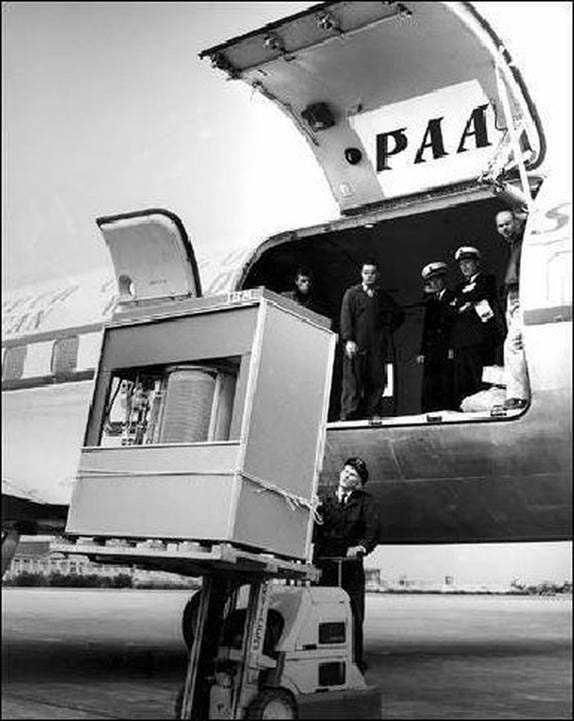
It’s the IBM 350 Disk Storage Unit, the disk drive of IBM’s 305 RAMAC computer. This was the first commercial computer to use a hard disk. The unit weighed about a ton, counting its air compressor, and stored a whopping five million characters — equivalent to approximately 3.75 megabytes by modern reckoning (not gigabytes!). It would take roughly 70 of these units to store the text of the Encyclopaedia Britannica.
Inside the cabinet, fifty aluminum disks, each 24 inches across, were stacked on a single spindle and spun at 1,200 revolutions per minute. Both faces of every disk, 100 surfaces in all, recorded data. Together those disks held the five million characters. The whole cabinet, roughly five by six feet across and about two and a half feet deep, held about as much as a single high-resolution smartphone photo does today. IBM didn’t sell the RAMAC; it leased the complete 305 system for about $3,200 a month (roughly $40,000 in today’s dollars), of which the disk unit accounted for $750.
Two trends explain where things went from there. Moore’s law, named for Intel co-founder Gordon Moore, derives from his observation in 1965 (revised in 1975) that the number of transistors that can be placed on a chip doubles roughly every two years. Kryder’s law, named for Seagate’s chief technology officer Mark Kryder, is the parallel observation for hard drives. According to it, the amount of data that can be recorded on a square inch of disk surface also doubles every couple of years, at times even faster than Moore’s law.
Neither Moore’s law nor Kryder’s law is a law of nature. Both track engineering progress, and both have slowed in recent years. But their effects are mutually reinforcing. The IBM 350 recorded about 2,000 bits per square inch. Today’s hard drives record well over a trillion. That is close to a billionfold increase, about thirty doublings in seventy years. Moore’s law, applied to memory chips, tracks what’s happened with flash and solid-state drives. Kryder’s law tracks what’s happened with hard drives.
By 1980, a five-megabyte Seagate hard drive, the ST-506, could sit on your desktop; it cost about $1,500 (nearly $6,500 in today’s dollars). That same year IBM announced the first gigabyte-class disk drive, the 3380, with deliveries beginning in 1981. Holding 2.52 gigabytes, it was a cabinet-sized machine that sold for $81,000 to $142,200. These devices seemed revolutionary by the standards of the 1950s. See here, here, and here.
By 1987, your standard Macintosh computer was coming with 20 megabytes of storage. By 1990, you could swap out those 20 megabytes for a then “large” 100-megabyte hard drive. And by 1996, Macs were coming with one or two gigabytes of storage. So, by the early to mid-1990s, an ordinary desktop hard drive could hold the full text of the Encyclopaedia Britannica; by 1996, it could hold several copies.
Jumping to the present, by 2026 magnetic hard drives reached capacities of 44 terabytes, using heat-assisted magnetic recording (HAMR), while the highest-capacity commercially shipping solid-state drive, Micron’s 6600 ION, offered 245.76 terabytes. In August 2026, DapuStor announced a 512-terabyte SSD, though not yet shipping it commercially. That would handle hundreds of thousands of copies of the Britannica’s text on a single device. The contrast with IBM’s 1956 RAMAC is remarkable: a one-ton system’s storage capacity is now surpassed millions of times by a device a person can hold in one hand. (Here, here, and here.)
Information on hard drives is stored on a two-dimensional surface, so it makes sense to ask how many bits or bytes are stored per square inch, square centimeter, or any other unit of area. Engineers call this areal density.
The areal density of IBM’s 350 came to roughly 250 bytes (2,000 bits) per square inch of magnetic recording surface. Compact discs (or CDs), which became popular beginning in the 1980s, also store information on a two-dimensional recording surface. A standard CD can hold roughly 700 megabytes. Disc storage capacity increased significantly beyond that. A DVD typically holds 4.7 gigabytes and a single-layer Blu-ray disc about 25 gigabytes.
Measured over the whole face of the disc (about 17 square inches, excluding the center hole), a CD holds about 330 million bits per square inch, a DVD about 2.2 billion, and a single-layer Blu-ray disc about 12 billion. Measured over only the ring that actually carries data, from about one inch to about two and a quarter inches from the center (roughly 13.5 square inches), the figures rise to about 420 million, 2.8 billion, and 15 billion bits per square inch. (Here, here, and here.)
DVDs, by using smaller pits and tighter packing of tracks, achieved substantially higher information densities than CDs. Blu-ray took the the packing even tighter. Commercial hard drives, meanwhile, pushed magnetic recording past a trillion bits per square inch, roughly a hundred times the density of a Blu-ray disc.
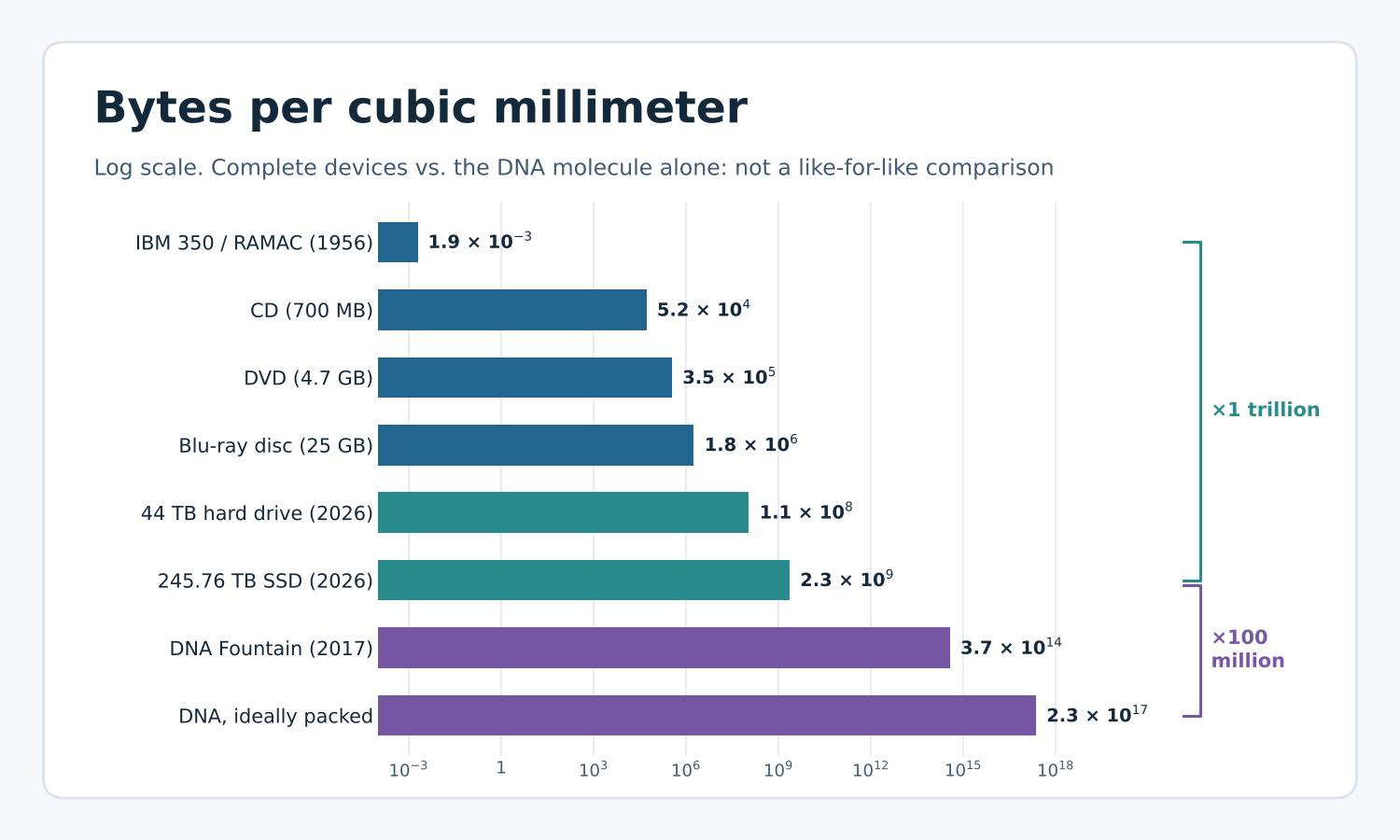
Areal density applies to measuring information in two-dimensional media, such as disks. But it does not apply to chips, much less to molecules. A more helpful metric, used for the rest of this article, is volumetric density: how much information a storage device holds per cubic millimeter of its volume. In the sequel, we will mean by information density the number of distinguishable bits or bytes a medium can store by volume. A cubic millimeter is about the size of a grain of coarse salt. IBM’s 350, with 3.75 megabytes in a cabinet of nearly two cubic meters, thus stored about 0.002 bytes per cubic millimeter. By that measure, it took 500 cubic millimeters to store a single byte (i.e., a cube about 8 millimeters per side). A CD holds about 50,000 bytes per cubic millimeter, and Seagate’s 44-terabyte hard drive about 110 million.
Flash memory, because it’s solid state and allows for three-dimensional stacking, has achieved remarkable information densities. In 2012, memory cells had features measured in tens of nanometers (the pits used to store information on a CD are roughly 500 nanometers wide). But the subsequent revolution has been in stacking cells vertically. By 2025, manufacturers were mass-producing flash chips with more than 300 layers, with some devices holding four bits in each cell. The result is storage capacity strikingly greater than when flash memory first became commercially important.
The densest commercial devices today are solid-state drives built from such chips. Micron’s 245.76-terabyte 6600 ION fits in a standard 2.5-inch U.2 enclosure of about 105 cubic centimeters, which works out to roughly 2.3 billion bytes (2.3 gigabytes) per cubic millimeter, enough for eight or nine copies of the Britannica’s text in every cubic millimeter. Measured this way, the best SSD is about a trillion times denser than IBM’s 1956 disk unit.
Nature Provides Denser Storage with DNA
While all this increase in density of information storage through digital technology is impressive, nature does far better. Cellular life stores its information with extraordinary density. A single copy of the human genome consists of roughly three billion nucleotide base pairs. That is approximately 750 megabytes if each base pair is represented by two bits, and therefore 25 percent less than a gigabyte. This is a measure of raw sequence-storage capacity, not a measure of how much of that sequence is functionally meaningful.
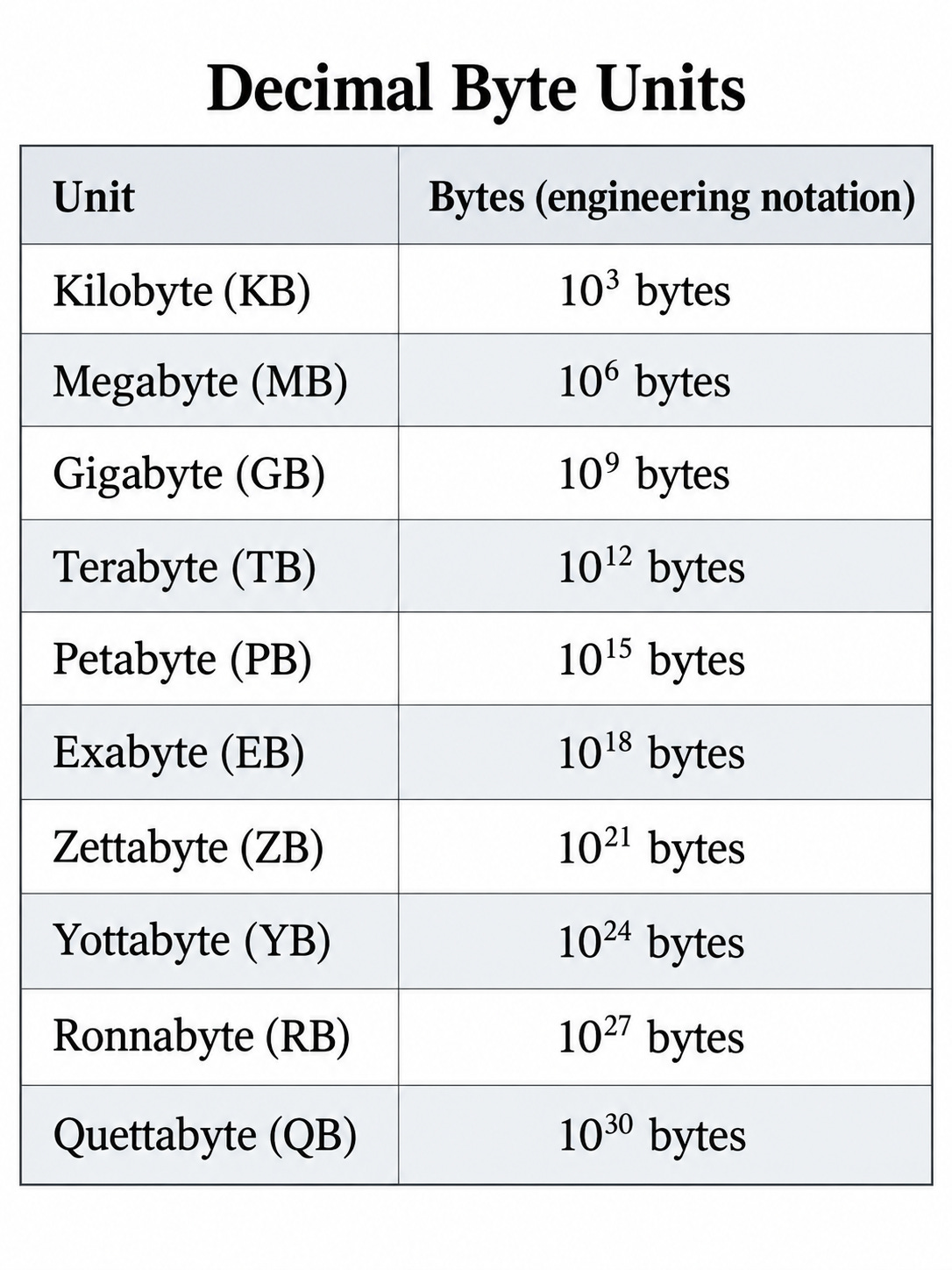
The DNA double helix is about 2 nanometers in diameter and rises approximately 3.4 nanometers with each complete turn, incorporating roughly 10 base pairs per turn. Each base pair therefore occupies about one cubic nanometer and carries two bits. Do the math, and tightly packed DNA has an idealized information density of about 2 × 1017 bytes per cubic millimeter (roughly a quarter of an exabyte). Because one inch is 25.4 millimeters, that works out to around 4 × 1021bytes, or four zettabytes, per cubic inch. By mass, at two bits per base pair and about 650 daltons per base pair, DNA holds roughly 230 exabytes per gram. These are idealized molecular-packing estimates, not capacities of a complete, readable storage device.
The gap between DNA and our best devices is staggering. The best SSD stores about 2.3 × 109bytes per cubic millimeter; ideally packed DNA stores about 2 × 10¹⁷, roughly 100 million times more. A single cubic millimeter of DNA, about the size of a grain of coarse salt, could in principle hold the contents of roughly 1,000 of today’s largest SSDs, or some 850 million copies of the Britannica’s text. But there’s a caveat: the figures for digital storage technologies count everything a working drive needs, while the DNA figure counts only the molecule. This idealized DNA number (2 × 10¹⁷) is therefore an idealized molecular benchmark, not a working capacity.
Working DNA requires more than brute information storage capacity. It also requires writing, indexing, preserving, and reading the information. Scientists are now using synthetic DNA to store digital information. In 2017, researchers demonstrated a method called DNA Fountain at a reported density of 215 petabytes per gram of DNA. Since DNA weighs about 1.7 grams per cubic centimeter, that comes to roughly 4 × 1014 bytes per cubic millimeter: more than 100,000 times the density of the best SSD, though still well short of the idealized figure 2 × 10¹⁷. The 4 × 10¹⁴ figure provides a more meaningful measure of experimentally demonstrated DNA storage than the idealized molecular calculation.
The field continues to make progress. In 2018, researchers at Microsoft and the University of Washington stored more than 200 megabytes in DNA, in 35 distinct files, and showed they could retrieve any one file without reading the whole archive. The bottlenecks now are writing and reading. Synthesizing DNA is still slow and expensive, and reading it back requires sequencing, which takes hours, compared with milliseconds for a hard drive and microseconds for an SSD. DNA will not replace everyday drives. Its promise is archival: extremely dense, long-lived storage for data that must be kept for decades or centuries but is rarely read.
Newer work addresses the writing problem. In 2024, a Chinese research team stored about 275,000 bits without having to synthesize new, customized DNA sequences for each writing operation. Instead, they imprinted chemical marks (methyl groups) onto prefabricated DNA templates, each mark serving as a bit, and read the marks back with nanopore sequencing. Writing remained far slower than conventional media, but the approach sidesteps the costliest step in DNA storage: building each sequence from scratch.
For readers whose eyes may be glazing over with all these large exponentials for measuring DNA storage, let me offer the following observation from Michael Denton’s book Evolution: A Theory in Crisis (p. 334). When I read this book in the 1980s, the following passage about DNA storage leapt out at me. The point it makes is as true today as it was back then, despite the 40 years of technological progress since:
A chemical solution to the problem of information storage has, of course, been solved in living things by exploiting the properties of the long, chain-like DNA polymers in which cells store their hereditary information. It is a superbly economical solution. The capacity of DNA to store information vastly exceeds that of any other known [technological] system; it is so efficient that all the information needed to specify an organism as complex as man weighs less than a few thousand millionths of a gram. The information necessary to specify the design of all the species of organisms which have ever existed on the planet — a number according to George Gaylord Simpson of approximately one thousand million — could be held in a teaspoon and there would still be room left for all the information in every book ever written.
Physics and Feynman’s “Room at the Bottom”
Impressive as the information density of DNA is, physics allows for information storage at a much greater density still. DNA is a complex molecule, and even the nucleotide bases that store genetic information consist of many atoms. Consequently, an encoded bit can depend on many physical parts.
But it is also possible to encode information in atomic and quantum-scale physical systems. Researchers have demonstrated striking ways of manipulating molecular spins and representing quantum states. Quantum mechanics changes what we mean by data storage: the number of mathematical parameters used to specify a quantum state is not the number of independent classical bits one can retrieve from a molecule.
Scientists have for decades explored data storage at the limits of physics. In 1959, physicist Richard Feynman offered a $1,000 prize for anyone who could shrink a page to 1/25,000 of its linear size. Since a page is two-dimensional, such a shrinkage would represent an increase in potential information density by a factor of 625 million, inviting the image of the Encyclopaedia Britannica written on the head of a pin.
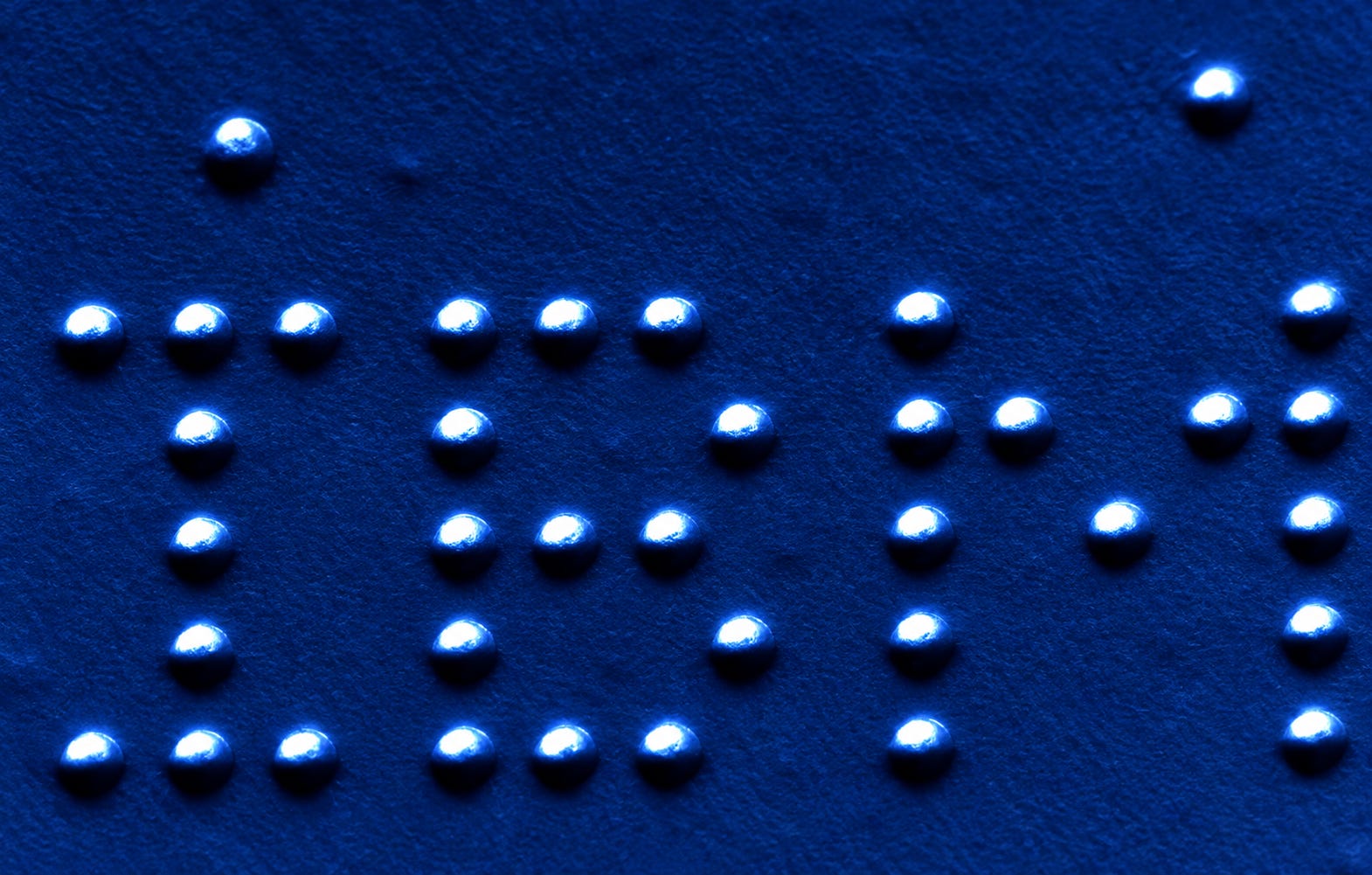
Not until 1985 did Feynman finally have to pay out his prize money. It went to Thomas Newman, a Stanford graduate student in electrical engineering, who used electron-beam lithography to engrave the opening page of Dickens’s A Tale of Two Cities in a square about six micrometers on a side, so small it could be read only with an electron microscope. This record held until 1990, when researchers at IBM arranged 35 xenon atoms to form the IBM logo (reported in Nature in April 1990):
Then, in 2009, researchers at Stanford made an extraordinary improvement on earlier atomic-scale storage results. Using electronic quantum holography, they represented patterns corresponding to tens of encoded bits through electronic quantum states, realizing reported information densities exceeding 20 bits per square nanometer, or roughly 2 × 1013 bits (20 terabits) per square millimeter (compare the 23 × 106 bits, or 23 megabits, per square millimeter of a Blu-ray disc). Rather than relying solely on the positions of individual atoms, they used carefully engineered patterns of electron wavefunctions. One bit per atom was no longer the natural benchmark for the density of an experimental quantum encoding. There was, indeed, more room at the bottom than had been imagined.
But the story did not stop with Stanford. In 2016, researchers at Delft University of Technology built a rewritable atomic memory containing 8,000 bits — approximately one kilobyte — by moving chlorine atoms on a copper surface. The information was encoded in the presence or absence of individual chlorine atoms at designated sites. At 502 terabits per square inch, about 800 gigabits per square millimeter (or 100 gigabytes per square millimeter), this was hundreds of times denser than the best commercial magnetic storage. At that density, the head of a pin (typically 1 to 2 mm across) could hold several hundred copies of the Britannica’s text, far beyond Feynman’s challenge of one. Unlike the Stanford holographic patterns, the bits formed a digital memory that could be read and rewritten, though only in a specialized, low-temperature laboratory setting.
In 2017, IBM researchers pushed classical magnetic information storage to a jaw-dropping limit: one bit in one atom. Working with individual holmium atoms on an insulating magnesium-oxide surface, they showed that the atoms can retain their magnetic states for hours. They could write and read those states independently, including the four possible configurations of a two-atom memory. The experiment offered no practical replacement for ordinary memory chips, but it established that a single atom could function as a stable, individually addressable magnetic bit.
Finally, in 2026, researchers at the University of Tokyo demonstrated another way to operate single-atom magnets. Rather than using electrical current pulses, they read and changed the magnetic orientation of individual holmium atoms using forces between the atom and a magnetic microscope tip. This force-based method suggests a possible route toward low-dissipation atomic memory, though it remains a laboratory demonstration, not a mass-production memory device. The experiments were carried out at 4.5 kelvin in a 3-tesla magnetic field, conditions far from what’s needed in practice for large-scale commercially viable storage.
Such experiments are all concerned with storage, but they focus on different types of systems. The Stanford result concerns exceptionally dense quantum-holographic encoding; Delft exhibited a rewritable atomic array; IBM and the 2026 researchers showed how to write and read stable single-atom magnetic bits. They cannot simply be ranked by “bits per electron” or “bits per atom.” Moreover, because they involve single layers of atoms on a surface, they are measured per unit area rather than per unit volume. Consequently, they cannot be directly compared on the same cubic-millimeter scale as the devices and DNA discussed earlier. They illustrate physical limits and new physical mechanisms, not prototypes ready for mass manufacture. Taken together, however, these results show how far the physical miniaturization of information storage has advanced.
Conclusion
To sum up, in 1956, an IBM disk unit storing only a few megabytes weighed roughly a ton and held about 0.002 bytes per cubic millimeter. By 2026, magnetic hard drives stored tens of terabytes, and solid-state drives could hold hundreds of terabytes, about 2.3 billion bytes per cubic millimeter, and that’s in devices small enough to carry in one hand. That is a trillionfold increase in density. Technological advances here have been impressive.
Nonetheless, these advances seem modest when compared with the information density of DNA, which is roughly 100 million times greater still. That far bigger information storage capacity of DNA makes our commercially available terabyte-scale storage devices seem crude. Indeed, the gap in storage capacity between what cells already achieve and what engineers may yet achieve will be the real practical measure of how much room remains — in Feynman’s sense — at the bottom.
Turning from engineering to physics, experiments in quantum holography, rewritable atomic arrays, and individual magnetic atoms underscore just how much greater the possibilities for miniaturization extend beyond what conventional electronic engineering has achieved. Even so, formidable obstacles exist to turning these laboratory demonstrations into everyday storage technologies. Yet the fact remains that the physical world offers astounding possibilities for storing information, many of which we have only begun to explore.
Feynman was right: there’s plenty of room at the bottom.