






































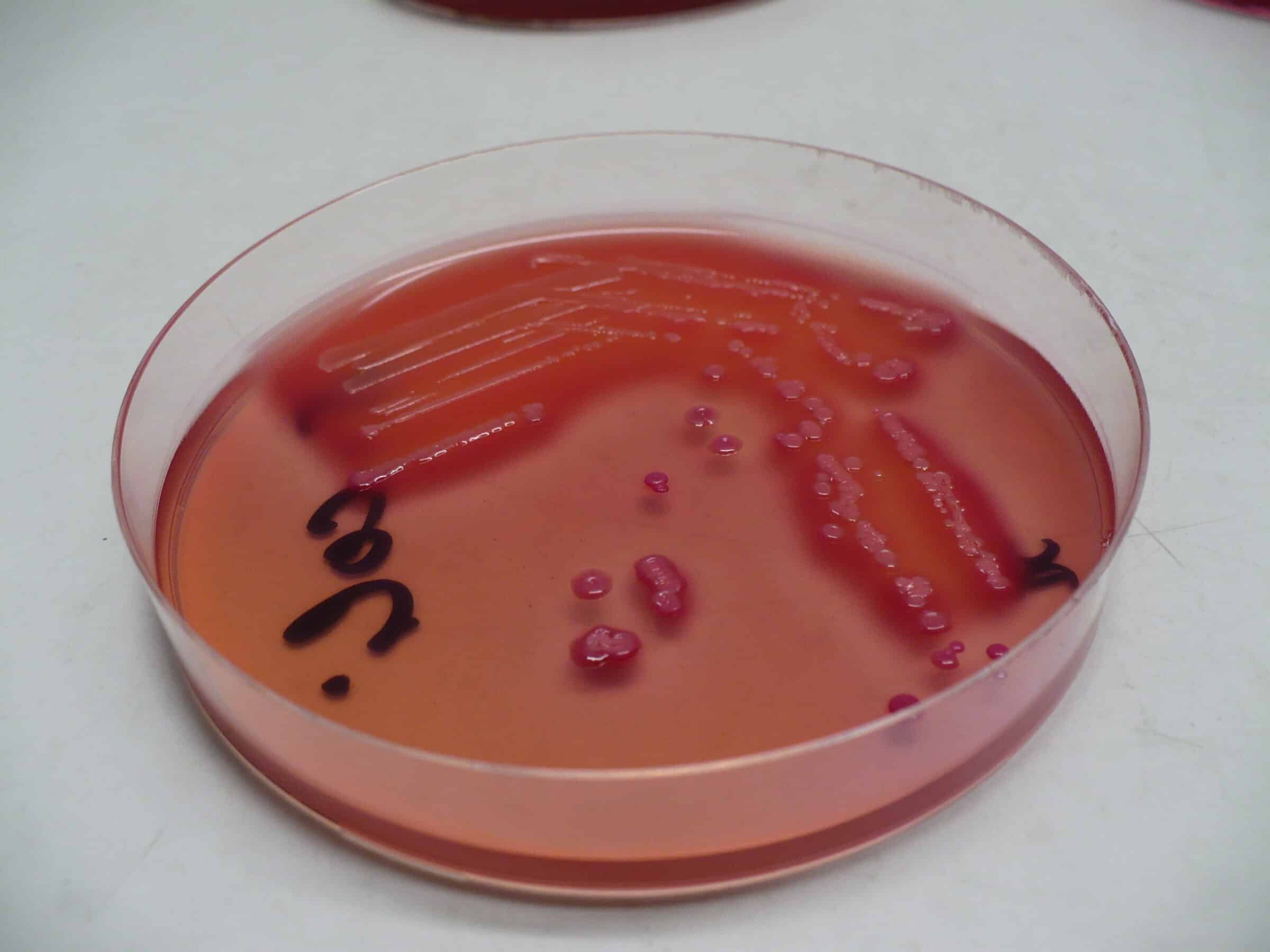
We have been going through Christoph Adami’s book, The Evolution of Biological Information. The last section of his chapter on “Experiments in Evolution” discusses the evolution of E. coli that can live on citrate in the presence of oxygen. Followers of the debate between intelligent design and Darwinian evolution will be familiar with this example, as it was widely trumpeted as a powerful demonstration of the power of evolutionary processes.
Richard Lenski, then at the University of California, Irvine, started a Long Term Evolutionary Experiment in 1988. He’s now at Michigan State. He has allowed a population of E. coli bacteria to grow in flasks in his lab. These bacteria grew in a medium that constrained citrate. This citrate would be an excellent food source for the bacteria, but they cannot absorb it when oxygen is present. Nevertheless, about a decade after the start of the experiment some of the E. coli evolved the ability to consume it.
Everything They Needed
But why couldn’t E. coli absorb the citrate when oxygen is present? They are perfectly capable of absorbing citrate when there is no oxygen. Other bacteria in the same family can absorb it when oxygen is present. So what is the problem? As it turns out, their inability to absorb citrate in the presence of oxygen is primarily due to the fact that the protein needed to pull citrate into the cell is turned off when oxygen is present.
So it’s not that the bacteria need to evolve sophisticated new mechanisms to absorb citrate. The bacteria already had everything they needed. It just was not turned on at the right time. The primary mutation is simply one that causes the already existing gene to be expressed even when oxygen is present.
The Problem with the Story
The story underscores the fundamental problem with Adami’s book. He purports, in his title, to be giving an explanation of The Evolution of Biological Information. His subtitle promises to account for How Evolution Creates Complexity, from Viruses to Brains. But when it comes to actually demonstrating that, he shows evolution uses already existing information in the genome. The bacteria already had all the information needed to utilize citrate, it just had to be turned on.
This is a theme we have seen across the examples of evolution that we have looked at in this book. The evolution of a new organ in Podarcis siculus is almost certainly due to preexisting genetic information. The adaptation of amoebas to higher temperatures is likely largely based on pre-existing information. Computer simulations like Tierra or Avida show success precisely due to external information being injected into the system. Adami explains the evolution of crystallin by borrowing it, already evolved.
Now, he points to the evolution of citrate consumers in a population that already had everything necessary to utilize citrate, it just needed to be turned on. Time and time again, Adami purports to show the origin of biological information, but actually just shows its recycling.