






































Joe Deweese, professor of biochemistry at Freed-Hardeman University and an advocate of intelligent design, is an expert in both the biochemistry and therapeutic targeting of topoisomerases (Murphy et al. 2017).
Topoisomerases are molecular machines that play a critical role in resolving DNA tangles and supercoiling generated during DNA replication. As the DNA double helix is unwound to allow replication, positive supercoils build up ahead of the replication fork. To relieve this torsional stress (and occasionally untangle knots), topoisomerases transiently break one or both strands of the DNA, pass a strand through the break, and then re-ligate the severed strand, resolving the stress (Murphy et al. 2017). To see this happen in real-time, check out this video:
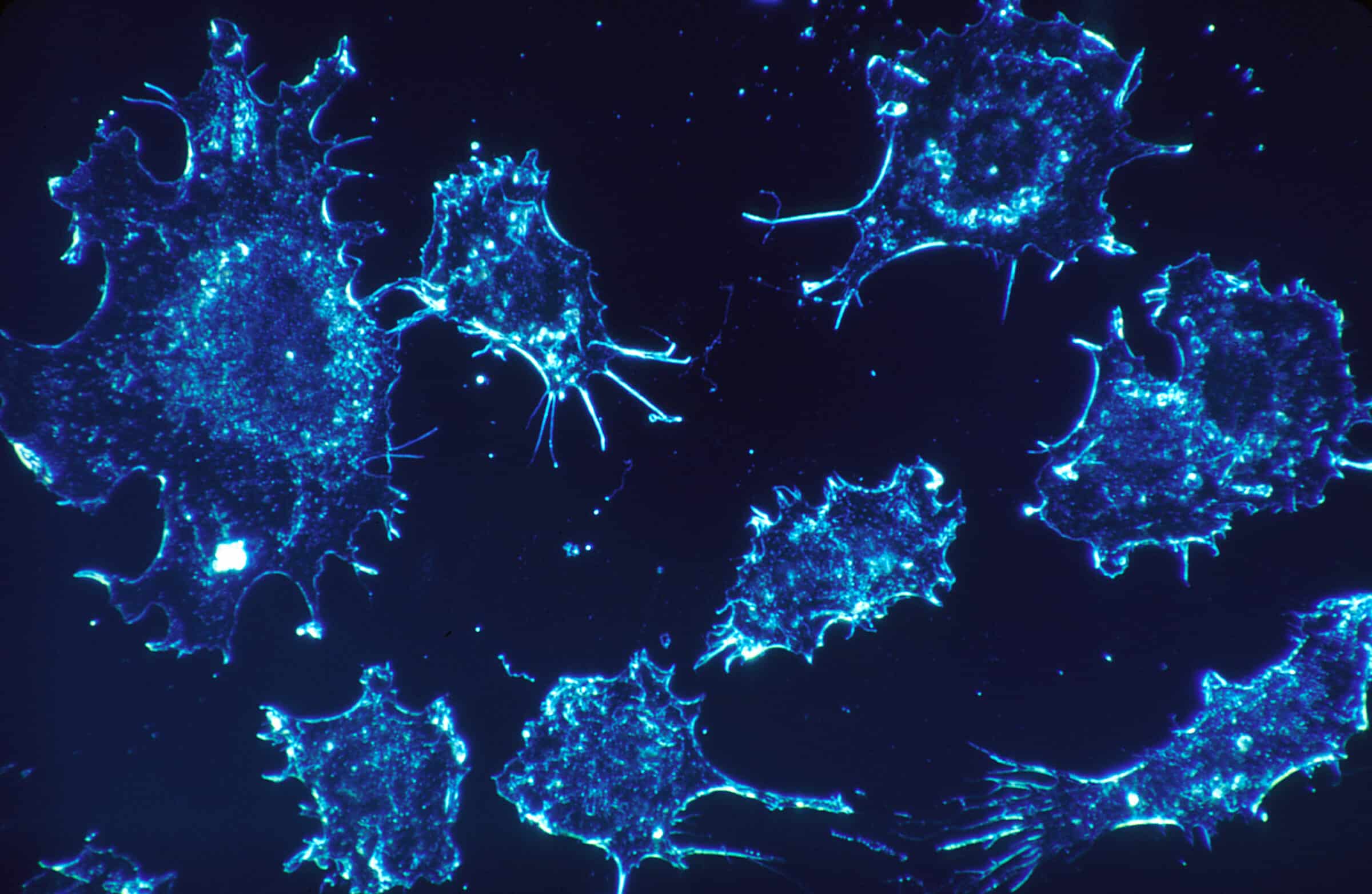
In cancer, uncontrolled cell proliferation drives DNA replication. In this context, poisoning topoisomerases prevents cancer cells from resolving their accumulating positive supercoils, leading to DNA damage that triggers death of the cancer cell via apoptosis. This outcome is beneficial when cancer cells have escaped normal cell- and tissue-level controls and are endangering the organism (Murphy et al. 2017).
How ID Has Facilitated Understanding Topoisomerases
Today I want to examine two ways in which aspects of intelligent design theory have helped facilitate understanding of the topoisomerases. First, we will examine how an intelligent design perspective encourages researchers — such as Joe Deweese — to approach these molecular machines. With ID, unlike Darwinian evolution, the assumption is that every component serves a useful purpose. This perspective motivates deeper investigations into poorly understood aspects of biology, rather than dismissing them as evolutionary leftovers or dead ends. Second, as we will see, application of the concept of irreducible complexity within disease research can help identify drug targets.
Poorly Understood Aspects of Biology
Humans and other vertebrates express two type II topoisomerases, known as topoisomerase II⍺ (TOP2A) and IIβ (TOP2B). Both isoforms play critical roles in our cells. While TOP2B is more important for transcription and regulation of chromatin, TOP2A plays important roles in DNA replication and mitosis. Because of this function, TOP2A has been a major focus of anticancer therapeutics. Unfortunately, very few drug candidates have been found that are selective for TOP2A over TOP2B (Murphy et al. 2017). This is in part because the enzymes are very similar in sequence. However, there is a region that differs significantly between them: the carboxy-terminal domain, or CTD. The CTD not only varies significantly between isoforms, but it is also variable across organisms.
A challenge in studying this portion of TOP2 is due to the fact that this region is intrinsically disordered, which is to say that it does not fold into a regular, ordered structure like most of the rest of TOP2. Experiments in the 1990s demonstrated that this region was not required for catalytic activity, but those experiments were typically run in a purified setting outside of cells. While the CTD can be removed from the purified enzyme and the enzyme still works, loss of the CTD in a cellular context would likely cause major problems with localization and interactions with DNA and proteins.
Some researchers have avoided the CTD because of its lack of sequence conservation and because of other challenges brought on by its innate flexibility and high number of post-translational modifications. Deweese, however, adopted a different approach. Assuming good design of the enzyme and function for this domain, he set out to test whether the CTD plays a role in regulating the enzyme. To that end, he and his research team performed a series of experiments in which he altered selected amino acids within the C-terminal domain and then assessed whether those changes affected the protein’s functions. Importantly, he discovered a role for this domain in regulating enzymatic activity, concluding: “the CTD of TOP2A has a role in regulating enzyme activity and DNA interactions.” (Dougherty et al. 2021) He has followed up on this work by analyzing additional TOP2A mutants combined with bioinformatic data (Endsley et al. 2024; Chang et al. 2025).
Deweese also considered whether post-translational modifications might be affecting the ability of the CTD to fold and he decided to test this computationally using AlphaFold3. Deweese found that AlphaFold predicts that the CTD can fold in the presence of post-translational modifications and DNA (Nartey and Deweese 2025). This research lays the foundation for biochemical experiments to explore whether these computational predictions can be validated. Deweese’s research aims to identify new targeting strategies that could selectively inhibit TOP2A in cancer cells and reduce toxic side effects of TOP2 chemotherapy.
Irreducible Complexity Helps Identify Key Drug Targets
Topoisomerases are essential molecular machines for cellular life; as Deweese’s review notes, “all known life forms encode at least one type I and one type II topoisomerase” (Murphy et al. 2017). This essentiality itself exemplifies irreducible complexity at the cellular level. Irreducible complexity, a term coined by Michael Behe 30 years ago in Darwin’s Black Box, describes systems composed of “several interacting parts that contribute to the basic function, and where the removal of any one of the parts causes the system to effectively cease functioning” (Behe 1996). Such systems could not have arisen through stepwise addition of parts, because multiple components must all be present for a selectable advantage. However, irreducible complexity is also practically useful for identifying drug targets as it focuses on the core components required for minimal system function.
Because topoisomerases are indispensable, they are part of a cell’s irreducibly complex core of molecular machines. Without functional topoisomerases, cells accumulate unresolved DNA entanglements and torsional stress, ultimately leading to cell death. Disrupting an irreducibly complex component of the cell produces local cell system failure (for example, out-of-control DNA supercoiling) that triggers apoptosis. In the context of cancer, this selective elimination of rapidly proliferating cells can protect the larger organism. A clear understanding of irreducible complexity at successive system levels therefore informs which components could be targets for drugs.
Applied to the enzyme itself, the perspective of irreducible complexity helps us consider the core mechanical features that, if broken, halt the entire catalytic cycle. A common mechanism shared by clinically approved topoisomerase poisons is stabilization of the cleaved DNA–topoisomerase intermediate. This traps the enzyme on the DNA, preventing completion of catalysis and converting the topoisomerase into a physical roadblock. Stalled replication forks then collapse into single- and double-strand DNA breaks, triggering cell death (Murphy et al. 2017). Researchers, including Deweese, are actively mapping the precise aspects of topoisomerase function that can be poisoned to achieve this outcome in rapidly dividing cells, which helps us understand how irreducibly complex the enzyme is.
Therefore, by understanding the irreducibly complex core of a cell, one can identify effective drug targets. And by considering the irreducibly complex aspects of an enzyme, one can gain insight into how to poison an enzyme for therapeutic purposes.
Better Science with ID
We’ve looked at two ways that a design perspective can help researchers do better science. Intelligent design can provide justification for studying poorly conserved regions of genes. Additionally, the topoisomerase is (for most cells) part of its irreducibly complex core, which means if it is poisoned, the cell will die. Understanding irreducible complexity can help us think about the core components necessary for a cell to stay alive, which can also have implications for how to eliminate cells that have lost connection with their surrounding tissues.
I’m excited about how intelligent design helps scientists do their work productively, and Deweese has given some incredible examples to look at. Do you have an angle of your research that has been helped by an intelligent design perspective? Write to us and let us know!
Sources
- Behe, Michael J. 1996. Darwins Black Box. Free Press.
- Chang, Jeong Won, Addison K. O’Brian, Allison J. Thomas, et al. 2025. “Mutagenesis of Intrinsically Disordered Domain Impacts Topoisomerase IIα Catalytic Activity.” International Journal of Molecular Sciences 26 (8): 3604.
- Dougherty, Ashley C., Mariam G. Hawaz, Kristine G. Hoang, et al. 2021. “Exploration of the Role of the C-Terminal Domain of Human DNA Topoisomerase IIα in Catalytic Activity.” ACS Omega 6 (40): 25892–903.
- Endsley, Clark E., Kori A. Moore, Thomas D. Townsley, Kirk K. Durston, and Joseph E. Deweese. 2024. “Bioinformatic Analysis of Topoisomerase IIα Reveals Interdomain Interdependencies and Critical C-Terminal Domain Residues.” International Journal of Molecular Sciences 25 (11): 5674.
- Murphy, Matthew B., Susan L. Mercer, and Joseph E. Deweese. 2017. “Inhibitors and Poisons of Mammalian Type II Topoisomerases.” In Advances in Molecular Toxicology. Advances in Molecular Toxicology. Elsevier.
- Nartey, Charisse M., and Joseph E. Deweese. 2025. “Evaluating AlphaFold 3 Folding of the Intrinsically Disordered Human DNA Topoisomerase IIα C-Terminal Domain.” DNA 5 (4): 46.