






































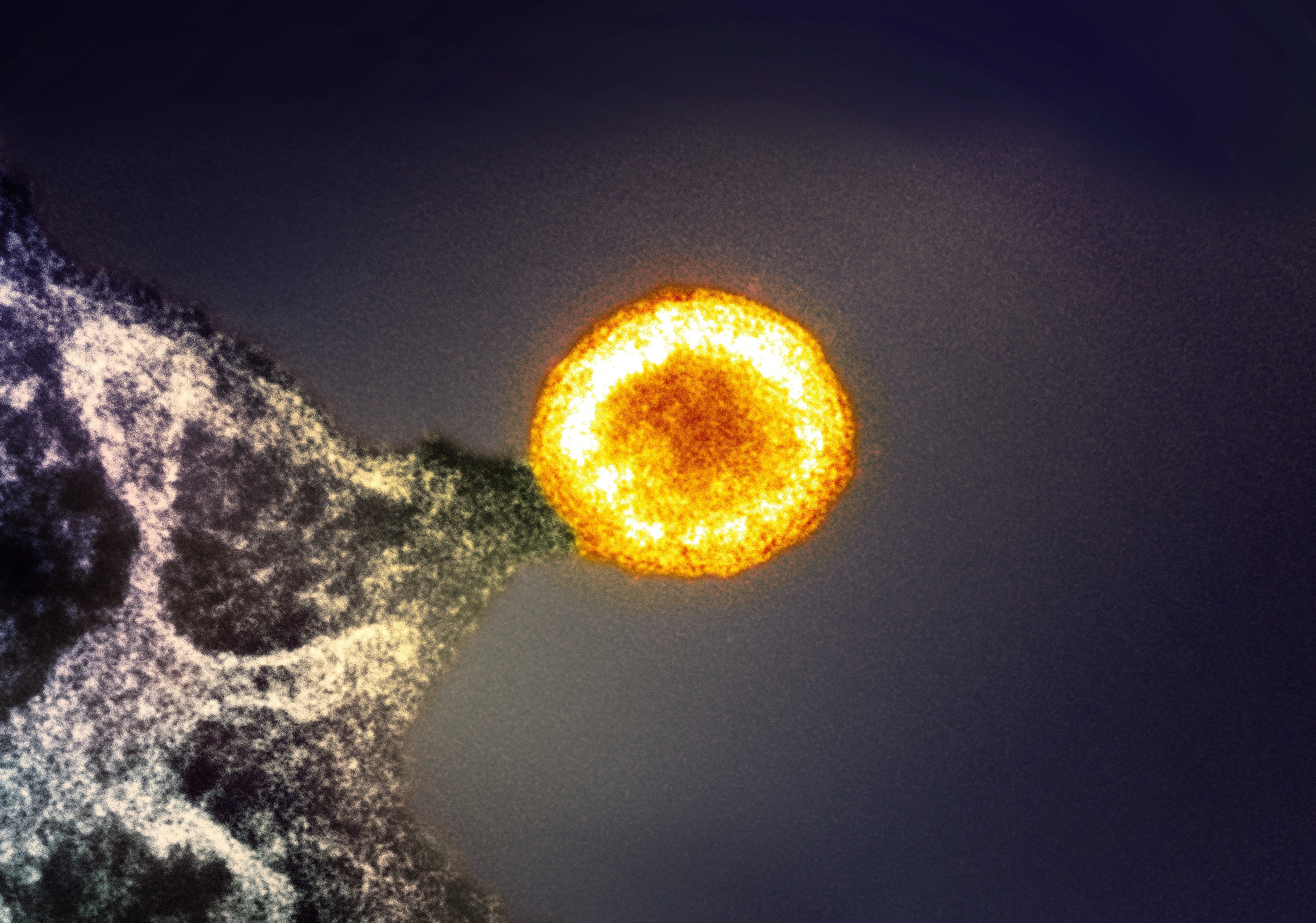
In two previous articles (find the full series here), I revisited YouTuber Dave Farina’s engagement with me on biochemist Michael Behe’s work, noting various substantive issues with Farina’s understanding of the relevant subject matter. In this third installment, I will assess Farina’s discussion of the Vpu protein in HIV-1, which he had previously offered as a counterexample to Behe’s thesis in The Edge of Evolution.
Farina remarks,
Another example I mentioned in the Behe debunk is the VPU protein in HIV-1. It evolved the ability to counteract part of the human immune system that’s different from other apes, a completely new function, without losing its ancestral function.
Factually Accurate, But…
Farina’s representation of this example is factually accurate. However, this adaptation was achieved through minor modification of an existing viral protein (specifically, changes to the transmembrane domain) rather than de novo creation of a new protein. As I noted in a previous article addressing Farina, Vigan and Neil mapped the key changes to specific residues (in particular, A14, W22, and to a lesser extent A18) in the transmembrane domain.1 These residues cluster on one face of the alpha helix and are crucial for tetherin interaction and antagonism. Farina responds,
Jonny attempts damage control here too. First he references a completely different paper which investigates only one region of the protein, instead of the paper I referenced which investigates two regions, specifying that adaptations in both of these regions are required for the novel activity. The paper Jonny pivoted to examines only one of these. Creationist cherry picking at its finest.
However, while changes in both segments of the transmembrane domain do contribute to optimal function, the strongest effects come from the central cluster (especially A14 and W22). Mutations affecting the N-terminal segment have weaker effects and mostly contribute to efficiency rather than being strictly critical. Indeed, beyond the three amino acid modifications I referred to in my previous article (and above), no other residue changes are required for the core tetherin-antagonism function of HIV-1 Vpu.
Farina further comments,
It’s also worth noting that another study looking at a different HIV subgroup, HIV-1N, showed four amino acid substitutions that activated VPU against human tetherin, which are totally different from the ones in the study on HIV-1M. So this example also debunks another classic creationist straw man, the idea that there is only one way to get a particular function. Two different sets of mutations yielding the same novel function in two different subgroups of the virus. Isn’t it lovely when one example debunks two creationist talking points at the same time?
It is true that having multiple combinations that achieve a complex adaptation increases the probability of finding one of them by chance. However, as the number of required co-dependent mutations for a selective benefit to be realized, the probability that there are alternative combinations decreases.
Consider that, for a two-residue interaction, the number of possibilities is 202, or 400. For a 3-residue interaction, the number jumps to 203, or eight thousand. For a 4-residue interaction, the combinatorial space is as high as 204, or 160,000. For a 5-residue interaction, the number of possibilities is 205, or 3.2 million. Unless the number of solutions grows proportionally, the fraction of adaptive combinations drops dramatically.
Farina further states,
After that Jonny decides to whine about how none of it matters and this example doesn’t count, because it’s in viruses which mutate so rapidly. No fair! OK then, moron.
A Limited Grasp of Population Genetics
Farina’s dismissal of this important point suggests that he does not understand the subject of population genetics very well. Viruses such as HIV have enormous effective population sizes, very high mutation rates, and extremely short generation turn-over times. These render multi-mutation effects vastly more probable than in bacteria, let alone multicellular organisms such as animals. If complex adaptations can happen anywhere, they are most likely to occur in viruses. Even this particular case is not especially impressive given the highly optimal conditions for viral evolution relative to higher life-forms.
In the fourth installment in this series, I will appraise Farina’s discussion of bacterial flagella.
- Vigan R, Neil SJ. Determinants of tetherin antagonism in the transmembrane domain of the human immunodeficiency virus type 1 Vpu protein. J Virol. 2010 Dec;84(24):12958-70. doi: 10.1128/JVI.01699-10. Epub 2010 Oct 6. PMID: 20926557; PMCID: PMC3004320. ↩︎