






































Part of mastering technology will be deciding the nature of our relationship with artificial intelligence. And before we can do that, we should know what AI actually is and where it came from. So over a few posts, I have been endeavoring to give you a brief history of thinking machines to help orient and inform you.
I earlier highlighted the Mechanical Turk, a late 18th-century invention that managed to convince many people that thinking machines were possible. The chess-playing automaton was an elaborate hoax, of course, but the story shows that our approach to artificial intelligence has as much to do with our own perceptions and attitudes as with the technology itself.
I continued our brief history with a post about ELIZA, the 1960s chatbot program created by MIT computer scientist Joseph Weizenbaum. ELIZA helps us understand the limits of programmed chatbots, as well as the emotional reactions people can have after conversing with computer programs, however simple or elaborate they may be.
The Case of Ada Lovelace
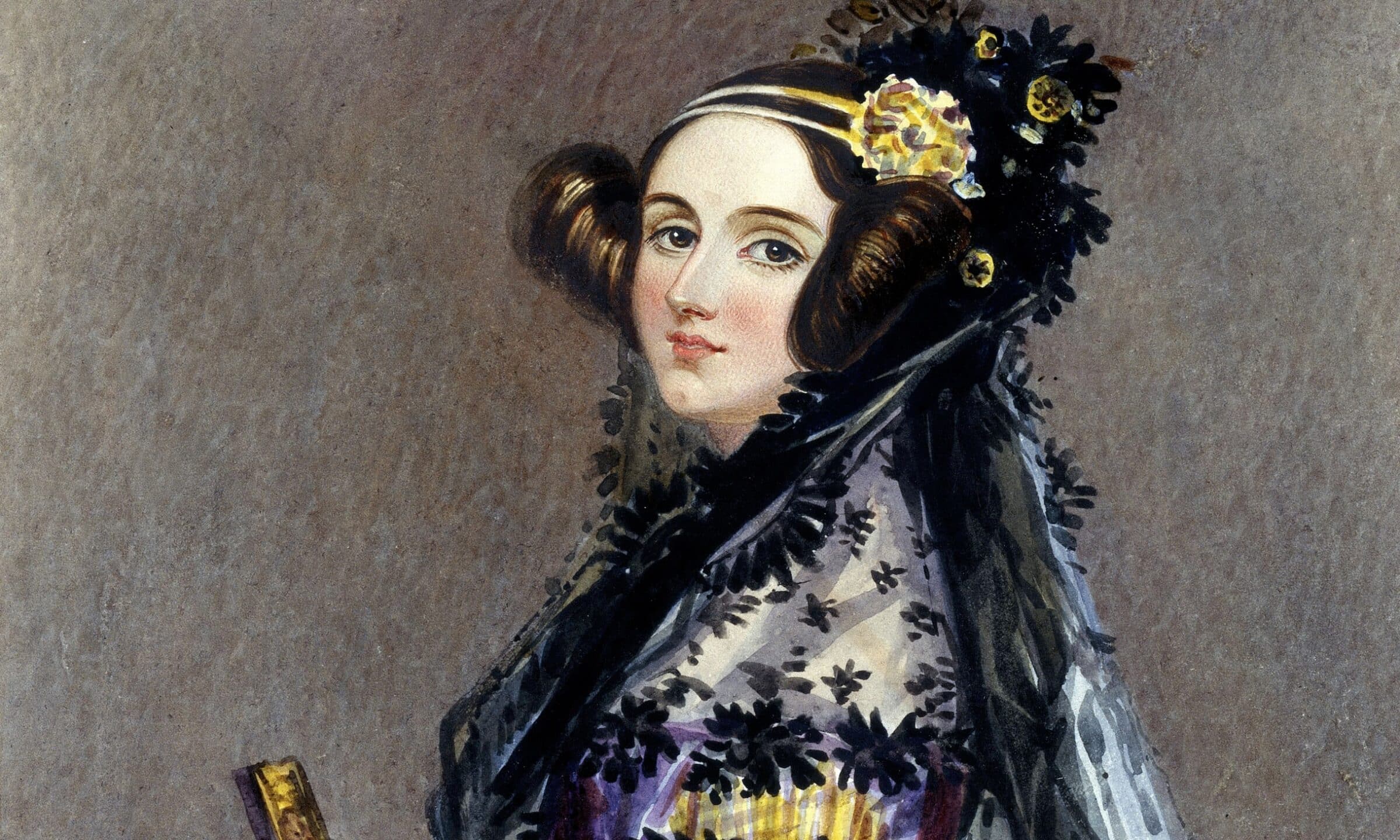
Today, I want to share a few insights from another notable figure in the history of computing and artificial intelligence. Ada Lovelace was born Augusta Ada Byron King in England in 1815, daughter of Lady Byron and the famed British poet George Byron. Lovelace did not know her father, who left soon after her birth and died when she was eight. Her childhood was marked by illness, but she persevered in her studies. Her mother aided her in excelling at the facts of mathematics. But it was the application of Lovelace’s imagination to math and machinery that allowed her genius to shine through. This combination of poetry and science1, bringing together the factual and the conceptual, the empirical and the metaphorical, allowed Lovelace to make a unique contribution to the history of computing.
When she was 18, Lovelace was introduced to English mathematician, philosopher, and engineer Charles Babbage, considered the Father of the Computer for his pioneering work developing the first mechanical computer, the Difference Engine. Inspired by Babbage’s invention and accomplishments, Lovelace began a long working relationship with Babbage. Lovelace married William, Lord King, in 1838 and started a family. She continued to correspond by letter with Babbage, who was working on plans for a second, more advanced calculating engine. By 1840, Lovelace began to formally study mathematics again under the tutelage of Augustus De Morgan, a well-known mathematician of her time.
Her Best-Known Work
A few years later, Lovelace produced the work for which she is best-known today, a translation of Italian military engineer Luigi Menabrea’s description of Babbage’s Analytical Engine. Encouraged by Babbage himself, Lovelace added her own original notes to the translation. The notes, longer than Menabrea’s article itself, provided lucid technical detail on how the Engine worked, explained how it was more sophisticated than the Difference Engine, and hinted at the innovative capability of the machine “for developing and tabulating any function whatever.”
Lovelace was enchanted by Babbage’s machines, for they married the invisible logic of mathematics with visible apparatus. A religious believer, she took great delight in what mathematical truth could reveal about the natural world. In her notes on Babbage’s Analytical Engine, she describes it this way:
Those who thus think on mathematical truth as the instrument through which the weak mind of man can most effectually read his Creator’s works, will regard with especial interest all that can tend to facilitate the translation of its principles into explicit practical forms.
But for all her imagination and optimism, Lovelace was still careful to offer clarity on the limits of such a machine as the Analytical Engine. In Note G, she cautions her readers to put the engine’s powers in perspective:
It is desirable to guard against the possibility of exaggerated ideas that might arise as to the powers of the Analytical Engine. In considering any new subject, there is frequently a tendency, first, to overrate what we find to be already interesting or remarkable; and, secondly, by a sort of natural reaction, to undervalue the true state of the case, when we do discover that our notions have surpassed those that were really tenable.
Lovelace continues:
The Analytical Engine has no pretensions whatever to originate anything. It can do whatever we know how to order it to perform. It can follow analysis; but it has no power of anticipating any analytical relations or truths. Its province is to assist us in making available what we are already acquainted with.
Parallels with Today’s AI
Though Lovelace’s words are almost two hundred years old, I think they can help us understand today’s artificial intelligence. The computers of our age may be vastly more complex than Babbage’s Analytical Engine, but the logic remains very much the same. Today’s computers can calculate and output at incredible rates, but they are still governed by the same limitations as the Analytical Engine; namely, the necessity for programming instructions. Current AI models perform impressive feats of analysis and prediction, but their capabilities are limited by their training data and their programmed parameters and safeguards.
Certain hallmarks of modern computing and AI systems — their automatic operation, their ability to output in patterns we normally associate with intelligence, and the tendency of their results to impress us — might make us willing to think they have crossed the threshold from calculator to originator. But only minds can originate. Machines don’t have minds. As amazing and sophisticated as today’s computers and machines are, they are mindless. They calculate what we originate.
Ahead of Her Time
Lovelace was a woman ahead of her time. Her poetic approach to science, her energetic enthusiasm for learning, and her steadfast belief in the beauty and symmetry of God’s handiwork gave her a rare ability to envision what was not yet there. In her study of the Analytical Engine, she anticipated the capabilities of modern artificial intelligence. For example, she saw that future iterations of Babbage’s engine would be able to tabulate and develop much more than mathematical numbers. Anything that could be expressed through the abstract science of operations could be produced using such a device. As she writes:
Supposing, for instance, that the fundamental relations of pitched sounds in the science of harmony and of musical composition were susceptible of such expression and adaptations, the engine might compose elaborate and scientific pieces of music of any degree of complexity or extent.
No doubt, as a lover of all things mechanical and mathematical, Lovelace would be in awe of our computers and AI models. But I also wonder what she would think of AI-generated music, videos, and text, amalgamations of human-generated work, yet as a whole, not the product of human imagination. Would she consider it a wonder and encourage its use? Or warn against it as a step too far in the relationship between man and machine? One can only guess.
A Beautiful Passage
Lovelace did not live a long life. She died at 36 from cervical cancer. But her work, her correspondence, and her example survive her, and we can be inspired by her still today. I’ll leave you with a beautiful passage from a letter Lovelace wrote in 1841 about the importance of imagination in revealing the truth of the unseen and seen worlds:
Imagination is the Discovering Faculty preeminently. It is that which penetrates into the unseen worlds around us, the worlds of Science. It is that which feels and discovers what is, the REAL which we see not, which exists not for our senses. Those who have learned to walk on the threshold of the unknown worlds, by means of what are commonly termed par excellence the exact sciences, may then with the fair white wings of Imagination hope to soar further into the unexplored amidst which we live not—Mathematical Science shows what is. It is the language of unseen relations between things…Imagination too shows what is, the is that is beyond the senses. Hence…should be especially cultivated by the truly scientific…”
Notes
- Lovelace scholar Betty Toole has written about Lovelace’s “poetical science” and the role her “imaginative rationality” plays in her work. I recommend Toole’s 1987 article. See Toole, Betty. “Poetical Science.” The Byron Journal, Issue 15, Jan 1987, 55-65.
Cross-posted at The Human Adventure.