






































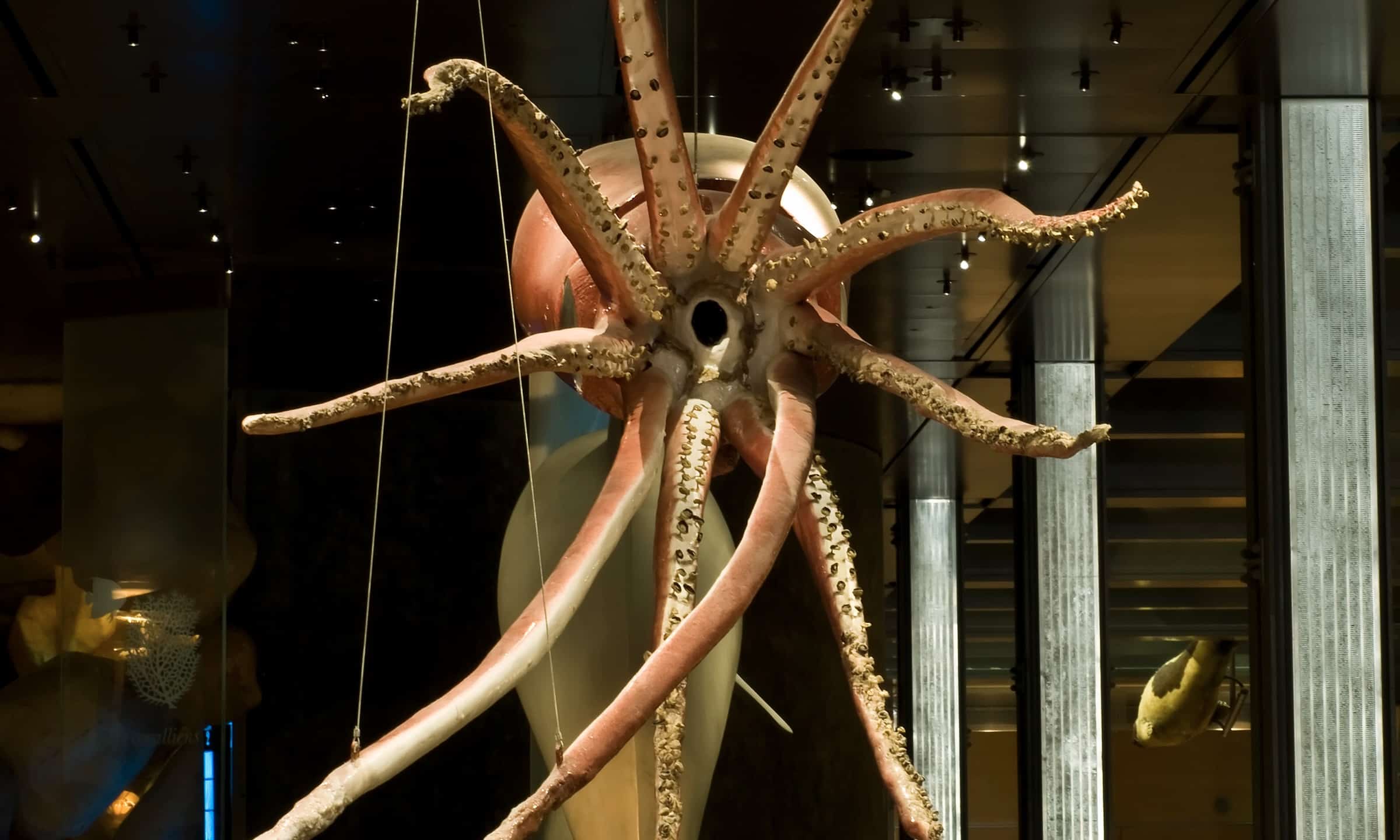
Giants once roamed the earth: super-sized dinosaurs, giraffe-size pterosaurs able to leap into the air and fly, wooly mammoths, massive marine reptiles, in addition to large specimens of familiar creatures (dragonflies, beavers, sloths, bears, lions, armadillos, sharks) that make their modern counterparts look puny. Earth retains some giants, such as blue whales, giant squid, giant sequoia trees, and whale sharks, but almost every phylum of plants and animals had bigger members in the past. The present biosphere seems impoverished by comparison.
In his excellent new book Ultimate Engineering (Discovery Institute Press, 2026), award-winning engineer Dr. Stuart Burgess discusses life at the extremes of the possible. In Part I, he shares details of human body systems that exemplify ultimate engineering and can only be explained by intelligent design. In Part II, he expands the scope of his subjects to other well-designed creatures. Chapters 19 and 20 in particular include a gallery of ultimately engineered creatures that push the limits of the possible in terms of size (both large and small), materials, structures, echolocation, locomotion, coloration, navigation, and habitat. Burgess argues that engineering at these extremes goes beyond mere intelligent design. They suggest an ultimate cause: theistic design.
Giants of the Past
Burgess’s point is best strengthened by examples. Here are some recently reported news stories about giant creatures coming to light from their fossil remains.
- Kraken octopus. That is an octopus that well could have frightened ancient sailors as a sea monster. The only parts of an octopus that fossilize well are made of chitin, the protein comprising insect exoskeletons. These are the beak and radula (teeth) that form the octopus “jaw” for consuming prey. Judging from the size of these parts found in museum collections, researchers estimate some extinct octopuses grew to 10 meters long, possibly up to 19 meters (62 feet), rivaling the giant mosasaurs (marine reptiles) in length. “They could be thought of as the orcas or great white sharks of the invertebrate world — large, intelligent and highly effective apex predators,” said one researcher (New Scientist).
- Giant echidnas. Researchers at Museums Victoria, reporting at Phys.org, found fossil evidence of an echidna estimated to be a meter long, weighing 15 kilograms — 50 percent larger than the biggest living echidnas (the largest monotremes alive today). Last year, National Geographic reported that, based on its tooth size, an extinct platypus, the other monotreme, was three times as big as living ones: up to three feet long.
- Giant dragonflies. “Griffinflies” they are sometimes called: extinct giant flying insects that resemble today’s mayflies, with wingspans of 17 inches, and giant dragonflies with wingspans of 27 inches. Before now, scientists presumed that these giants could only survive if there was about 45 percent more oxygen in the atmosphere than at present. Scientists at Arizona State University are now questioning that explanation, according to an article in Science Daily. If oxygen was not a limiting factor, “researchers must explore other explanations for why insects once grew so large.” However they breathed, these insects must have performed at the limit of the possible.
Burgess explains that large size causes engineering trade-offs. He explains that when size doubles, weight and volume increase up by a factor of eight, but cross-sectional area only goes up by four. This requires larger legs or stronger materials to support the increased weight. Physical laws set limits on how large land animals can be. “And in the case of the largest dinosaurs, it is thought that they are at that limit.”
Marine giants also face trade-offs. Although they can benefit from the buoyancy of water, they must also be engineered for supersizing. Burgess explains that there is a size limit to how large a heart can pump blood to reach all the tissues of a giant marine animal.
Small Wonders
Size is not always an advantage. Engineers must also apply design principles in the art of miniaturization. Consider how these animals thrive despite small size.
- Small migrator. The thrush nightingale is not much bigger than an index finger and weighs only about as much as a letter, Lund University reports. Yet it crosses the Sahara Desert, the Mediterranean Sea, and the Arabian Desert, traveling 18,000 km on its annual round trip migration. Rather than feed on the way, the birds rely entirely on stored resources. And they have another strategy for crossing the deserts: flying at night. “‘This is extreme behaviour. They push themselves several nights in a row and basically shut down completely during the day,’ says Pablo Macías-Torres, researcher at Lund University.”
- Minisaur. Not all dinosaurs were huge. A dinosaur fossil found in Patagonia, a type of alvarezsaur, weighed only two pounds at maturity, reports Science Daily. The size range of dinosaurs is astonishing, yet each species had all the dinosaur parts. Human engineers can make vehicles small (like motorized skateboards) and large (like rocket transporters), but no artificial vehicles can lay eggs and grow copies of themselves.
- Cleaner ants. Remember how small fish clean the teeth of big fish? Something similar happens with ants in the Arizona desert, reports Phys.org. Mark Moffett of the Smithsonian was collecting data on desert ants and found that “tiny ants turn into living hygienists, climbing inside bigger ants’ mandibles and cleaning them.” It was not reported whether the small ants have smaller ants that clean ’em, and so on ad infinitum.
- Tiny wasps. Parasitic wasps of the genus Trichogramma are among the smallest insects in the world — the size of a grain of sand — “yet they play an important role in natural ecosystems and agricultural landscapes as natural antagonists of pest species,” says the University of Regensburg. These minute insects, though, are born with all the insect parts to function. Researchers at the university found that “unimaginably small amounts of the female pheromone are sufficient to attract males and trigger their courtship behaviour.” They’re talking 600 attograms of pheromone: 6×10-16 grams! The males have sensors able to detect this “almost inconceivably small amount” and respond.
Other Animals Living at the Limits
Dr. Burgess mentions other extremes that some organisms thrive at, such as extremes of temperature, pressure, and mobility. Here are some additional examples from the news:
- Dolphin speed. Burgess mentions tunas as the fastest swimmers in the world. They swim up to 45 mph, comparable to a white-tailed deer running on flat ground, even though the density of water is a thousand times greater than air (p. 301). Dolphins are mammals but have similar body shapes. Research at the University of Osaka, reported by Phys.org, shows that a dolphin’s high speed and maneuverability in water is achieved by a hierarchy of vortices generated by the muscular tail fin. An embedded video animation illustrates the vortices.
- Hedgehog hearing. The humble hedgehog, one of Europe’s most familiar and well-loved animals, can hear high-frequency ultrasound. Ecologist Sophie Lund Rasmussen, writing for The Conversation, tells how this ability, also found in bats, requires modifications in the ear: an eardrum fused to the first ossicle bone, a smaller stapes, and a more compact cochlea. These specifications allow the high-frequency vibrations to be transmitted. The limit of human hearing is about 20 kHz. The hedgehog can hear vibrations up to 85 kHz, beyond what dogs and cats can hear.
- Birdsong virtuosity. May 3 is designated “International Dawn Chorus Day,” celebrating the symphony of song produced by birds (here is a sample from central Africa). The diversity of bird calls is truly astonishing, made possible by their vocal apparatus called the syrinx. In his article for The Conversation, Carlos Abrahams, who specializes in ecoacoustics, shares some videos of birds performing. Even more examples are shared by composer Justin Morey in another article at The Conversation, where he compares various bird calls to the music of human composers, some of whom were inspired by specific birds like nightingales.
An Engineer’s View Improves Biology
Ultimate Engineering is a great read. It pioneers a new genre of biological writing that looks at life from an engineer’s perspective. “Modern science claims that biology has two fundamental subjects: chemistry and evolution,” he says, contending that evolutionary theory has not offered substantive explanatory power for biologists. He offers an alternative:
In reality, the two foundational subjects to biology are chemistry and engineering. Biology is full of advanced engineering, and it is thanks to the discipline of engineering that there have been so many recent advances in our understanding of biology.
If biology students were to add some training in engineering principles, he proposes, they would benefit far more in their training than if they took courses in evolution. “To understand animal biomechanics, you have to understand engineering mechanics,” he adds. His own successes in biomimetics prove that to be true. He has not only imitated living systems to construct high-performance machines for aerospace and medicine but has used that experience to understand and appreciate biomechanics, clarifying the ultimate engineering requirements that make their extreme capabilities possible.