






































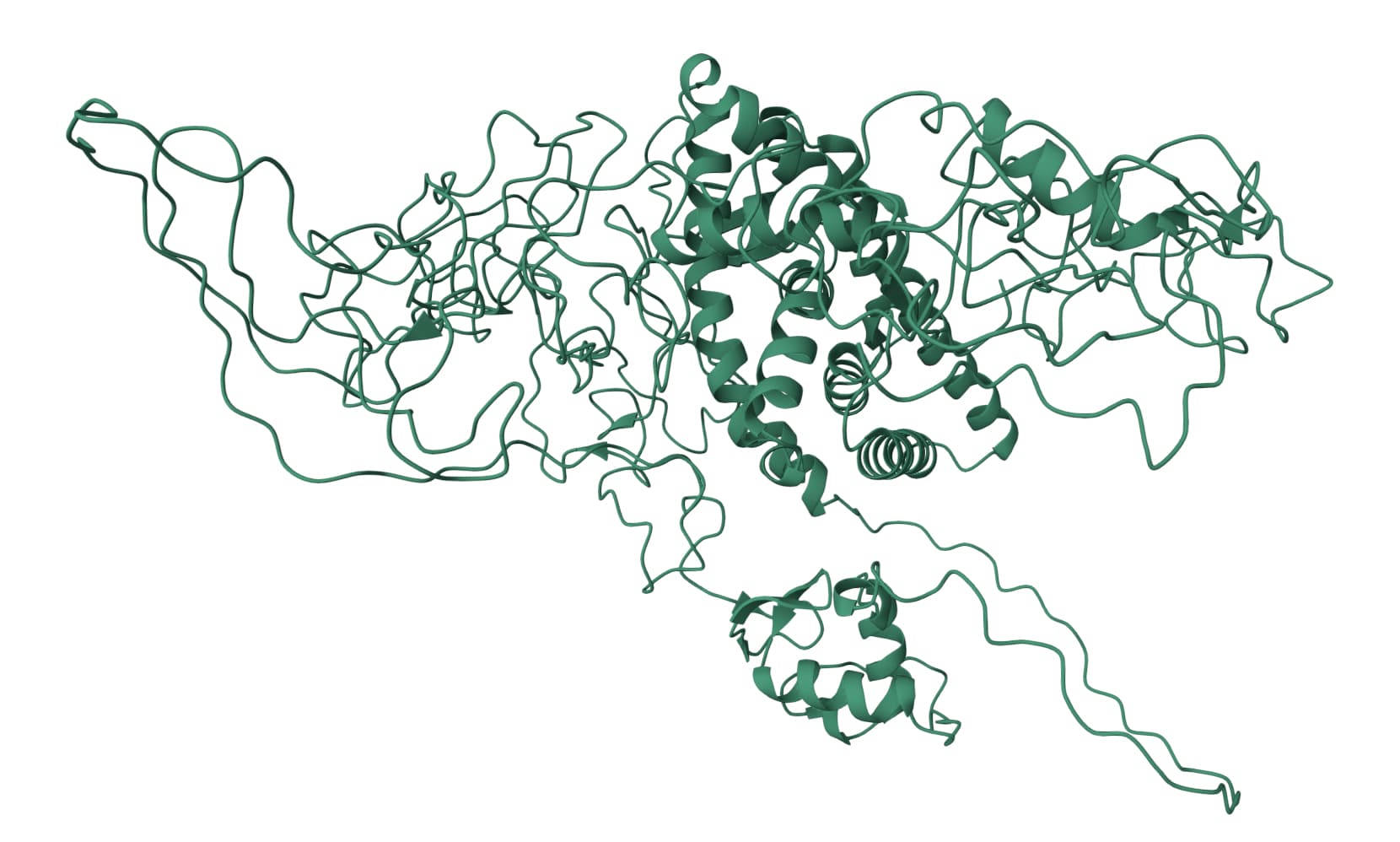
Intrinsically disordered portions of proteins may not be functionless after all. They appear to be multi-functional, says a new study published in PNAS, titled, “A functional map of the human intrinsically disordered proteome.”
Proteins used to be visualized as tightly packed, stable structures. Indeed, AlphaFold in 2018 was one of the first winners of a major grand challenge in biochemistry and genetics: predicting the end state structure of a protein with high accuracy from the sequence of its amino acid residues. For 50 years, the “protein folding problem” appeared too difficult for computation. The Levinthal paradox estimated it would take longer than the age of the universe for random sequences to achieve a functional structure, yet cells fold many proteins in milliseconds.
Overlooked in this success was the mystery of intrinsically disordered proteins (IDPs): polypeptides that do not fold into a stable shape. Because researchers were looking for stable structures, it was more difficult to observe and study flexible polypeptides. Are they mistakes, mere flotsam and jetsam in the cell, getting in the way of the “real” proteins? Some proteins are partly folded with intrinsically disordered regions (IDRs) that, by first appearances, seem to be useless, like threads unraveling on a sweater. This was based on the naïve assumption that only a stable fold could do anything.
Exploring the Frontier
Some functions of IDRs have been coming to light in recent years. Now, the study by a team primarily from the University of Toronto has discovered “a hidden logic of information encoded in disorder”:
Much of the human proteome lacks stable structure and consists of intrinsically disordered regions (IDRs). IDRs have key roles in cellular signaling, gene expression, and cellular organization, but their rapid sequence evolution has made them notoriously difficult to study using standard tools. This work offers insights into human disordered proteins by focusing on conserved bulk molecular features of the sequence rather than positional sequence conservation. By mapping these features across thousands of human IDRs, the study reveals which conserved aspects of disorder contribute to specific protein functions or interaction networks and which are associated with disease-risk genes. This resource charts the hidden logic of information encoded in disorder, a long-standing frontier in proteome science. [Emphasis added.]
The team built on their previous work mapping IDRs from their sequence conservation, during which they found an “unexpectedly large number of functional groups.” The researchers point out that one-third of the human proteome contain IDRs, of which about 5 percent are intrinsically disordered proteins (IDPs).
That the cell works with all this alleged “disorder” hints at a higher order. Discovering a “hidden logic” in that fraction could open a long-standing frontier in proteome science and increase understanding of the proteome’s operations and functions. IDRs seem to “defy the established structure–function paradigm,” but as decades of progress in biochemistry have illustrated repeatedly, there’s more signal in the noise if scientists find where to tune the dial.
Here, we show that evolutionarily conserved molecular features of IDRs enable clustering of the human disordered proteome (IDRome) into a map with strong functional enrichments. We quantify how conserved IDR features correlate with functional terms and, for a subset of terms, provide proteome-wide predictions of annotations for IDRs. Further, we show that conserved features of IDRs can predict protein localization to different biomolecular condensates and underlie elevated intracluster connectivity in condensate-associated IDRs, as well as enrich for short-linear motif-binding domains among interaction partners. We highlight patterns of conservation in disordered proteins with unknown function and in clusters enriched for proteins encoded by disease-risk genes. Our map of the human IDR-ome should be a valuable resource that aids in the discovery of new IDR biology.
“Evolutionarily conserved” means, as usual, unevolved. With that detail clarified, welcome to another “-ome” (a set of similar elements, like a genome or proteome): the “IDR-ome.” It’s exciting to see the functional proteome enlarging to encompass what were previously dismissed as disordered, finding instead new levels of order.
Orderly Processing of Disorder
The research team found evidence of post-translational modifications in the IDR-ome. This indicates that disordered regions are not entirely coded in the DNA:
The functional importance of IDRs and IDPs is increasingly appreciated, especially in the context of biomolecular condensates. More generally, the biological functions of IDRs often relate to protein localization (both subcellular and extracellular), cell signaling interactions modulated by posttranslational modifications, and other aspects of protein regulation.
The posttranslational modifications could occur during splicing, suggesting a role for introns and alternative splicing in their manufacture and targeting. The team identified 20 categories of biological functions wherein IDRs appear to cluster:
Some of the most populated clusters are associated with DNA binding (23%), Chromatin/Chromatin binding (33%), RNA metabolism (22%), Cytoskeleton (12%), Signaling (11%), Transmembrane transport (7%), and Reproduction (7%), which are molecular functions and cellular processes frequently attributed to proteins containing IDRs (e.g., transcription factors, splicing factors, and signaling proteins). We also take note of some less widespread, but significantly overrepresented terms from the IDR-ome-based map, such as those associated with “histone modifications” (4%), “cell morphogenesis” (2%), “innate immune response” (2%), “nuclear pore complex” (1%) and “clathrin binding” (1%).
Since some proteins contain multiple IDRs, this suggests that they do not fit neatly into single functional categories. Do IDRs embed the benefit of increased connectivity with diverse proteins? Are they gregarious multi-taskers instead of loners with only one skill?
Flexibility as a Virtue
Notice that the researchers found an association of IDRs with condensates. (Learn about the discovery of condensates here, here, here, and here.) The authors find that IDRs, thanks to their flexibility, can participate in various short-term interactions within transient molecular gatherings such as condensates, nuclear speckles, and stress granules, and within more stable hubs like the nucleolus. IDRs might even play roles in the physics of phase separation that creates and disperses condensates.
Despite their lack of ordered structural elements, IDRs function in key cellular processes and frequently act as hubs in protein–protein interaction networks, often via transient, multivalent interactions that promote phase separation and involvement in biomolecular condensates.
This is already exciting, but there’s more. As Stephen Iacoboni wrote in March and May 2026, a new paradigm is afoot. There is nothing “disordered” about IDPs and IDRs, he says; they are examples of “active matter” in the cell whose flexibility confers the ability to “respond to the nanosecond demands of the intracellular world.” The unfortunate label “disordered” begins to sound like the discredited “junk” insult conferred on portions of DNA that were misunderstood.
Having now mapped 20,000 human IDRs, the authors “show that combinations of the conserved IDR molecular features correlate with specific protein-level functional annotations and subcellular localizations.”
The map of the human IDR-ome introduced here represents a resource for discovery of functional elements for vast parts of the human proteome that have thus far eluded standard bioinformatic approaches….
Our predictions reflect the rich complexity of IDR-associated functions and support discovery and contrasting of IDR features strongly associated with different IDR functional categories.
This Could Be the Start of Something Big
In keeping with the trend of higher order coming to light as researchers probe deeper into molecular biology, the horizon of discovery is expanding before the eyes of these scientists. Notice these quotations from the paper:
- “More principled segmentation of IDRs that can distinguish between the many types of functional IDRs is an important direction for future work.”
- “The list of relevant molecular features will likely increase in the future, and efforts have already been taken to discover functionally relevant features in a systematic and unbiased way using self-supervised deep learning approaches.”
- “An active area of IDR research focuses on the role of particular IDRs in phase separation and formation of biomolecular condensates. How condensates achieve specificity and why certain proteins localize to certain condensates are key questions.”
The authors presume that evolution has been active in IDRs, but perhaps only in a negative way. They hint that the non-conserved IDRs have been damaged by mutations:
Based on these results, we hypothesize that mutations that disrupt conserved features of IDRs in those clusters are more likely to have a pathological impact, a focus of our future research.
If this is the case, there is no justification for combining discussion of function with disease as they did in the Abstract:
We highlight patterns of conservation in disordered proteins with unknown function and in clusters enriched for proteins encoded by disease-risk genes. Our map of the human IDR-ome should be a valuable resource that aids in the discovery of new IDR biology.
Substitute “original design” for conservation, and “devolution” for proteins encoded by disease-risk genes, and this extracts evolution from the discussion of IDPs and IDRs. In place of using the Darwinian approach, design advocates can envision higher levels of intelligent design at work than could be fathomed under the old Central Dogma. Young scientists may wish to advance the science of so-called “disordered” regions of the proteome and, perhaps while at it, give the concept a more appropriate name.