






































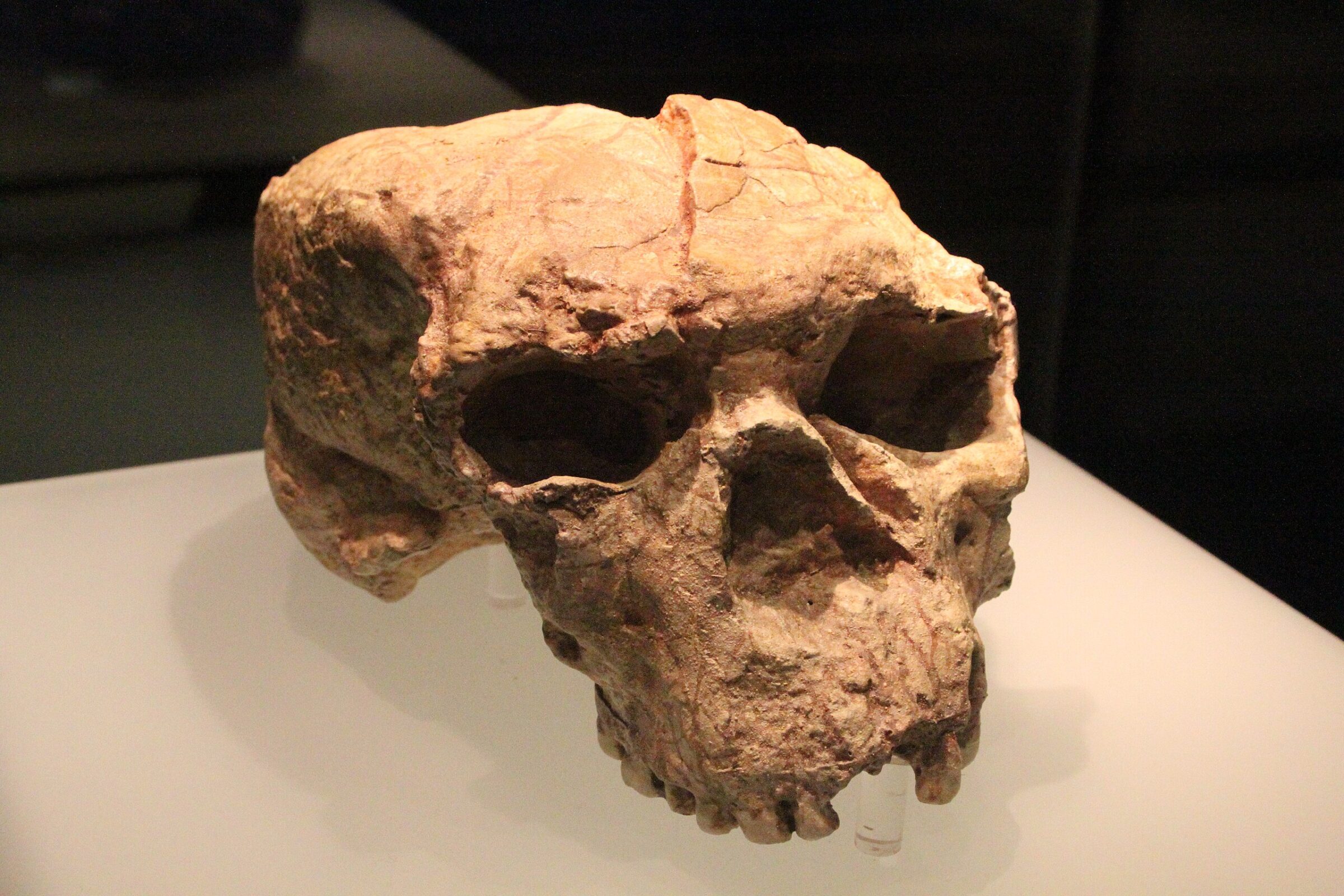
How many times have we been told that some new paleoanthropological find is “rewriting the story of human evolution”? (See here, here, here, or here where we’ve covered such stories in the past.) Well, it seems to be happening again. A new paper in Science, that has spawned news stories from the BBC, Live Science, and elsewhere, presents analyses of two very human-like skulls from China that are said to belong to the species Homo longi. These “Yunxian” skulls are thought to be about a million years old. According to the BBC’s story, “Million-year-old skull rewrites human evolution, scientists claim.” They suggest that “if Yunxian 2 walked the earth a million years ago … early versions of Neanderthal and our own species probably did too.” Live Science puts it this way:
“The Homo longi clade, containing the Denisovans, lasted for over a million years,” study co-author Chris Stringer, a paleoanthropologist at the Natural History Museum in London, told Live Science in an email. “But so did the Neanderthal and sapiens lineages.”
As I’ll explain below, I’m open to the possibility that Homo sapiens is over 1 million years old. I’m certainly not dogmatic about this, and I’m not completely sure if it’s true, but it’s a fascinating possibility we should consider. But right or wrong, their particular claim that our species is over a million years old is based in large part upon an evolutionary chain of reasoning. Their conclusion could be right, but the standard (and dubious) evolutionary assumptions in their reasoning should give us some pause. Perhaps an intelligent design perspective could shed more light on the situation.
Evolutionary Dating Methods
The researchers’ argument goes something like this: These Yunxian skulls are dated to about 1 million years (the geological age is between 0.94 and 1.10 million years), and morphological analysis indicates that the skulls are from a group that is very closely related to Homo sapiens — what the editor’s summary calls a “sister to H. sapiens.” (Please note: Their phylogenetic scheme differs from many previous views which placed Neanderthals as the closer “sister” group to Homo sapiens.)
To determine this close relationship, the researchers looked at various traits in skull specimens from the genus Homo. Then they ran the matrix of traits through a phylogenetic algorithm, which basically groups specimens into clades based upon their degrees of morphological similarity and difference. The main assumptions behind these algorithms are always thoroughly evolutionary. To be more specific, they assume (a) that similarity generally reflects inheritance from a common ancestor, and (b) that greater degrees of similarity equal a closer evolutionary relationship. Their phylogenetic analysis yielded a tree which predicted that a clade they called “Longi” was the sister group to the clade that includes modern humans called “Sapiens.” They then used known ages of the skulls and the degree of difference between the “Sapiens clade” and the “Longi clade” to predict that Homo sapiens branched off from Homo longi around 1.02 million years ago — or 1,019,040 years to be exact (if you buy the precision of their methods!). It’s a date based entirely upon evolutionary reasoning, and it leads them to believe that our species is over 1 million years old.
How does this result square with the fossil record? There are some problems. Clear-cut fossil evidence of Homo sapiens isn’t thought to be much older than about 300,000 years. True, some other very human-like fossils that landed in the “Sapiens clade” date back earlier, but none reach an age of a million years. So the proposed ages of these clades have some discordance with the known fossil record. In such cases, evolutionary scientists just assume that this means there are gaps in the fossil record, and won’t let such gaps get in the way of what their evolutionary reasoning tells them. So they invent ghost lineages as needed to resolve any fossil chronological problems.
More Reasons for Caution
Even if you are willing to accept the evolutionary assumptions here, there’s so much opportunity for homoplasy (i.e., convergent similarities), intraspecies morphological variation, gene-flow between these highly similar groups, and potential for error and ambiguity in the reconstruction of these fossils that I would not put large sums of money on the high degree of dating precision or even the overall tree structure yielded by their phylogenetic analysis. The notion that they purport to date the divergence of you and the Denisovans down to precisely 1,019,040 years (or 1019.04 x 1,000 years if you want to get the significant figures right!) has red flags all over it. Their would-be precision certainly makes me chuckle.
And there are other concerns. According to the technical paper, the skulls were highly deformed — “distorted,” “crushed,” with “fragmentation” and “obvious plastic deformation,” including “twisting, banding, or flatting of a curved surface when subjected to continuous force or stress.” Yunxian 2 was less distorted than Yunxian 1, but even then it had “small fractures and displacement of large fragments.” To appreciate what they look like, look at two public domain photos from Wikipedia. One appears at the top of this article. It is Yunxian 2. Below is Yunxian 1:
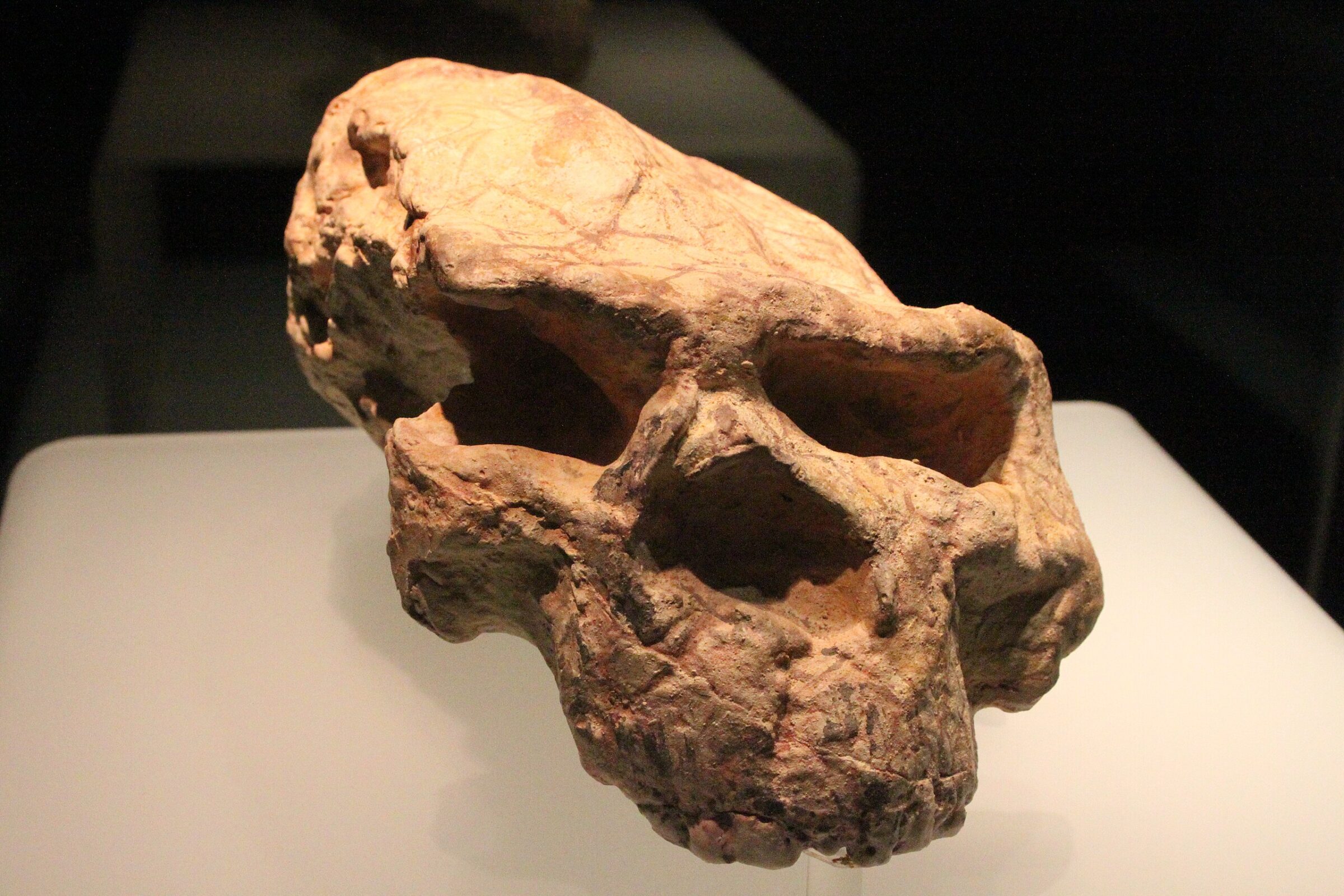 Photo source: Wikimedia Commons.
The paper even states that the poor state of skulls can be a problem:
Our understanding of human evolution is largely based on fossil cranial specimens, but many of these are incompletely preserved and/or distorted. Proper reconstruction of these imperfect fossils is therefore critical to studying their phylogenetic relationships.
That’s exactly right — and perhaps their reconstructions are valid. But we need to acknowledge the poor state of these fossils. All that said, the possibility that Homo sapiens is over 1 million years old is very interesting; they still could be right, but don’t ask me to invest large sums of money in the methods they used to reach that conclusion.
A Single Species?
But perhaps there are other ways to reach a similar conclusion that don’t require all the evolutionary reasoning and assumptions. While it’s possible that these Yunxian skulls belong to a species other than our own — it’s also possible that we are all one species, and that these fossils, along with Neanderthals and Sapiens, represent variation within a single grand human species. Even the mainstream scientific view allows for this possibility. Quite a few paleoanthropologists have proposed that humans and Neanderthals were the same species, and undoubtedly the same could be said for humans and this proposed species “Homo longi.” In fact, the opening words of the technical paper acknowledge this point:
Diverse forms of Homo coexisted during the Middle Pleistocene. Whether these fossil humans represent different species or clades is debated.
Of course, some paleoanthropologists (called the “splitters”) see lots of different species, but if the question is “debated” then there are also people who hold the opposite opinion and think they’re all one species (called the “lumpers”). Indeed, the BBC article notes that if Neanderthals, Longi, and Sapiens all “co-existed on the planet for around 800,000 years,” then they may have been “interacting and interbreeding.”
That’s a key claim: According to some common definitions of species, if you interbreed in nature, then you should be considered part of the same species. For example, Google reveals that the Oxford language definition of species is “a group of living organisms consisting of similar individuals capable of exchanging genes or interbreeding.” Under such a standard definition, it’s hard to rule out Sapiens, Neanderthals, and Longi being the same species.
Indeed, I also found it of interest that their phylogenetic analysis (which at heart is just a comparison of similarities and differences) found three closely related clades: the “Neanderthal Clade,” “Longi clade,” and “Sapiens clade.” Within these clades there is great similarity, as the study concludes: “The narrow temporal gap between Yunxian and deeper Longi nodes suggests rapid early diversification of the Longi clade, as in the Sapiens and Neanderthal clades.” Their tree similarly shows narrow temporal gaps in the diversification among the three clades. Practically speaking, the prediction that these groups diverged from one another quickly means they’re morphologically very similar and there is a close relationship between them. This is all highly consistent with the possibility that the members of these three clades are all one species.
What about morphology? The cranial capacities of the two Yunxian skulls are over 1000 cubic centimeters (cc) — 1065 cc and 1143 cc — smaller than average for modern humans but nonetheless within the range of modern human variation. This is common for hominid fossil material from the mid-Pleistocene: it’s usually so similar to our species that it’s hard to definitively say that they aren’t human and that we aren’t all just one big species with a lot of variation. Günter Bechly wrote about this last year in a fantastic review of mid-Pleistocene Homo fossils. He proposed that these may all represent one human species. I very much agree.
An Intelligent Design Perspective
Could an intelligent design perspective simplify the analysis and not require all the dubious evolutionary assumptions? The study’s central finding — that these Yunxian skulls are similar enough to modern humans to place them in a “sister” species — is noteworthy. In other words, they’re very humanlike. It’s very intriguing that we are finding human-like skulls and other specimens going back over a million years.
And that brings us to the key point: If we (Neanderthals, Longi, and Sapiens) are all part of one species — Homo sapiens — then we do see direct fossil evidence of Homo sapiens prior to 1 million years ago, suggesting our species was designed somewhere around that time. I’m not going to pretend we have enough information to put a date as precise as 1,019,040 years on the origin of our species, but I think that’s a good thing. Sometimes when a theory tries to tell you too much that can be a bad sign — one astute paper called this the “illusion of precision.”
A lot more could be said, and I’m hardly going to be dogmatic about the “single species” thesis. At the end of the day, the evidence is sparse for everyone. As I explained in my 2023 paper, “Comparing Contemporary Evangelical Models Regarding Human Origins,” there are multiple viable non-evolutionary options for the origin of humans worth considering. As I said when that paper came out:
At present I’m somewhere between the unique origins design model and the classical old earth creationist model. But I also like elements of the Homo heidelbergensis model — without the evolutionary aspects. I see lots of strengths and weaknesses and I would not say that I’m strongly committed to one particular model. Perhaps in the future I’ll solidify my preference more in one particular direction.
I’m still in mostly the same place, but I’m encouraged by the prospect that the view that these three groups are from a “single species” that originated around 1 million years is highly consistent with the unique origins design model, which is based upon the work of ID theorists Ann Gauger and Ola Hössjer which found that if humanity originated prior to 500,000 years ago then we can easily account for modern genetic human variation. I would also say this view is compatible with William Lane Craig’s Homo heidelbergensis model, although I don’t know if he prefers the idea that humans to go back as far as 1 million years ago.
In any case, intelligent design thus allows us to consider a conclusion very similar to this paper by simply accepting the fossil evidence indicates that all these similar forms represent one single species whose remains date back prior to 1 million years. Even better: intelligent design can consider this conclusion without requiring all of the baggage found in the paper’s dubious evolutionary assumptions and overly precise evolutionary reasoning.