






































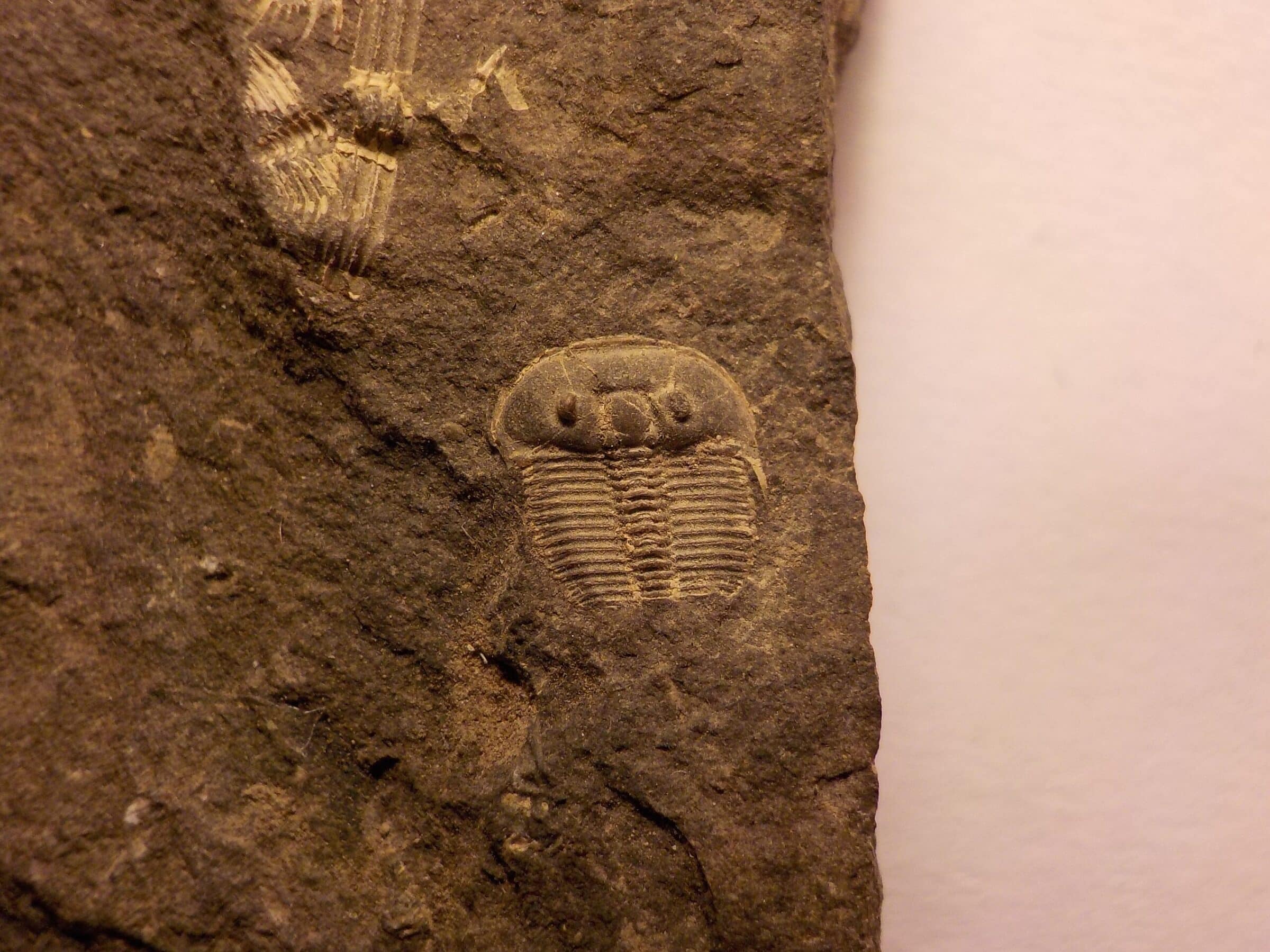
Trilobites, extinct marine animals that first appear in the Cambrian rock layers, glided across ancient ocean floors. Typically, fossilization preserves only their hard exoskeletons, leaving little evidence of delicate structures like sensory organs. However, an exceptionally well-preserved Aulacopleura koninckii, a species of trilobite, revealed a compound eye with striking similarities to those of modern insects and crustaceans.
In a study published in Nature, lead author Brigitte Schoenemann and her team described this trilobite’s eye as a “fully modern” visual system, comparable to those of living bees, dragonflies, and diurnal crustaceans. They state:
We show that this Palaeozoic trilobite in principle was equipped with a fully modern type of visual system, a compound eye comparable to that of living bees, dragonflies and many diurnal crustaceans. It is an example of excellent preservation, and we hope that this manuscript will be a starting point for more research work on fossil evidence, and to develop a deeper understanding of the evolution of vision.
A Very Modern Eye
The fossil’s exquisite preservation allowed researchers to identify features of an apposition compound eye, a type found in modern arthropods like shrimp, lobsters, and crickets. The apposition compound eye works by dividing the visual field into thousands of tiny segments, each processed by an ommatidium (ommatidium is one individual structural unit that comprises the compound eye of an arthropod), to create a broad, motion-sensitive mosaic image. Although compound eyes are not understood to have as high of resolution as human eyes, these eyes afford a near-360-degree panoramic view, faster processing of visual changes, and the ability to detect polarized and ultraviolet light in some species. These capabilities enable arthropods to perceive patterns and navigate in ways beyond human vision.
Upon examination of the A. koninckii eye, which had soft tissue structures preserved, the scientists discovered a very modern compound eye. Does this discovery suggest that the principles of compound vision emerged nearly half a billion years ago as the authors concluded? That would imply that such complex visual systems developed within short evolutionary timeframes during the Cambrian period. This rapid emergence challenges current understanding, as evidence for the creative capacity of random mutation and natural selection to produce such intricate structures in a brief window remains limited and debated. The finding of such modern vision hardware in an ancient organism further challenges the standard evolutionary story for the origin of vision.
For more on the Cambrian explosion and its implications, consider reading Darwin’s Doubt.