






































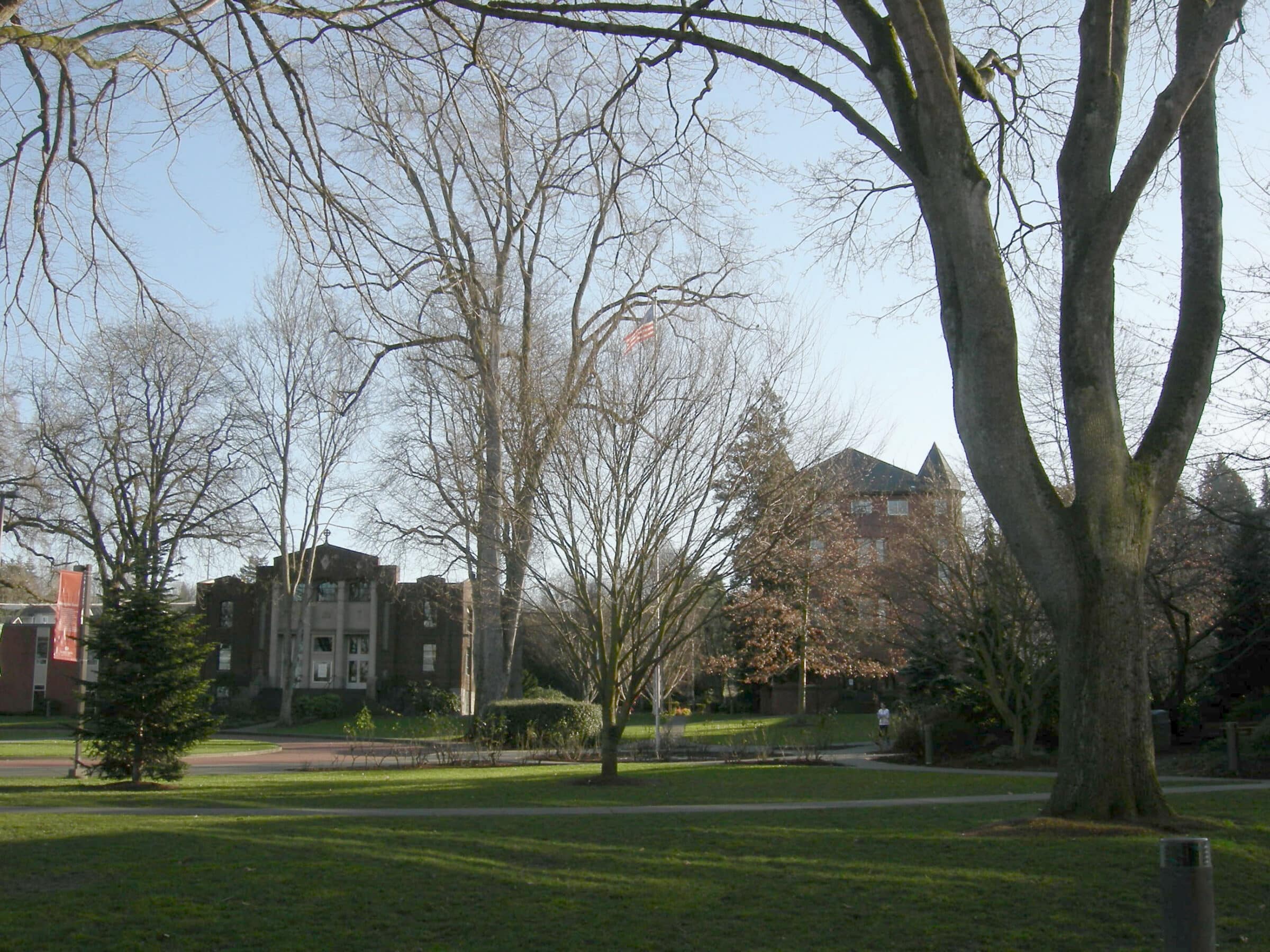
McKinley Hall on the campus of Seattle Pacific University was the site of Discovery Institute’s launch of the Center for Science and Culture, 30 years ago today, August 10, 1996. You can see the building to the left in the photo at the top. Here, you can watch the launch event itself, with co-founders John West and Stephen Meyer, along with Michael Behe and Reed Davis. Yes, the fashion in eyeglass styles has evolved significantly in three decades (for the better, I might add).
Phillip Johnson, advisor to the CSC, delivered the keynote address on “Reason in the Balance.” He was introduced by Discovery founder Bruce Chapman.
At the time, my own oversized eyeglasses and I lived in New York, and so I was not present. I think the most charming thing about the first video is the friendship, characterized by insight as well as humor, it reflects between Dr. West and Dr. Meyer. That remains. Beyond it, I was struck by how the vision of intelligent design that they articulated for the CSC is also unchanged.
Nature, Volume, Depth
What has changed dramatically is the nature, volume, and depth of the scientific evidence that supports ID. In a series of articles this week, Casey Luskin will be sketching some of that evidence that has been coming in, right down to the moment. It’s truly impressive. Remember, little of that was known in 1996. The CSC vision had support, and Behe’s then freshly published book, Darwin’s Black Box, was at the forefront of it. As Luskin wrote here last week, Behe’s case for ID has been vindicated many times over.
But having a vision may mean that you’re willing to articulate it even before every bit of relevant evidence is in. With everything that has happened in the past 30 years, the vision has been factually confirmed. In a way, it’s no longer a vision but simply an objective observation of what reality can tell us about nature.
In the argument about ID, what can we say about the other side? Dr. Luskin also wrote here last week about a brand-new peer-reviewed journal article in Trends in Ecology & Evolution. It addresses what many scientists, in and out of the ID research community, have recognized as the enigma of the Cambrian explosion. Dr. Meyer, in Darwin’s Doubt, and others have argued that that event provides evidence of a designer’s mind in action.
A Stunning Solution
The authors of the Trends in Ecology & Evolution article have another solution to the problem, and it’s a stunner. They argue that the revolution in biological origins was sparked by the accumulation of fecal matter in the Cambrian seas. This is what Luskin calls the Feces Theory of the Cambrian explosion.
Are they trolling us? No! It’s totally serious, and the publication is a respected one. See, “The Cambrian fecal revolution: Fueling the Cambrian Radiation.” One author of the study is affiliated with the American Museum of Natural History in New York, and the other with the State Museum of Natural History Karlsruhe, in Germany.
It tells us something about the desperation of the evolutionists — who, in trying to explain the Cambrian event without reference to purpose or design, previously leaned on the hardly less absurd Oxygen Theory.
The article was like a little anniversary present to the CSC. For which, we thank you. This is what the debate has become. As Casey Luskin will be detailing shortly, intelligent design has — at least on the merits, if the evidence is lined up neatly to be evaluated — already won this.