






































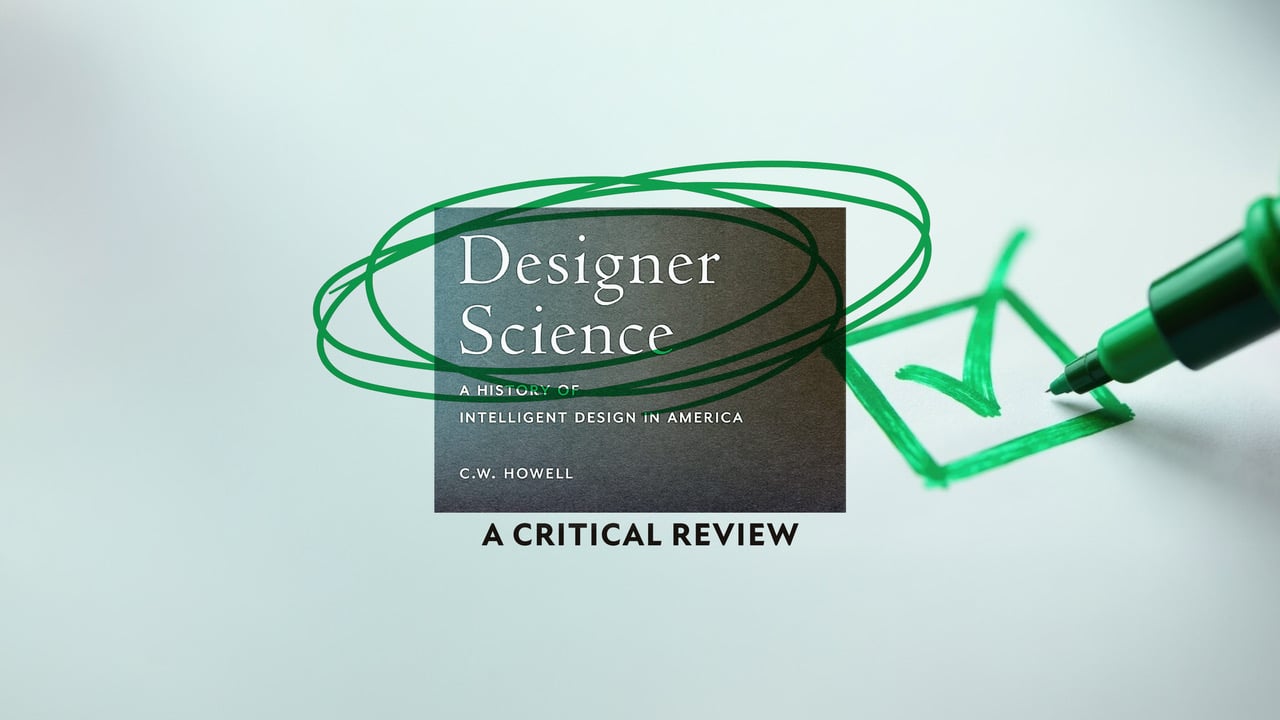
Editor’s note: C. W. Howell’s Designer Science has been pulled by its publisher, NYU Press. See, “Scholarship Hits the Fan: Designer Science Now Gone from Multiple Sites.”
Up till now, my review of Designer Science: A History of Intelligent Design in America, by C. W. Howell, has been critical. (Find the full series here.) But I promised to cover the positive aspects of the book as well, and now I will.
There are some genuine positives that deserve mention. As I’ve already noted, the book is well written and often an enjoyable read. Howell is a very good writer and clearly has done a lot of homework — especially on the first 20 years of ID’s history, even if he missed extremely important aspects of ID’s progress over the past 20 years.
I agree with Doug Groothuis — who ultimately takes a negative view of Designer Science — when he compliments the book as not being a “secular scorched-earth denunciation of ID.” At many points, albeit small ones, you can see Howell trying to be fair.
For example, he frequently tries to provide the ID perspective by letting ID proponents speak for themselves, even if those quotes are also frequently counterbalanced by some naysaying comment from Howell or a critic. You might think that letting the ID view speak for itself would be the norm in histories like this, but it isn’t. I was glad that Howell seems to have quoted me accurately. That may seem like a modest thing to ask, but it’s appreciated.
Positive Aspects of Designer Science
Designer Science has major flaws, but it’s probably the most comprehensive and objective treatment among the anti-ID histories of ID to date. Not that that’s saying much. Some additional positive aspects:
- It acknowledges that ID is different from young earth creationism, not based upon the Bible, and grounded in molecular biology: “ID grew out of the scientific revolutions in molecular biology and targeted well-known scientific problems such as the origin of the first cell. Furthermore, as ID emerged, it abandoned many of the principles that made creationism (at least in it most prominent forms) distinctive — most importantly the young Earth and the global flood from Genesis. ID demoted the Bible as an arbiter of what scientific concepts were permissible to merely a side issue.” (p. 9)
- Howell acknowledges that there was at least some scientific impetus behind the origin of intelligent design. He notes ID arose “partly because of new directions in the fields of biochemistry and molecular biology, and partly because of the ideological differences among its advocates.” (p. 202)
- The book correctly notes that ID proponents span diverse views on common ancestry (p. 2).
- It accurately recounts that Discovery Institute opposed what the Dover School District did (p. 12), noting that Discovery Institute “urged” the Dover school board “not to incorporate ID into the school’s science classes.” (p. 119) He quotes John West as saying “we don’t think intelligent design should be required in public schools.” (p. 121)
- It correctly states that “it would be a mistake to assume, as most critics did, that ID disappeared or died after Dover,” (p. 155) noting that ID is still “active.” (p. 7)
- It provides some likely-accurate psychoanalysis of ID critics, noting that they felt it was “crucial” to try to “establish” ID as “stealth creationism” out of “legal” motivations because they believed that “was the most expedient way to eradicate it [ID] from the US body politic.” (p. 21)
- It includes a couple of nice quotes from me. On p. 180 he cites me as saying that “It’s safe to say that ID proponents were being ‘cancelled’ by critics long before ‘cancel culture’ was widely known as a thing” and on p. 157 quotes me as writing that “Despite what you hear — or don’t hear — from critics (especially those in the media), the past 5 to 10 years have been a boom period for pro-ID scientific research.”
- Though the coverage is overall small, the book does deserve credit for occasionally mentioning that ID has a research program (see, e.g., pp. 4, 160-162, 177). It doesn’t talk about the research program enough, but a couple of accurate points include its noting that one of ID’s earliest goals was to establish “a positive scientific research program” (p. 4) and that “In the post-Dover world, ID — and the Discovery Institute behind it — would divert more resources to articulating a positive vision of design and would attempt to establish a research program based on it.” (p. 155) We can count these as positives, or “near-positives.”
- It also offers a quote from the late historian Ronald Numbers noting that quite a few critics don’t understand ID: “I suspect most people don’t understand what intelligent design is. I’ve talked to enough people who didn’t understand it to make me really suspicious, and there are even people who lecture about it and don’t know what they’re talking about.” (p. 10)
- Lastly, I want to recognize Howell for being willing to remove the fabricated Behe quote from his book after we wrote a letter to NY University Press about it. Though the process that led to the inclusion of this quote in his book reflects some concerningly inaccurate scholarship, his response shows a lot of integrity on his part.
Those are all fine things, but despite these positive qualities, the book is largely stuck in 2005 in the Dover era. In Howell’s mind, ID is still recovering from Dover, and if there’s evidence to the contrary, he doesn’t want to see it. Howell makes his case only by ignoring key trends and numerous innovations in ID over the past 20 years.
This is why I said in Part 1 that Howell’s book has “bimodal quality.” The book gets quite a few things about ID right — especially when we’re talking about the first 20 years of ID’s history up through the Dover case (minus his huge mistake about fake Behe testimony quote). But as fair as that part of his book is, his coverage of the past 20 or so years from 2006 to the present represent highly inaccurate and incomplete scholarship. This is probably unintentional, but it almost feels like Howell tried to be very careful in documenting the first 20 years of ID’s history, only so he could try to get away with being far less accurate when recounting the last 20 years of ID’s history — and leave the reader with his central (and also inaccurate) thesis that ID is a dying movement devoted to attacking the “consensus.” I don’t think he did this on purpose, but given how bad the fake Behe quote was, the Designer Science project is highly problematic.
Near-Positive Aspects of Designer Science
Speaking of his false caricatures of ID, the following sentence is exemplary of the dismissive and demeaning manner in which it treats the ID research program overall:
While there have still been efforts at mainstream, or at least mainstream-like scientific enterprise — in the establishment of journals, the publication of findings, the funding of lab work (as with BioLogic [sic]) — there has been a far stronger strand of defiance, anti-establishment rhetoric, and the denunciation of experts qua experts. (p. 199)
Aside from demeaning the import we place on ID’s research program (something I already covered), it’s astonishingly inaccurate to claim that ID is somehow anti-expert. ID books and papers are constantly affirmatively citing to experts who aren’t in the ID camp, but whose work and words nonetheless support ID arguments. My citation for this point is: just about everything ID has ever written. Pick a page at random from virtually any ID book or read any ID article, and there’s a good chance you’ll find one of us IDers affirming and praising the work of an expert who isn’t part of the ID community. Yes we do disagree with the neo-Darwinian interpretations of many scientists, but that doesn’t make us reflexively anti-expert — especially given the evidence we marshal to support our positions. If you disagree with me, just read anything ID has written.
Compared with earlier histories of ID, Designer Science is ultimately a step in the right direction. But it still has its own agenda, and when that agenda is clearest it’s also where the book’s factual basis is weakest.
The Lessons Learned: Our world is complex, and something can have both good qualities and bad qualities, all at the same time. Let’s not only talk about the bad but also recognize the good, and give credit where credit is due. But everyone probably knew that already. So a more useful lesson here is likely that one should be careful not to be so impressed and happy that something isn’t completely terrible, that one then fails to recognize the serious flaws that remain and need to be corrected.
Tomorrow, “Steady and Consistent Growth: The Real Story of Intelligent Design”