






































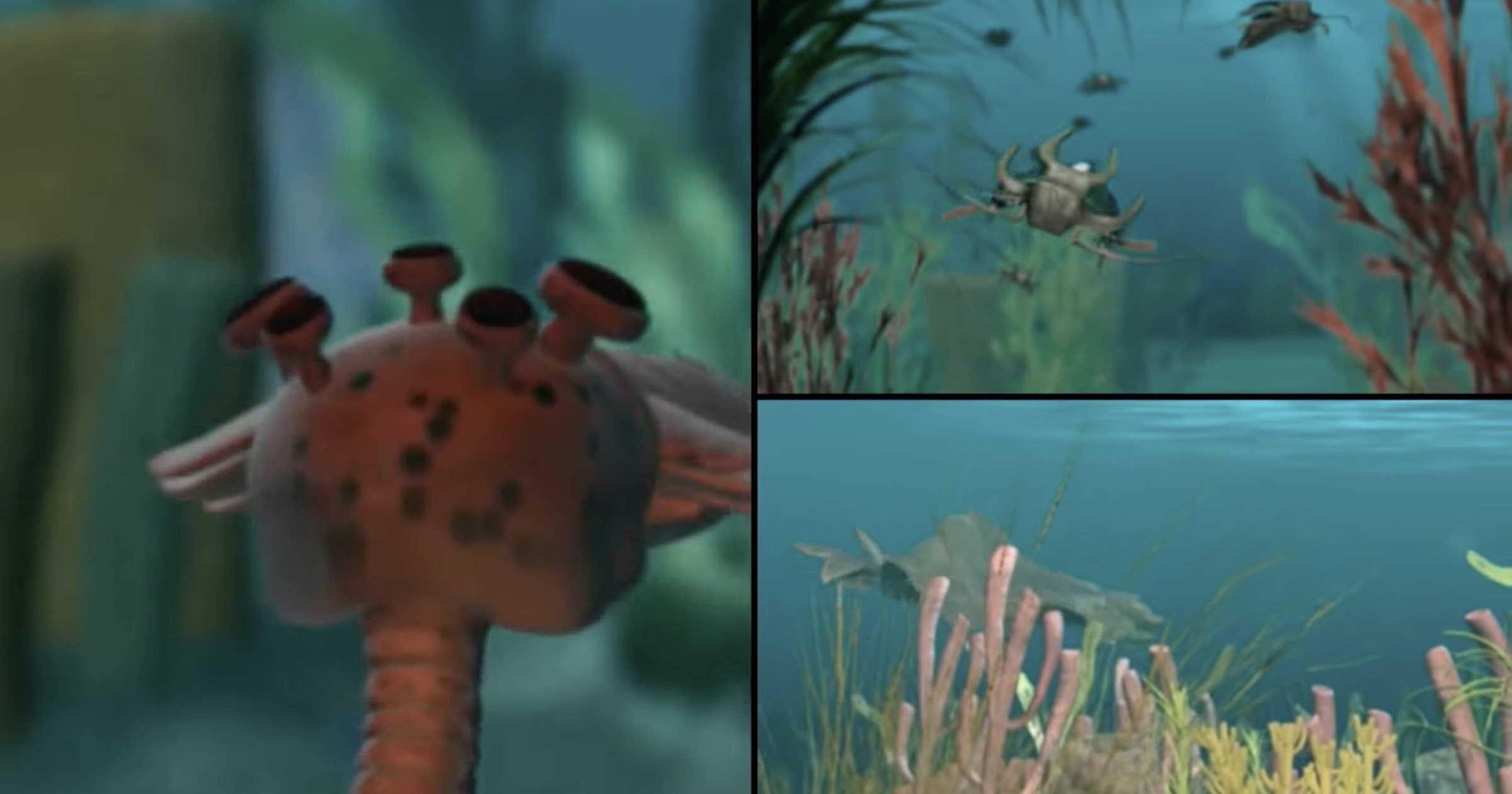
Get ready because this article is going to go a little bit into the sewer. A new paper in Trends in Ecology & Evolution, “The Cambrian fecal revolution: Fueling the Cambrian Radiation,” proposes an unorthodox explanation for why animal diversity exploded during the Cambrian period. If you guessed “poop” then you’re correct. In fact, an article at Gizmodo calls this “The Weirdest Theory Yet for Why Life on Earth Suddenly Exploded” with the subheading “It was all thanks to a lot of poop.” Welcome to The Best of Evolutionary Theory 2026.
The Origin of Feces?
The Gizmodo article continues:
In the first 20 million years of the Cambrian period, Earth experienced an explosion of life — a great evolutionary era dubbed the Cambrian Explosion. Scientists have differing views on what drove this phenomenon, but this one may be the strangest one yet: poop. Literally. Just a [****] ton of poop.
Specifically, a slow accumulation of fecal matter — poop — helped allocate organic material and nutrients throughout the ocean, which in turn made marine environments ripe for the birth and evolution of life. The findings, published yesterday in Trends in Ecology & Evolution, suggest a key connection between the distribution of fossilized feces and the emergence of animals with complex digestive systems.
So now we’re being told that poop caused the Cambrian explosion? Weirdest theory yet, indeed. The technical paper explains the thesis:
Most studies assessing the Cambrian Radiation focus on oxygen levels, biogeochemical cycles, feeding and food webs, predator–prey interactions, or the dynamics of functional feeding groups. The role of feces in early ecosystems is commonly poorly understood. The origin of fecal matter remains one of the most fundamental yet elusive questions in the evolution of animal life. … Complex marine systems can only develop when a combination of temperature, nutrition, and biological drivers are present. Evidently, the ability of nutrients to be moved further from the shelf is central to the expansion of these systems. The rapid acceleration of organism size during the Cambrian Radiation increased coprolite size, which yielded a positive feedback loop, further accelerating the establishment of these ecosystems. It is evident that fecal matter played a much more important role than previously thought, and it is imperative that we move beyond considering coprolites as evidence for predator–prey systems and into a framework that explores their role in accelerating evolutionary innovation and ecological diversity.
What Causes New Genetic Information?
Just as other papers have claimed that oxygen can somehow effectively create massive amounts of new genetic information needed to build new animals during the Cambrian, this paper is proposing that fecal matter can somehow effectively create massive amounts of new genetic information needed to build new animals during the Cambrian. In other words, first the Oxygen Theory, now the Feces Theory. But how much experience do we really have with feces creating new genetic information? The answer is the same as with the answer for oxygen: none.
To parallel what I wrote back in January: High levels of fecal matter in the ocean may be a necessary, but far from a sufficient condition for complex animal life (and their associated ecosystems) to exist. If this is the case, then feces is not the real “trigger” that caused the Cambrian explosion. Fecal matter can do whatever it wants (in a manner of speaking) throughout earth’s history and animals won’t come into existence — until the actual trigger is pulled. Given that (a) thousands of new genes must have arisen to generate the new animal forms that arise in the Cambrian explosion, (b) those new genes represent a huge amount of new genetic information, and (c) information comes from a mind, I think the real trigger behind the Cambrian explosion is something a lot more powerful than merely the presence of increased fecal matter in the ocean.
Interesting Side Comments About Ediacaran Fossils
Despite the weaknesses of the paper, it does make some side observations about Ediacaran fossils that are quite interesting. First, it states that “many of the Ediacaran organisms are problematic to interpret and are of uncertain affinity and paleobiology.” This is a common view, and it runs counter to certain overconfident claims that Ediacaran animals related to the Cambrian animal phyla has been found.
The paper also notes that “there are currently no coprolites [i.e., fossilized fecal matter] known from Proterozoic [in this context meaning ‘late Precambrian’] deposits.” This is an interesting observation, and it certainly contradicts recent claims we’ve seen that some Ediacaran organisms were bilaterian animals with guts (see here or here), or that complex bilaterian animals were “diverse and flourishing” in the Ediacaran. In contrast, this paper notes that Cambrian coprolites are common, which is exactly what one would expect if the Cambrian represents the appearance of the first modern-style animals with “trophic dynamics [that] were broadly similar to those of modern ecosystems,” as the paper puts it.
A Missed Opportunity
In the end, this is an interesting study of what Cambrian coprolites can tell us about the role of fecal matter in Cambrian ecosystems. But if we think that it explains the evolution of Cambrian animal forms, then we’ve drifted from (a) a really cool study giving important and fascinating insights into the nature of Cambrian ecology to (b) typically inadequate evolutionary explanations for the Cambrian explosion that are highly disconnected from reality. I wish the authors had limited their conclusions to the realm of (a) and not felt it was appropriate to apply them to (b), because it would have made for a much stronger and more attractive paper.