






































Transhumanists and other anti-human exceptionalists have been arguing of late that artificial-intelligence machines are destined to become so sophisticated that they will become “self-aware,” and hence, entitled to be considered “persons” deserving of rights akin to those possessed by human beings.
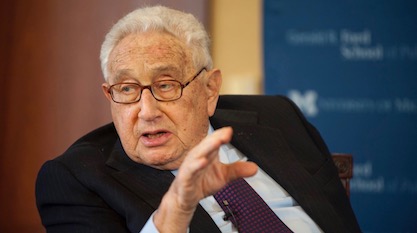
Henry Kissinger effectively demolishes this nonsense in a fine Atlantic essay describing the potentials and perils of A.I., while noting that such very sophisticated computers would still be merely computers — and would not “think.” From, “How the Enlightenment Ends” (my emphasis):
Ultimately, the term artificial intelligence may be a misnomer. To be sure, these machines can solve complex, seemingly abstract problems that had previously yielded only to human cognition.
But what they do uniquely is not thinking as heretofore conceived and experienced. Rather, it is unprecedented memorization and computation.
Because of its inherent superiority in these fields, AI is likely to win any game assigned to it. But for our purposes as humans, the games are not only about winning; they are about thinking. By treating a mathematical process as if it were a thought process, and either trying to mimic that process ourselves or merely accepting the results, we are in danger of losing the capacity that has been the essence of human cognition.
In other words, A.I. machines will remain merely and just that. They will not possess inherent capabilities or capacities except those with which they will be programmed by us, or which they will be able to instill in their own programming based on technology devised by us.
Moreover, unlike us, they will always be two-dimensional things, not actual beings. That means they will be very valuable inventions, worth a heck of a lot of money, no doubt. But they will have no greater inherent moral worth than a toaster.
After all, even Pinocchio remained a mere puppet, just so much wood and magic-conjured animation — until he became a real boy. True, that’s a fairy tale. But so is the notion that a sophisticated computer should ever be considered to be more than a mere object.
Kissinger’s essay goes way beyond the small tidbit I have dealt with here. Read the whole thing. He raises vital concerns that we are well advised to grapple with now while we can still guide the development of this important technology intelligently and with wisdom, rather than having to deal with it all when the cyber-beasts are upon us.
At the very least, as Kissinger notes and to use my parlance, these issues are much too vital to just leave to “the scientists.”
Photo: Henry Kissinger, Gerald R. Ford School of Public Policy, University of Michigan, via Flickr.
Cross-posted at The Corner.