






































Michael Zimmerman of the Darwin-lobbying Clergy Letter Project takes to Huffington Post again to demonstrate that his collective of gullible clergy men and women — or anyway their spokesman — doesn’t understand the debate he seeks to influence or the players in it. In this, Zimmerman succeeds wonderfully.
In a previous HuffPost article he tried to attack Discovery Institute and intelligent design on several imaginary fronts, for being “fundamentalist,” for seeking to redefine science, for promoting an idea out of step with public/religious opinion. Before responding in public, I emailed him to ask what meaning he attached to the term “fundamentalist” — a favorite scare word with Darwinists, depicting a phantom menace and always-under-the-bed boogeyman with, in my own personal experience anyway, no actual referent in the real world of the scientific debate about Darwinian theory. Of course I realize that genuine fundamentalists exist — folks insisting that science reflects their own literal reading of the Biblical text — and they are very useful to Darwinian propaganda efforts. But I don’t work with any of them. Zimmerman never answered me.
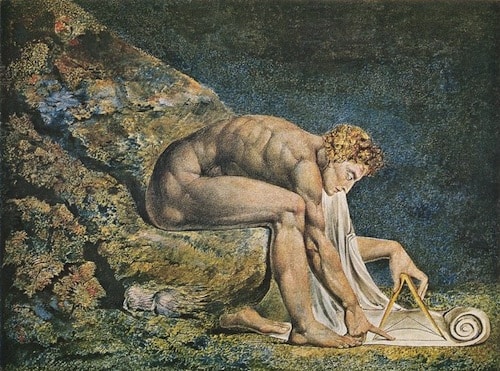
In his current HuffPost contribution, he seeks to make the case that intelligent design proponents such as those affiliated with Discovery Institute want to roll back science as represented by the likes of Isaac Newton. (That’s William Blake’s Newton above.) But as Stephen Meyer shows in Signature in the Cell, Newton himself made design arguments — in the Opticks, for the intelligent design of the eye; in the Principia, for the intelligent design of the planetary system. Newton explained, “[Thus] this most beautiful system of the sun, planets, and comets could only proceed from the counsel and dominion of an intelligent and powerful being.”
Zimmerman writes, “Bacon and Newton and others like them moved us away from superstition and ushered in the modern scientific world.” OK, fine, but it’s precisely a scientific worldview of the kind embodied by Newton — not arbitrarily ruling any scientific explanation out of bounds just because it violates dogmatic materialism but following the evidence where it goes — that intelligent-design proponents seek to reinvigorate.
As for the main point he makes in his original article — that Darwin-doubting puts its proponents in a societal margin occupied by a sliver of fever-swamp “fundamentalists” (whatever that means), an obvious bid to intimidate those gullible clergy with the threat of social embarrassment — I pointed out here at ENV that a view identical with ID represents the solid majority view of Americans whether religious or not. So Zogby polling reveals. To this, Zimmerman also doesn’t respond.
But he wouldn’t, would he. He couldn’t. Everything he thinks he knows about ID was apparently gleaned from skimming the Wikipedia article. The bulk of Darwinian apologetics, a great and futile exercise in shadow boxing, is based on a steady refusal to understand what the other side in the debate actually has to say.