






































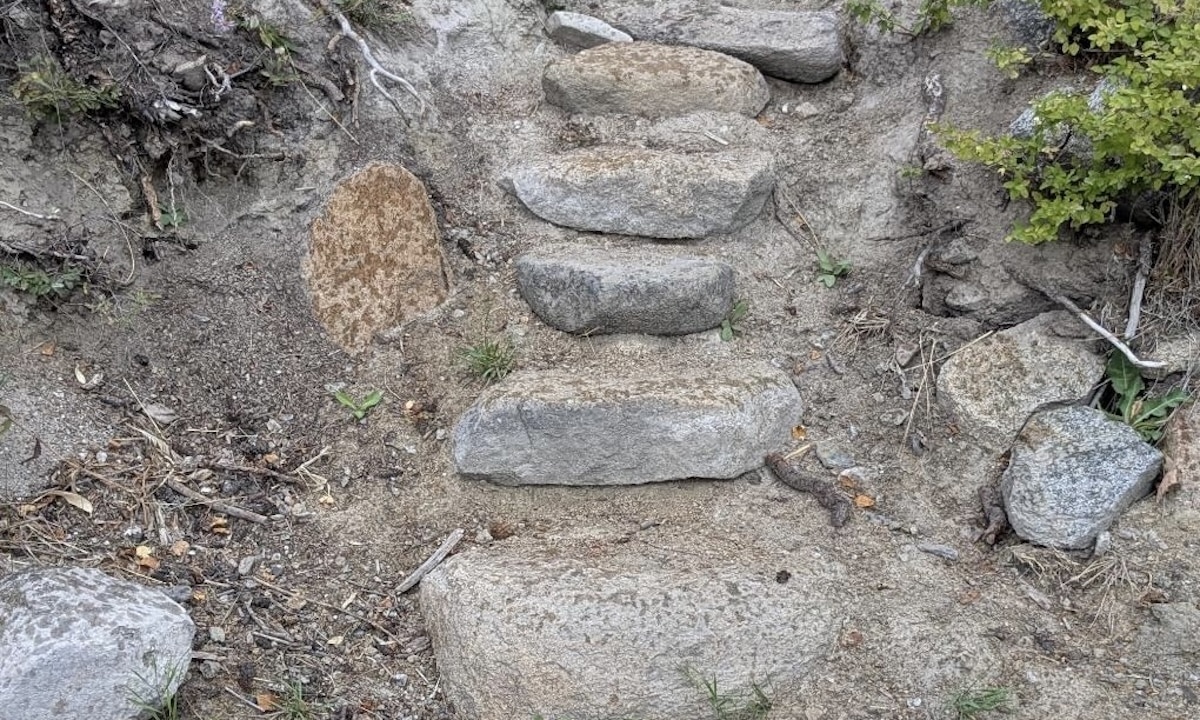
Recently, I was in a boat on a lake, looking for a place to land. As I looked at the shore, I saw a surprising sight: stairs. Larger rocks which would have otherwise been unremarkable had clearly been carefully arranged to form a staircase descending to the lake.
But why exactly was I immediately convinced that someone had deliberately created the staircase? The material for the staircase is unremarkable, being made up of the same dirt and rocks as the surrounding ground. I have no idea about the identity of the stair-maker. I have only a vague idea as to the purpose of building the staircase. But I am nevertheless convinced, as would be anyone who saw it.
A Single Rock
Would I have been so convinced had there only been a single rock placed as a step? Probably not. If a single large rock had been placed between high ground and shore, I probably would have attributed the placement of that rock to random chance. But what exactly is so different about a staircase of one rock versus a staircase of six rocks?
The method of design detection as laid out in the second edition of The Design Inference can help us explain this. A single rock being placed as a staircase is somewhat unlikely. For the sake of argument, let us say it has a chance of one in a million or 106. Following the rough method of calculating laid out in my recent article, we may describe it as a “staircase,” a description with a length of 1 word. Given the roughly 105 possible such descriptions, we end up with a discounted probability of 1 in 10. That is somewhat unlikely, but not so much as to provoke comment.
A Discounted Probability
However, what happens if we apply the same logic to the staircase with six rocks? Each rock has a one in a million chance of being in place. Together all six rocks thus have a probability of 1 in 1036. We can describe this staircase as a “six-step staircase.” That is three words and thus earns a discount of 1 in 1015. But that leaves a discounted probability of 1 in 1021 which is very small.
Of course, I did not actually perform calculations when I saw the staircase. But implicitly, I was reasoning that the staircase was both highly improbable and fit a pattern I was familiar with. That is fundamentally the same everyday insight that the logic of specified complexity seeks to make rigorous.