






































The mathematical plausibility of naturalistic origins-of-life scenarios has been a subject about which many of us in the intelligent design community have written. In a new paper made available last summer on the pre-print arXiv.org, systems biology professor Robert G. Endres, of Imperial College London, sought to place an estimate on the mathematical plausibility of chemical evolution. In particular, Endres focuses on the entropic and informational barriers to forming a viable protocell on the primitive earth, within the roughly half a billion years available. Endres utilizes AI models such as AlphaFold and whole-cell simulations to quantify biological complexity.
Endres concludes that chance alone, together with natural chemical reactions, are inadequate to account for the origins of life within the time available within the half-a-billion-year window. Systems naturally trend towards increased entropy (or disorder) rather than the reverse.
Determining the Available Time-Window
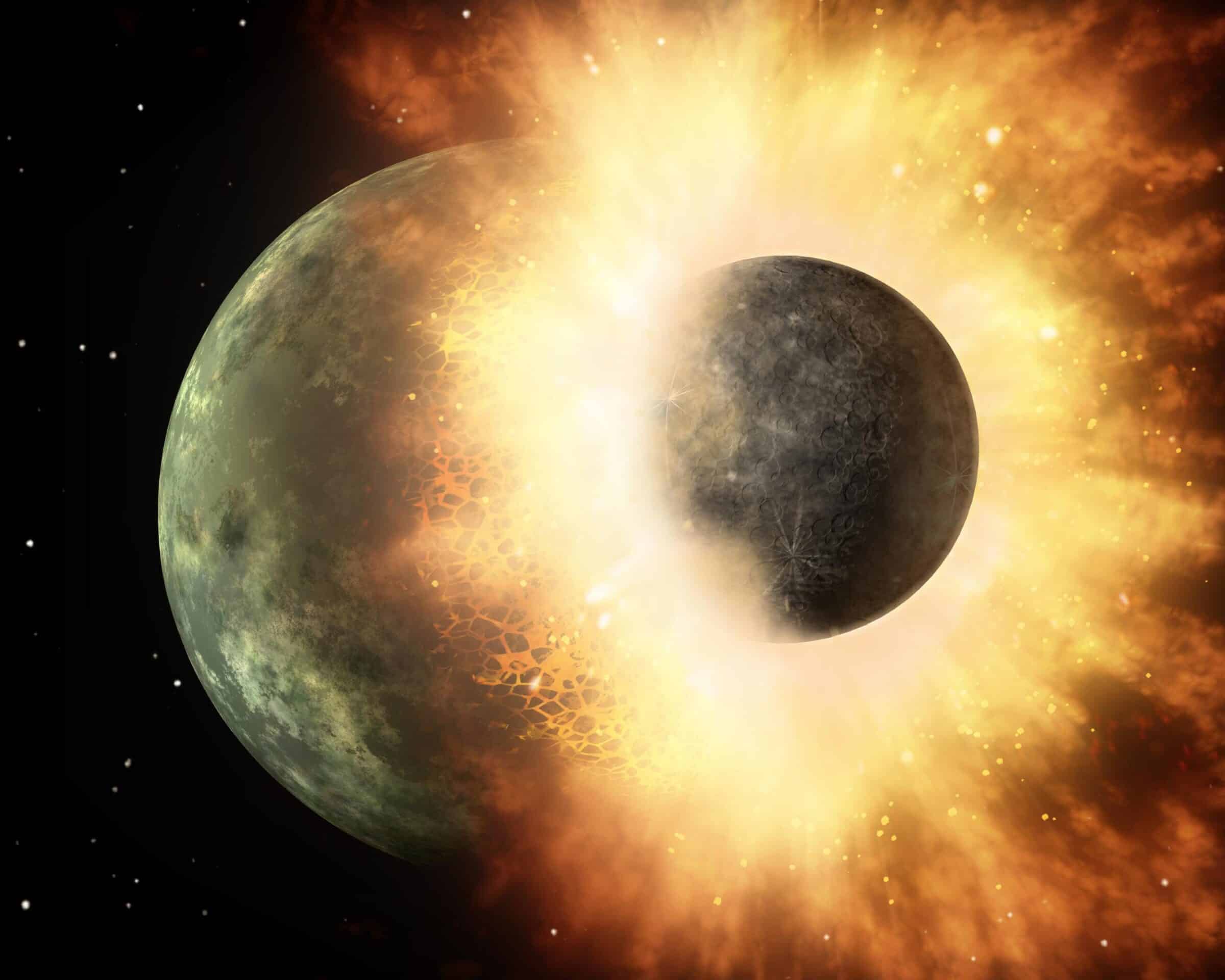
How long did life have to get started? Endres notes that life on earth could not have emerged until after two early global sterilizing impacts — the first was a collision with the Mars-sized body Theia (an artist’s conception may be seen at the top) roughly 4.51 billion years ago, and the second took place approximately 40 million years later. Furthermore, earth apparently already possessed an atmosphere and liquid water by 4.51 billion years ago, as revealed by zircon minerals — necessary prerequisites for life. The earliest incontrovertible evidence of life comes from microfossils dating to around 3.465 billion years ago, in rocks from Western Australia, but there is possible evidence of life as early as 4.1 billion years ago in carbon isotope signatures within zircons (though this evidence is disputed). The paper therefore assumes an available timespan of half a billion years between the initial habitability of our planet and the emergence of the first life.
The Astonishing Complexity of LUCA
Endres notes the astonishing complexity of the last universal common ancestor according to multiple phylostratigraphic analyses:
Surprisingly, LUCA is estimated to have lived around ∼ 4.2 Gy ago, based on calibration with fossil and isotope records. More perplexing still, LUCA appears to have been an anaerobic acetogen, metabolically similar to modern prokaryotes, and already equipped with ATP synthesis, a TCA cycle, early immune capabilities including CRISPR-Cas effector proteins, and embedded within a microbial ecosystem. A recent consensus across eight genomic and proteomic studies broadly supports this view.
It is not, of course, a given that life can get much simpler than this — in fact, the best evidence suggests that this is a picture of a minimally complex cell.
The Implausibility of Chance-Based Origins-of-Life Scenarios
According to Endres, if molecular assembly proceeds randomly and with short persistence (i.e., the average duration over which the chemical system retains directional memory while accumulating biological information, before progress is erased by random fluctuations), the expected time to arrive at the complexity of a protocell is 1017-1024 years, far exceeding the age of the universe by orders of magnitude. Endres concludes, “In other words, without immense persistence, life’s emergence becomes cosmologically implausible, potentially pointing to alternative mechanisms.”
Directed Panspermia?
Endres expresses some sympathy for the idea of directed panspermia, first proposed in 1973 by Francis Crick:
In their scenario, an advanced extraterrestrial civilization, facing extinction or perhaps scientific curiosity, dispatches microbial “starter kits” to habitable planets like ours… While Crick and Orgel attempted to formulate this idea more like a testable hypothesis, it deftly relocates the explanatory burden to someone else’s biochemistry.
Endres further indicates that he considers the idea of directed panspermia to be “a speculative but logically open alternative.” There is, however, no reason to think (and indeed reason to think otherwise) that relocating the explanatory burden to elsewhere in the universe could overcome the tremendous probabilistic barriers to a stochastic origins of life.
Physical Biasing?
Endres argues that, though his mathematical modelling suggests that a purely chance-driven origins of life is extremely unlikely to impossible on realistic timescales, it is still plausible that life could emerge if we suppose that there are physical biases or self-organizing processes that would render the origins-of-life non-random. Law-like processes, however, cannot produce the sort of complex and functionally specific irregularity necessary to generate the informational content required for living organisms.
Take-Away
This paper is useful for showing just how crucial it is, for a naturalistic origins-of-life scenario to work, for there to be some sort of physical biasing that reduces the chance element. But without a viable proposal of what kind of physical biasing could sufficiently reduce the dependence on chance to make life’s origins feasible, the best explanation remains intelligent design. It is no coincidence that origins-of-life models invariably break down at explaining the origins of biological information content — precisely the feature of life that, in every other realm of experience, results from intelligence.