






































In 1943, Warner Brothers released a Soviet film short that in English was titled “The Struggle for Life.” It depicted wild animals — such as bears, wolves, deer, and birds — facing predators, harsh environments, and survival challenges in their natural habitats.
The film’s point was Darwinian. And in fact, the title itself comes from the subtitle of Darwin’s Origin of Species, namely, The Preservation of Favoured Races in the Struggle for Life.
In the years following Darwin, struggle became a dominant theme in western thought. Struggle was seen as a creative force driving progress in biology, society, economics, and war. It was used to justify imperialism, capitalism, racial hierarchies, and eugenics, making competitive struggle the source of innovation and strength.
Chess champion and philosopher Emanuel Lasker took this line in his 1906 book Kampf (rendered Struggle in the 1907 English translation). Hitler’s Mein Kampf, in English translation, kept the original German title, but some English versions rendered the title parenthetically as My Struggle.
The Will to Power
Nietzsche reframed the Darwinian struggle as the will to power, an affirmative creative force where exceptional individuals overcome obstacles to achieve self-mastery, higher values, and cultural vitality.
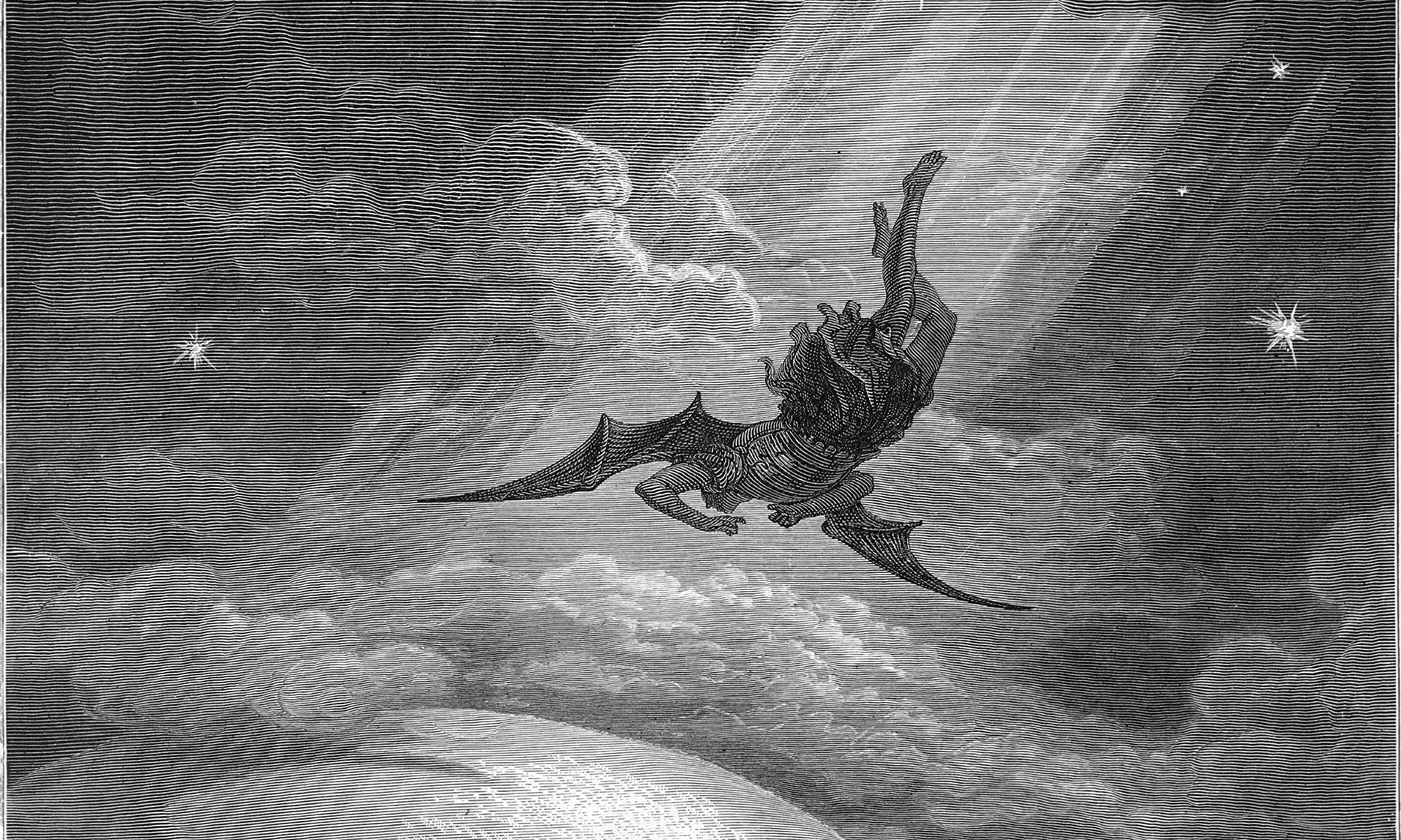
We might therefore say that struggle, by extending natural selection and the competition inherent in it to all spheres of life, became the god of the Darwinian age. It is a god who still holds great sway. In fact, we might say it is the god of this world. Or, to take a hard theological turn, we might say the god of struggle is none other than Satan.
Satan in the Hebrew Old Testament is the word for adversary, often a legal adversary. That is why in the New Testament, Satan is referred to as diabolos, or devil, meaning a slanderer or false accuser. But the root idea in the word Satan is that of opposition, someone who resists your purposes. One Bible scholar I knew preferred to think of Satan as the resister (not to be confused with electronic components that resist electrical current, that is, resistors).
“Resist the devil and he will flee from you,” writes James in his epistle. In light of our brief etymological study, this might be rendered, “Resist the resister and he will flee from you.” Clearly, in resisting the resister, we are engaged in a struggle.
To Steal, Kill, and Destroy
What is the benefit of resisting the resister? Jesus says of himself that he came to give us abundant life, but says of the resister that he comes to steal, kill, and destroy. Struggle with the resister therefore seems something less than a creative force and more a matter of surviving a vicious attack.
Still, if struggle is not the true God, it plays a role in the divine scheme for humanity. With the fall of humanity through sin, life is not one smooth flow where we are carried along from one happy moment to the next. There are struggles. We wrestle, and not just against flesh and blood but against evil spiritual forces.
God uses struggles to test us, to see whether the words we mouth coincide with the state of our hearts. In struggles, we face resistance. And resistance, though never pleasant, does mature us.
As it is, compassion and empathy presuppose resistance. Compassion and empathy are in response to our experiences of resistance, and those who show compassion and empathy can do so credibly only if they have gone through similar struggles.
Struggle can be harnessed in resistance training, where it can do good work. The struggle should not be too much or too little. Nietzsche’s “what doesn’t kill me makes me stronger” is only half true. The right level of struggle will make you stronger. Too little struggle, and there’s no benefit. Too much, and you’re so overmatched that there’s likewise no benefit; and if it doesn’t kill you, it may permanently weaken or disable you (as any athlete knows who has had a season- or career-ending injury).
We might imagine a world in which growth and maturity come by resting as much as possible and avoiding resistance as much as possible. But that is not the world we inhabit. In this world, we get stronger by engaging in resistance training that doesn’t undermatch or overmatch us, but as much as possible matches us just right.
Where does that put struggle as a creative force? I would say the idea of struggle as a creative force is entirely misconceived. It sees creativity as some sort of Herculean effort when in fact creativity is always a gift (from on high). For creativity to shine, we need to get out of the way. Struggle’s role is in getting us out of the way.
When I think of the greatest discoveries of science, the greatest proofs of mathematics, the greatest compositions of music, or the greatest works of art, the masters responsible for them never bewail the struggle to achieve creativity. They all received a gift. And though they had to work, the work was more joy than toil. Their example disproves the trope of achievement psychologists that mastery requires 10,000 hours of arduous deliberate practice. Look up Newton, Einstein, Euler, Mozart, and Michelangelo if you disagree.
A Response to Noise
As an information theorist, I see struggle’s role not as creative but as a response to noise that must be overcome. We, as fallen humans, are trying to recover our place in paradise and can do so only by tapping into the divine think-tank. God is continually communicating with us from on high. But the resister, Satan, is constantly introducing noise into channel. Our challenge, indeed our struggle, is to filter out the noise to hear clearly what God is communicating.
Darwin turned struggle into a creative force and thereby into a god. But struggle always presupposes a creative backdrop in which struggle can unfold. Struggle can bring out aspects of creativity in that backdrop, but it cannot account for that creativity itself.
Rocks Don’t Struggle
Let me put the point more starkly. Rocks don’t struggle. Waterfalls don’t struggle. Clouds don’t struggle. Struggle is for agents with purposes that can be thwarted. Struggle does not create those agents. Struggle presupposes such agents. It’s the old point that natural selection explains the survival of the fittest, not the arrival of the fittest.
For your listening pleasure, I conclude with the old Burl Ives rendition of “Royal Telephone.” In a down-home way, this song captures the information-theoretic view of creativity and struggle laid out in this brief essay (note the phrase “Satan’s crossed your wire”).