






































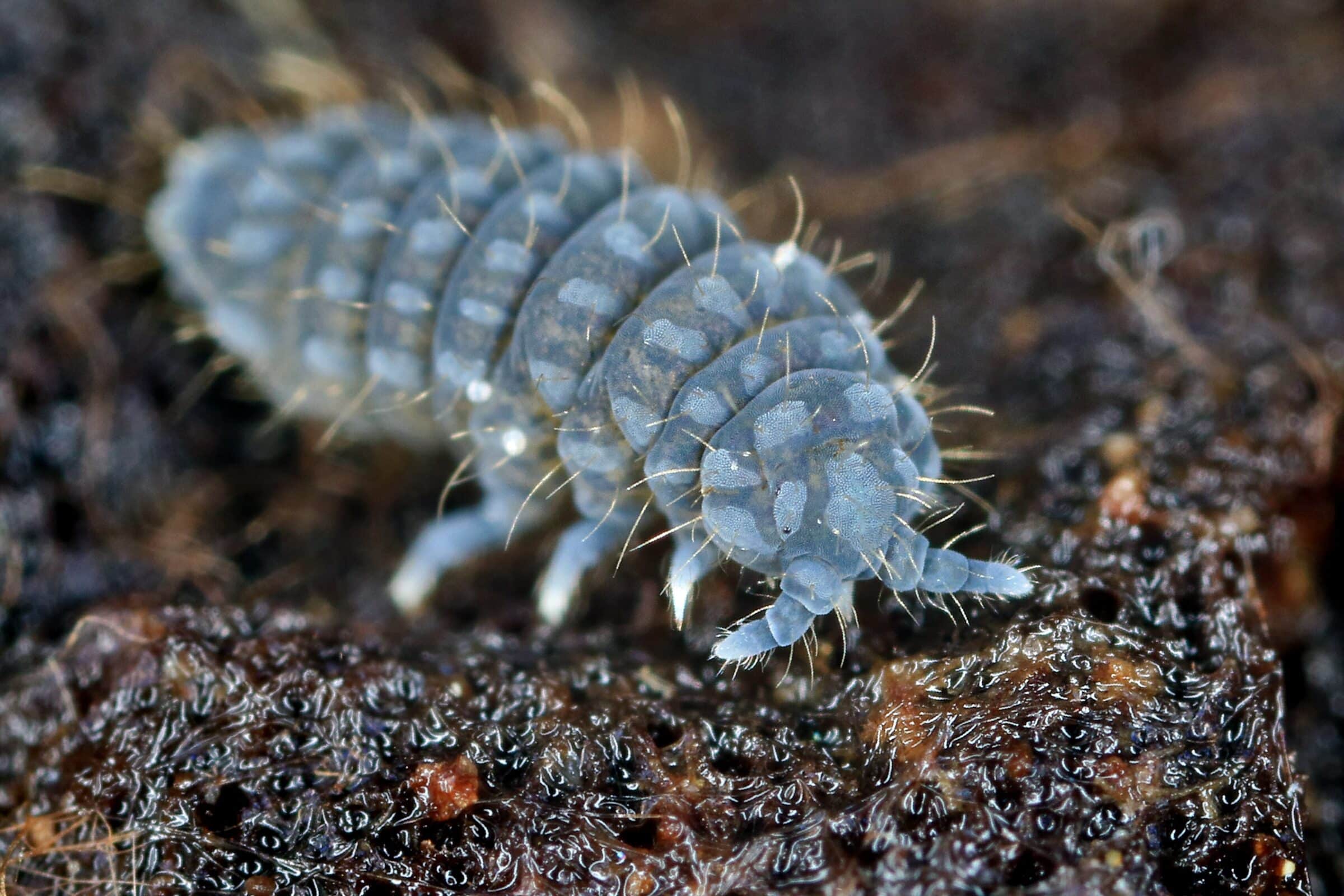
What’s not to love about springtails? These adorable gymnasts I became more aware of in 2022 fascinated us all with their Olympic-level short programs. Launching themselves into rapid flips from land or water in an instant too hard to capture without 10,000 frames per second, these miniature athletes seem too amazing to be real.
What’s more, they are harmless to humans and perform healthy services for the earth, regulating fungi and bacteria on which they feed. Last year I wrote about engineers at Harvard who boasted about a springtail-like hopping robot they made. It was much larger than the actual animal and couldn’t do backflips. We can admire the work but withhold excessive praise until they can get it to eat fungus, lay eggs, and make copies of itself.
Springtails have been in the science news again, and there’s more to love.
Astonishing Variety
For one thing, some of them are really beautiful. Biologists Mark Stevens and Cyrille D’Haese shared photos from their research, writing in The Conversation,
The largest and most colourful bear a strong resemblance to the “fantastic beasts” of the Harry Potter franchise. They come in lurid red, bright purple and fluorescent yellow, among other colours, and have tiny bumps and hairs covering their bodies, making them look more like colourful sea slugs. [Emphasis added.]
The resemblance of springtails to sea slugs should puzzle evolutionists, since they belong to a different phylum (Arthropoda) from sea slugs (Mollusca) and live on land, not under the sea. The appeal to “convergent evolution” seems inappropriate. In fact, Stevens and D’Haese reclassified some springtails that had wrongly been lumped together by that excuse:
The study proposes major changes within the Neanuroidea superfamily that giant springtails belong to. It dissolves one subfamily (“Uchidanurinae”) that was only aligned by convergent evolution – when species are unrelated but evolve similar features and functions because they occupy similar habitats.
Well, sea slugs and springtails fail the test of occupying similar habitats anyway. And Günter Bechly revealed in 2024 that the fossil record of springtails illustrates stasis, not evolution, convergent or otherwise.
Unlike insects, springtails lack wings and defined body segments and do not undergo metamorphosis. Their distinctive parts are the furcula, a lever on the underside that can store elastic energy to spring them upward out of harm’s way, and the collophore, an organ that can absorb water from the environment. The collophore allows them to inhabit some of the driest places on earth: dry deserts and ice deserts. As I mentioned last time, the collophore also helps springtails “stick the landing” when they launch and land on water.
Astonishing Distribution
Another fun fact about springtails is that they can live almost anywhere. There are probably oodles of them in your yard right now, hiding in leaf piles or in the soil, or skittering about in puddles of water. But some species are extremophiles, too:
In virtually every piece of land on Earth — from near the summit of Mount Everest to Antarctica to caves nearly 2,000 metres underground — live tiny critters that have shaped the health of our planet for hundreds of millions of years.
Later in their Conversation article, Stevens and D’Haese add,
Springtails are found in their many thousands in all environments around us, such as forests mangroves, caves, deserts and grasslands. They’re also found in all habitats, such as canopies, surfaces of ponds, soil, leaf litter, mosses and rotting wood. You will even find them in your household compost, gardens, potplants and terrariums.
Two new species of springtails were found living in a cave in Spain. The report was published in Subterranean Biology. Apparently, they survive on organic matter reaching the cave by percolation and detritus flowing underground. “Springtails are the most representative troglobitic fauna of the cavity,” the authors say.
Springtails also vary tremendously in size. The smallest are smaller than one millimeter; the largest one found to date is 17 millimeters long, about thumbnail size. Most of us are unaware of their presence because they are so tiny. The largest ones live inside rotting wood. In Stevens and D’Haese’s paper in the Zoological Journal of the Linnaean Society, they show one picture of a bright red springtail squeezing through a narrow passage in a tree. Those species lack a furcula, having nowhere to jump! An instance of Darwin Devolves, perhaps?
Desirable Ecological Services
Back in 2021 (here), before I knew much about springtails, I had quoted an article in Science that praised the ecological benefits they perform. More recent papers and articles have expanded my appreciation of these critters enormously.
Members of the class Collembola, the “giant springtails” that live in rotting wood perform vital ecological services. The paper begins with these facts about these ubiquitous workers:
Collembola are often regarded as inconspicuous fauna inhabiting, but not restricted to, leaf litter, soils, and rotting wood. Within rotting wood, there are numerous species that play an important role as saproxylic decomposers in forest ecosystems, contributing to nutrient cycling, and some are amongst the largest Collembola known.
Saproxylic means both dependent on rotting wood and helping decompose wood. Collembola springtails take part in the early processes of wood decomposition, cleaning out excess fungal and bacterial debris. This opens up more pore space for beetles and fungal hyphae.
The diverse team of saproxylic decomposers is effective! The trunk of a large oak in my backyard I thought might serve as support for a picnic table, but it is almost all gone now. It was a minor loss for me, but I’m glad these “microscopic ecologies” make the world a better place: “Springtails are crucial to the health of our forests,” the authors say. I’m glad they lack the mouthparts to bite us. They are happy dining on fungi, algae, and decaying matter. In the process, they recycle nutrients that benefit the biosphere. That includes us.
Not Evolved
Mark Stevens and Cyrille D’Haese are to be commended for raising awareness of the “magical world” of springtails and searching diligently for new species to photograph and describe. I only wish they could let go of evolution.
- “They are known as springtails — an ancient group of invertebrates that evolved along with mosses and lichens dating back to more than 400 million years ago.”
- “The evolutionary success of Collembola as a major contributor to healthy ecosystems means they have the potential to indicate when ecosystems are out of balance.”
Does it have to be called an “evolutionary success” instead of just a success? The adjective “evolutionary” performs no function. It is also contrary to the evidence, since the fossil record shows stasis, not evolution. Why not consider that they are successful because they were designed? Indeed, the whole ecosystem, with each part performing its role, bears the hallmarks of foresight and master planning. I wonder if a “habitable planet” could function without them.
Applications
Consider the subject of springtails as a fun science project for students in your family or school. To get them motivated, show them Dr. Adrian Smith’s amazing high-speed videos on Ant Lab (here, here, here). When sufficiently amazed, have them go into the yard looking for springtails to collect and describe. Give them a magnifying glass, loupe, or microscope to see them clearly. Help them devise a testable hypothesis. This could be a blue-ribbon entry in the science fair.
Let us help young students to grow in awe of the wonders of nature. They may need guidance in how to filter out the evolutionary detritus left, like litter, in the scientific literature. They will be ahead of the curve as Darwinism continues its slow decline. I think they will be happier, too.