







































Last December, we noted an article at Current Biology from Max Telford’s group at University College London (UCL), questioning the reality of the long-established clade, the deuterostomes. See, “Goodbye to a Basic Clade That Has Been with Us Since 1908?”
Now, in a stunning development, Telford and Ana Silva (the lead author on the deuterostome paper) are arguing that it is impossible to resolve the branching order of another long-established animal superclade, the Spiralia. Their pre-publication MS is open access at bioRxiv, asking, “Are interphylum spiralian relationships resolvable?”
Farewell to Another Textbook Regular
Silva and Telford write (p. 22, emphasis added):
The short internal branches and lack of signal suggest a short time between cladogenesis events and precious little opportunity for the evolution of major new characteristics, body plans or life cycles. Under this interpretation, it seems unlikely that characteristics shared by various combinations of spiralian phyla (shells, segmentation, larval types, chaetae) are synapomorphies of any superphyletic clades. A more plausible scenario involves some combination of loss in certain phyla of characters that had been present in a spiralian common ancestor and convergent or parallel evolution of characters in others. The lack of clarity as regards the evolutionary history of the characters possibly present in the stem lineages of the Spiralia and the spiralian phyla make reconstruction of the evolution of these groups as well as the interpretation of potential spiralian fossils a difficult problem. These difficulties are not restricted to Spiralia. Previous work, using both empirical and simulated data, has shown that, not only is systematic error widespread in metazoan data (Kapli et al., 2021; Kapli & Telford, 2020; Serra Silva et al., 2025) but that even under conditions that mitigate these errors, it is still often not possible to distinguish between alternative topologies (Serra Silva et al., 2025). Our results add to a growing body of work suggesting that rapid cladogenesis might have been a common aspect of early metazoan evolution.
Not Excessively Cynical
For “rapid cladogenesis,” one should understand — and we are not being excessively cynical here — “the evolution of these phyla from an unknown and possibly unknowable common ancestor must have happened, but we can’t say exactly how, and thus their family tree is a hopeless mess. Who knows what happened?”
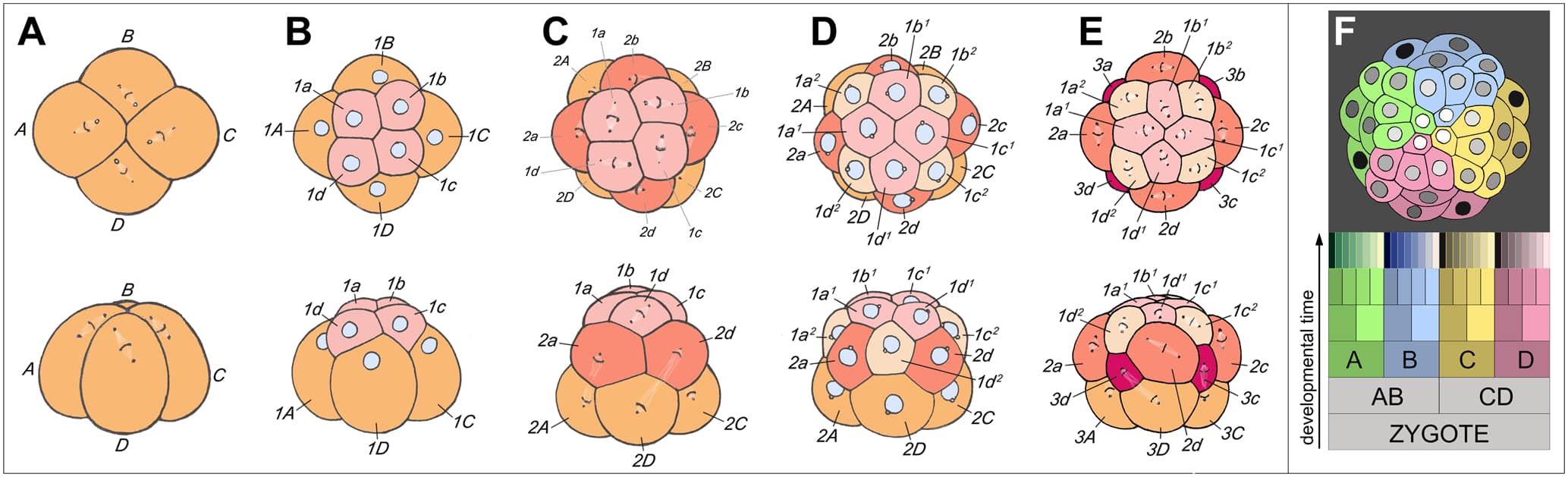
The Spiralia is another textbook regular. The term was coined in 1929 by the German embryologist Waldemar Schleip, so the clade is approaching its centennial as a taxonomic category. Any zoology or paleontology student would have learned about the superclade as a major grouping of protostome phyla, whose defining trait is a spiral pattern of cell cleavage early in development.
But the open agnosticism in this new MS is a short step away from throwing in the towel entirely, at an even more radical level. We’ll see.