







































Science and Culture Today Discovering Design in Nature
mousetraps
Photo: Mousetraps, by Tom, CC BY 2.0 <https://creativecommons.org/licenses/by/2.0>, via Wikimedia Commons.
Latest

Michael Behe: Battle of the Mousetraps

Categories
Evolution
Share
Facebook
Twitter/X
LinkedIn
Flipboard
Print
Email

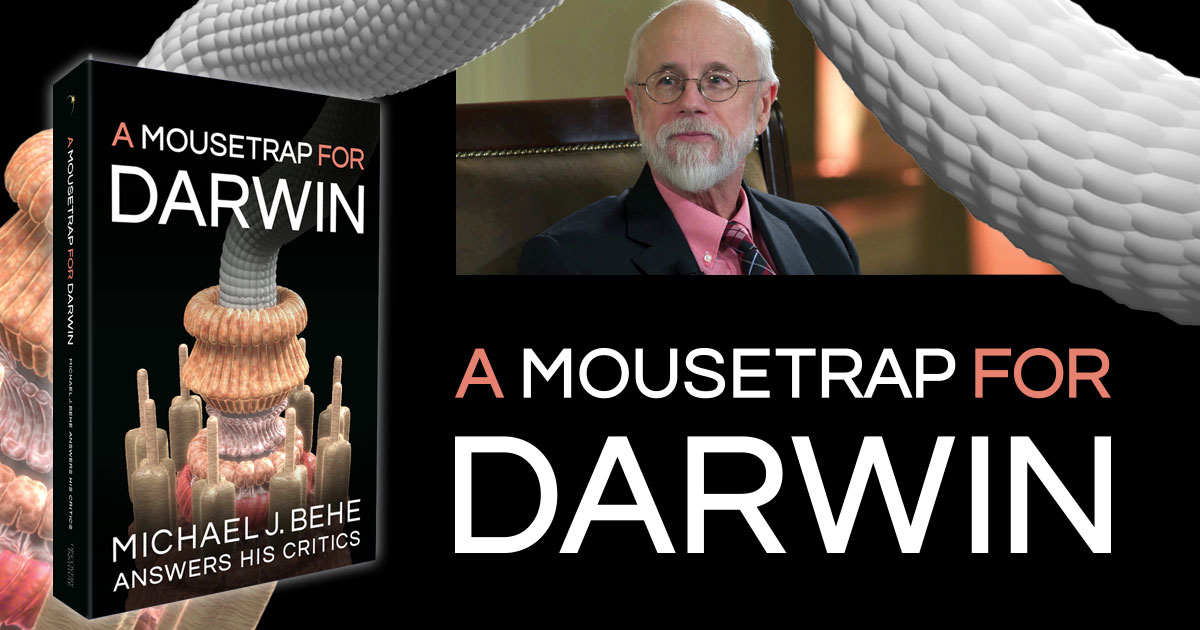
On a new episode of ID the Future, Michael Behe responds to the attacks on … his mousetrap. Behe used the common mousetrap to illustrate the idea of irreducible complexity, showing how various mechanical contrivances need all of their main parts to function, and to show how irreducible complexity poses a major challenge to Darwinism’s idea of gradual, step-by-step evolution of some biological machines. Download the podcast or listen to it here.

Most of the attacks on Behe’s argument have focused on the irreducibly complex biological systems he spotlighted, such as the outboard motor known as the bacterial flagellum. But some of his critics fixated on the mousetrap itself, and argued that the mousetrap wasn’t actually irreducibly complex. Behe rebuts these counterarguments and explains why he’s convinced they fail. The discussion is just a brief sampling of the deeper look that Behe offers in his newest book, A Mousetrap for Darwin.
Jonathan Witt

Executive Editor, Discovery Institute Press and Senior Fellow, Center for Science and Culture
Jonathan Witt, PhD, is Executive Editor of Discovery Institute Press and a Senior Fellow with the Center for Science and Culture. His co-authored books include Intelligent Design Uncensored (IVP), A Meaningful World: How the Arts and Sciences Reveal the Genius of Nature (IVP), and The Hobbit Party: The Vision of Freedom That Tolkien Got, and the West Forgot (Ignatius Press). Witt is also the lead writer and associate producer for Poverty, Inc., winner of the $100,000 Templeton Freedom Award and recipient of over 50 international film festival honors. His latest book is a YA novel co-authored with astronomer Guillermo Gonzalez, The Farm at the Center of the Universe.
Benefiting from Science & Culture Today?
Support the Center for Science and Culture and ensure that we can continue to publish counter-cultural commentary and original reporting and analysis on scientific research, evolution, neuroscience, bioethics, and intelligent design.

© Discovery Institute