

























Science and Culture Today Discovering Design in Nature
Topic

Walter Bradley Center

laughter
Robert J. Marks
Photo credit: Jordan Whitfield via Unsplash.

Robert J. Marks: Humor, Ambiguity, and AI

Dr. Marks thinks it’s possible that AI may improve in its ability to resolve ambiguous language. Right now it’s not looking so good. Read More ›
AI robot
delusion
Photo credit: Adam Muise via Unsplash.

Robert Marks: Materialism and the AI Delusion
Since humans are only the “result of purposeless, as-yet-unidentified physical phenomena,” machine are not in any way blocked from becoming what we are and much, much more. Read More ›
bonobo
Photo credit: Jeroen Kransenvia Flickr(cropped).

Egnor Imagines: Professor Terminated; Replaced by Bonobo
“The search committee interviewed several apes, three mules, and a tomato plant.” Read More ›
Homo erectus pekinensis
racism
Image: An artist imagines Homo erectus pekinensis, by Cicero Moraes [CC BY-SA 4.0], via Wikimedia Commons.

Why Darwinism Can Never Separate Itself from Racism
You think if Darwinian theory had emerged not in the dark age of the 19th century but in our own woke era, it would be different? No, it wouldn’t. Read More ›
Marks, Medved
Great Minds
Marks and Medved, via Discovery Institute

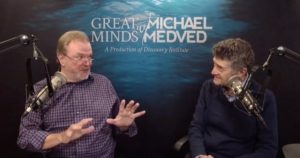
Great Minds: How Darwinism and AI Are Oversold, Often at the Same Time
The Center for Science & Culture and the Bradley Center for Natural & Artificial Intelligence share more than the commonality of being sponsored by Discovery Institute. Read More ›
Lennox Marks
uploading
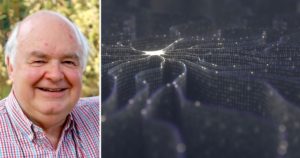
Photo: John Lennox, via Walter Bradley Center for Natural & Artificial Intelligence.

Lennox, Marks: Uploading the Mind Would Mean Eternal Death
Dreams of god-like immortality achieved through uploading the mind have a serious drawback, one among others. A computer operates algorithmically, strictly so, whereas the mind does not. Read More ›
computer chip
Photo credit: Brian Kostiuk - @BriKost via Unsplash.

Marks on the AI Church: “The Singularity Is Far”
New religions, including one centered on Artificial Intelligence, follow a stereotyped pattern. Read More ›
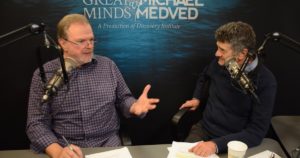
Marks Medved GMMM
human exceptionalism
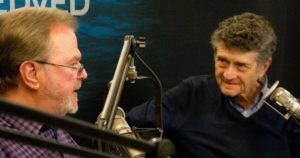
Photo: Robert Marks and Michael Medved, by Nathan Jacobson.

Great Minds: Marks, Medved on Human Exceptionalism’s Two Frontiers

There are fundamental, unbridgeable chasms on either side, animal and machine. The capacity for creativity, for one thing, stands permanently outside the reach of algorithms. Read More ›
Claude Shannon
information theory
Photo: Claude Shannon, by DobriZheglov [CC BY-SA 4.0], via Wikimedia Commons.

Trends in Philosophy of Science: What Does “Semantic Information” Mean?
Theorists hope to alleviate a deficiency in Shannon information theory, which dealt only with the structure of a communication, not its semantics. Read More ›
Marks Medved
Photo: Robert Marks and Michael Medved, by Nathan Jacobson.

Great Minds: Robert Marks, Michael Medved on the Limits of Computation

There’s no danger of computers ruling us, but there is a peril in employing them to greatly magnify the impact of our own errors. Read More ›

© Discovery Institute