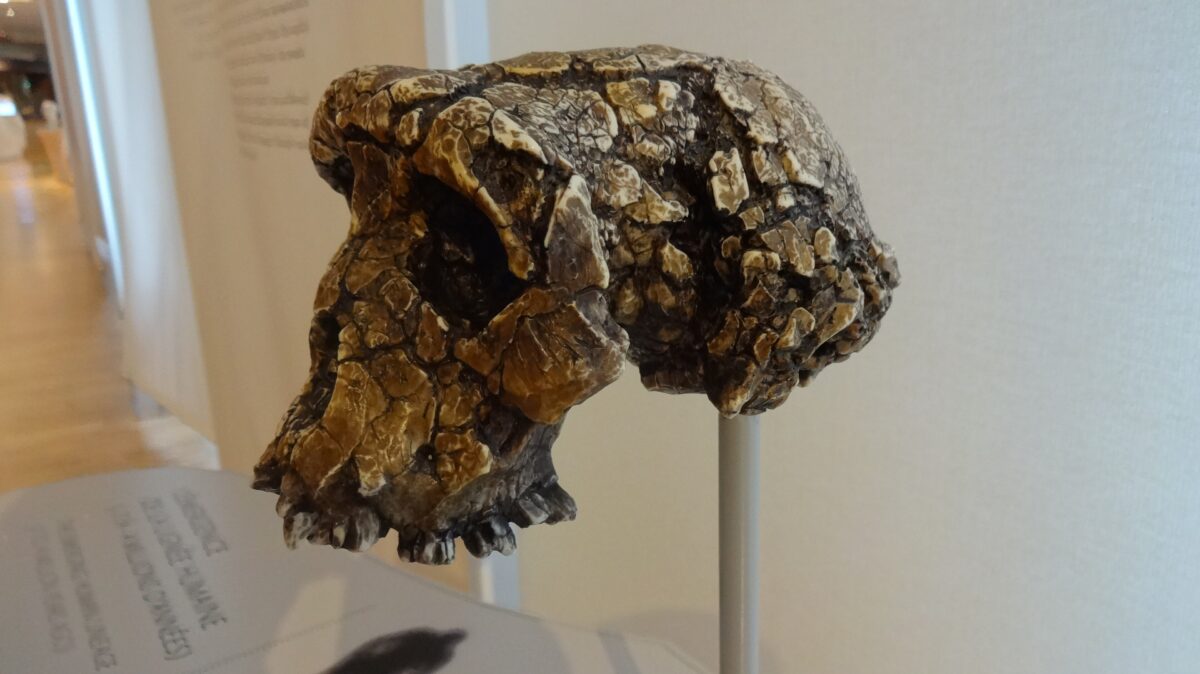
SahelanthropustchadensiscraniumleftsideintheMuse Type post Author Casey Luskin Date January 12, 2026 CategoriesEvolutionHuman Origins and Anthropology Tagged , bipedalism, Chad, chimpanzees, common ancestor, Haaretz, hominins, human origins, John Hawks, Journal of Human Evolution, knuckle-walking, Le Centre national de la recherche scientifique, Leipzig, Marine Cazenave, Martin Pickford, Max Planck Institute for Evolutionary Anthropology, Michael Brunet, Milford H. Wolpoff, Nature (journal), New Scientist, New York University, paleoanthropologists, paleontology, Rhianna Drummond-Clarke, Roberto Macchiarelli, Sahelanthropus tchadensis, Science Advances, Scientific American, Scott Williams, Toumaï, trees, University of Wisconsin-Madison, Washington Post New Paper Fails to Settle Debate Over Bipedalism in Sahelanthropus tchadensis Casey Luskin January 12, 2026 Evolution, Human Origins and Anthropology 8 Many have called this fossil a human ancestor that lived at about 7 million years ago, around the time of our supposed most recent common ancestor with chimps. Read More ›
file-drawer Type post Author David Coppedge Date May 29, 2025 CategoriesEthicsMetascienceScience Reporting Tagged , accuracy, artificial intelligence, data, data science, evidence, Evolution News, fakery, fallibility, file drawer problem, fraud, generative ai, integrity, knowledge, Leipzig, Nature (journal), objectivity, peer review, PLOS ONE, PNAS, politicization, post-trust, predatory journals, pseudoscience, public trust, replicability, scientific reliability, scientists, suppressed evidence, The Conversation, transparency How the “Scientific Community” Undermines Its Own Trustworthiness David Coppedge May 29, 2025 Ethics, Metascience, Science Reporting 10 The “file drawer problem” leads invariably to biased reporting. It refers to scientists deciding not to report negative results. Read More ›