Science and Culture Today Discovering Design in Nature
Category

Human Origins and Anthropology

Human-Chimp Evolution Dialogue (Part 2): Author of Science‘s “The Myth of 1%” article Backpedals, Promotes the “Myth” of 1%

In Part 1, I recounted how Darwinists are deeply invested in the rhetorical value of the emotional argument that humans and chimps have a 98% – 99% genetic similarity. Anthropologist John Marks reports that sometimes Darwinists even use this statistic to contend that our lives are “meaningless”! To explore this debate, I recently blogged about a Science news article entitled “Relative Differences: The Myth of 1%” that reported that the 1% human/chimp genetic difference statistic was a “myth,” because “studies are showing that [humans and chimps] are not as similar as many tend to believe.” The Science news article reported that improved genome comparison modeling methods indicate that humans and chimps are “6.4%” genetically distinct from one another. Apparently my Read More ›

Human-Chimp Evolution Dialogue (Part 1): An Exchange with Jon Cohen, Author of Science‘s “The Myth of 1%” Article

From a technical scientific perspective, the degree of genetic similarity between humans and chimps seems to be of questionable relevance when one is trying to determine whether two species share a Darwinian past. After all, designers regularly re-use parts that work, especially programming components, so there’s no reason to presume that mere genetic similarity necessarily implies common descent over common design. Moreover, even if such genetic similarities were to imply common ancestry, they don’t demonstrate a plausible stepwise Darwinian evolutionary pathway. Nonetheless, on a rhetorical level, the claim that humans and chimps are 99% the same is a powerful emotional argument aiding those seeking to evangelize for Darwinism. For example, last year a cover story of Time magazine proclaimed: “chimps Read More ›

1% Genetic Difference Between Humans and Chimps a “Myth”

Last July, David Tyler wrote an insightful post at ARN stating, For over 30 years, the public have been led to believe that human and chimpanzee genetics differ by mere 1%. This ‘fact’ of science has been used on innumerable occasions to silence anyone who offered the thought that humans are special among the animal kingdom. ‘Today we take as a given that the two species are genetically 99% the same.’ However, this ‘given’ is about to be discarded. Tyler was quoting a Science news article entitled “Relative Differences: The Myth of 1%,” which reported that “human and chimpanzee gene copy numbers differ by a whopping 6.4%.” The statistic of an alleged 1% difference between human and chimp DNA is Read More ›

Human Origins Update: Harvard Scientist and New York Times Reporter Get the “Plug Evolution Memo”…Sort of

What a difference a month, and a couple likely internal memos, can make. Last month I discussed the fact that newly reported Homo erectus fossils predated fossils of “Homo” habilis, meaning that habilis could not possibly have been an evolutionary link between the Australopithecine apes and our genus Homo. When the press covered that story, Harvard biological anthropologist Daniel Lieberman was quoted in the New York Times stating that those fossils “show ‘just how interesting and complex the human genus was and how poorly we understand the transition from being something much more apelike to something more humanlike.’” It’s a fascinating admission, and I wrote at the time, “Daniel Lieberma[n] apparently did not get the memo about refraining from making Read More ›

Nine Gorilla Teeth and a Confession of Evolutionist Ignorance

As I’ve noted before, it is often only after Darwinists report a new fossil discovery that they retroactively admit how little they previously knew about a given evolutionary transition. This happened again recently as a team of paleoanthropologists reported finding 6-7 million year-old fossil gorilla teeth that Nature News claimed “helps to fill in a huge gap in the fossil record.” Accompanying this find, however, was a striking admission of ignorance regarding the evolution of humans: “The human fossil record goes back 6 to 7 million years, but we know nothing about how the human line actually emerged from apes,” the researchers said in a statement on Wednesday that accompanied publication of their study in the journal Nature. “Chororapithecus gives Read More ›

Paleoanthropologists Disown Homo habilis from Our Direct Family Tree

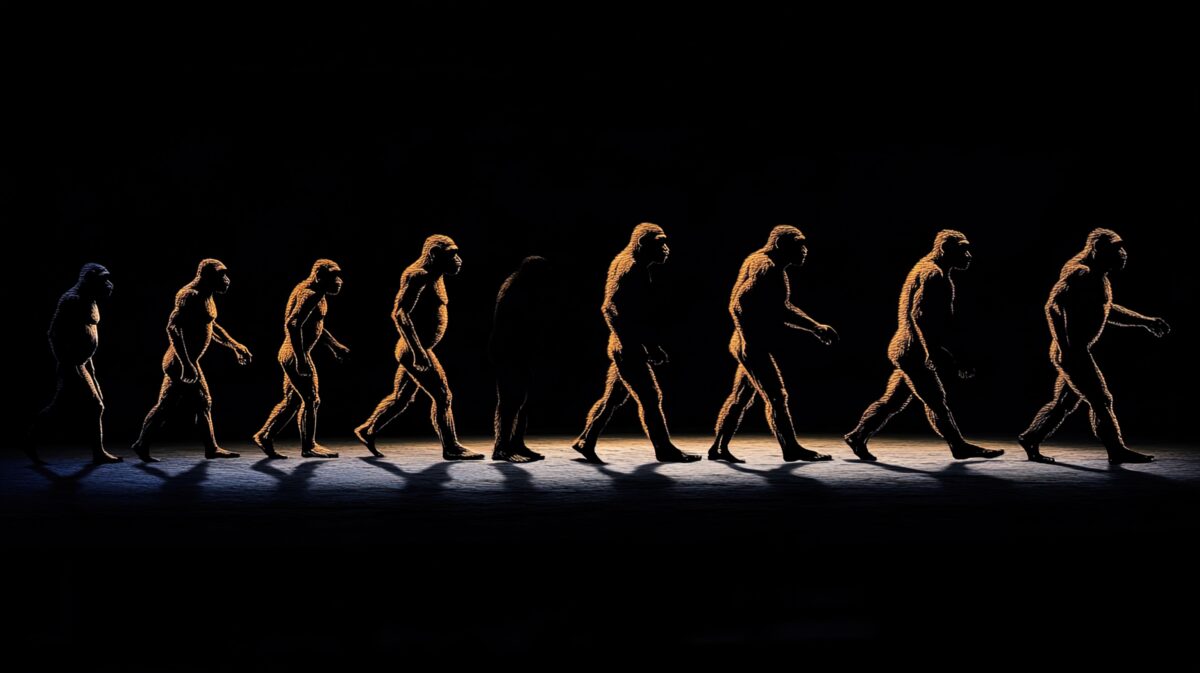
An Associated Press article titled “African fossils paint messy picture of human evolution” explains that common popular conceptions of human evolution are incorrect: “Surprising fossils dug up in Africa are creating messy kinks in the iconic straight line of human evolution with its knuckle-dragging ape and briefcase-carrying man.” Indeed, the inappropriateness of such “straight line” depictions of human evolution was one of Jonathan Wells’ main points in chapter 11 in Icons of Evolution, “From Ape to Human: The Ultimate Icon.” A Harvard biological anthropologist stated the newly reported fossils reveal, “how poorly we understand the transition from being something much more apelike to something more humanlike.” The Associated Press article goes on to explain why Homo habilis can no longer Read More ›

William Dembski Addresses Forthcoming Intelligent Design Research that Advances ID and Answers Critics (updated)

Our recent podcast interview with Robert Marks, Distinguished Professor of Electrical and Computer Engineering at Baylor University, discusses his new Evolutionary Informatics lab at Baylor University. Additionally, Mario Lopez recently has posted an interview with William Dembski at the IDEA Center’s website discussing Dembski’s research with Robert Marks’s Evolutionary Informatics lab at Baylor University. Dembski thinks the lab’s research puts ID “in a position to challenge certain fundamental assumptions in the natural sciences about the nature and origin of information.” Dembski’s work has long-been a lightning rod for ID-critics who take a science-stopping approach to ID by alleging that areas of Dembski’s continued ID-research actually represent unsolvable problems for the science of ID. In essence, some of Dembski’s critics have Read More ›

Neanderthals: Are They Us, or Are We Them (or Both)? Overcoming the Icons of Evolution

Who were the Neanderthals? Were they ape-like primitives with low intelligence, or were they more like us–perhaps nearly identical to modern humans in both body and mind? Biology textbooks often portray Neanderthals as unintelligent versions of modern humans. For example, this graphic from Biology: The Dynamics of Life (pg. 483, 2000 ed.) portrays Neanderthals as stooped primitives struggling kill a giant bear using clubs, spears, and incompetently, a burning stick: But according to a recent article in the Washington Post, Neanderthals may have been virtually indistinguishable from modern humans in terms of both their appearance and intelligence. A lead author on the study declared that “we would understand both to be human. There’s good reason to think that they did Read More ›

Time Aping over Human-Chimp Genetic Similarities

The current issue of Time features a cover story preaching evolution to the skeptical public and editorializing that humans and chimps are related. Though the cover graphic (below) shows half-human, half-chimp iconography, University of North Carolina, Charlotte anthropologist Jonathan Marks warns us against “exhibit[ing] the same old fallacies: … humanizing apes and ape-ifying humans” (What It Means to be 98% Chimpanzee, pg. xv [2002]). The cover-graphic commits both fallacies: The article also claims that it’s easy to see “how closely the great apes — gorillas, chimpanzees, bonobos and orangutans — resemble us,” but then observes in a contradictory fashion that “agriculture, language, art, music, technology and philosophy” are “achievements that make us profoundly different from chimpanzees.” Perhaps Michael Ruse was Read More ›

Media Goes Ga-Ga Over Baby Australopithecine Fossil

An exciting find was recently reported as scientists discovered what may be the most complete australopithecine fossil specimen ever found. It is reported to be a toddler. Unfortunately, the media is misrepresenting this fossil as if it closely mimics humans. Consider the diagram below which comes from the Seattle Times (“Scientists Find Fossil Child from 3.3 Million Years Ago,” Thursday Sept. 21, 2006, pg. A2): Does Australopithecus afarensis really look so similar to humans? This diagram is extremely misleading. Consider a diagram from an actual scientific paper which reveals the stark differences between Australopithecus (right) and the earliest members of our genus, Homo (left): (From http://www.umich.edu/~newsinfo/Releases/2000/Jan00/r011000b.html covering the Hawks et al. paper) The media is calling this baby fossil “a Read More ›

© Discovery Institute