






































Science and Culture Today Discovering Design in Nature
Author

Casey Luskin

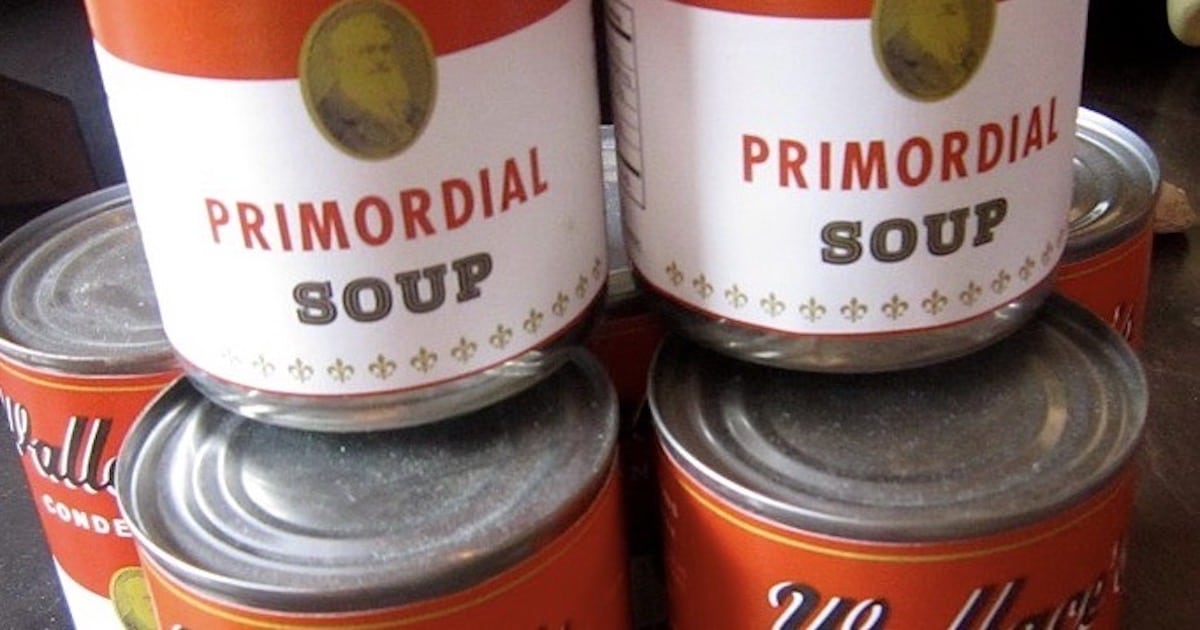
primordial soup
Image credit: anokarina, CC BY-SA 2.0 <https://creativecommons.org/licenses/by-sa/2.0>, via Wikimedia Commons.

A Mystery: Prebiotic Synthesis of Simple Organic Monomers

In 2010, University College London biochemist Nick Lane stated the primordial soup theory “doesn’t hold water” and is “past its expiration date.” Read More ›
Louis Pasteur
Image: Louis Pasteur, by Sanjai B R 1840722, CC BY-SA 4.0 <https://creativecommons.org/licenses/by-sa/4.0>, via Wikimedia Commons.

All Living Systems Must Process Energy, Store and Utilize Information, and Replicate
Louis Pasteur showed that what appeared to be life springing forth from nonliving matter was actually life emerging from exceedingly small living organisms. Read More ›
grass lawn
Photo credit: © Walter Bradley.

Did Life First Arise by Purely Natural Means?

Evolutionary theory and the development of the second law of thermodynamics are two of the three major scientific discoveries of the 19th century. Read More ›
stop light
Photo credit: Archer Hadland via Unsplash.

Science Stopper? Intelligent Design as a Fruitful Scientific Paradigm

When critics claim that research is not permitted to detect design because that would stop science, it is they who hold science back. Read More ›
fairies
Photo: Garden fairies, by helena.40proof, CC BY-SA 2.0 <https://creativecommons.org/licenses/by-sa/2.0>, via Wikimedia Commons.

Can Materialistic Models Accommodate the Scientific Data?

Would you believe someone who claimed that fairies and leprechauns were caught on video, but they are too small or too fast to be seen? Read More ›
future
Photo credit: Drew Beamer via Unsplash.

Does Intelligent Design Make Predictions or Retrodictions?
I would argue that a chronology of exactly what was predicted when is not dispositive as to whether a positive argument can be made. Read More ›
Richard-Dawkins
Photo: Richard Dawkins, by Anders Hesselbom, Public domain, via Wikimedia Commons.

Does Darwinian Theory Make the Same Predictions as Intelligent Design?
Richard Dawkins predicted that “a large fraction” of our genomes has no function, because, “The true ‘purpose’ of DNA is to survive, no more and no less." Read More ›
Mind The Gaps
Photo credit: WillMcC, CC BY-SA 3.0 <https://creativecommons.org/licenses/by-sa/3.0>, via Wikimedia Commons.

Using the Positive Case for Intelligent Design to Answer Common Objections to ID

As for the “God of the gaps” charge, the basic objection is that ID is an argument from ignorance, based upon what we don’t know. Read More ›
hubble_32nd_hickson40
Photo: Galaxies as seen by the Hubble Space Telescope, by NASA, ESA, STScI; Image Processing: Alyssa Pagan (STScI).

The Positive Case for Intelligent Design in Physics
Multiple physical laws and constants must be finely tuned for the universe to be inhabited by advanced forms of life. Read More ›
DNA
Image credit: lisichik, via Pixabay.

The Positive Case for Intelligent Design in Genetics

Functionality for junk DNA is prevalent, and was successfully predicted by intelligent design.  Read More ›

© Discovery Institute