






































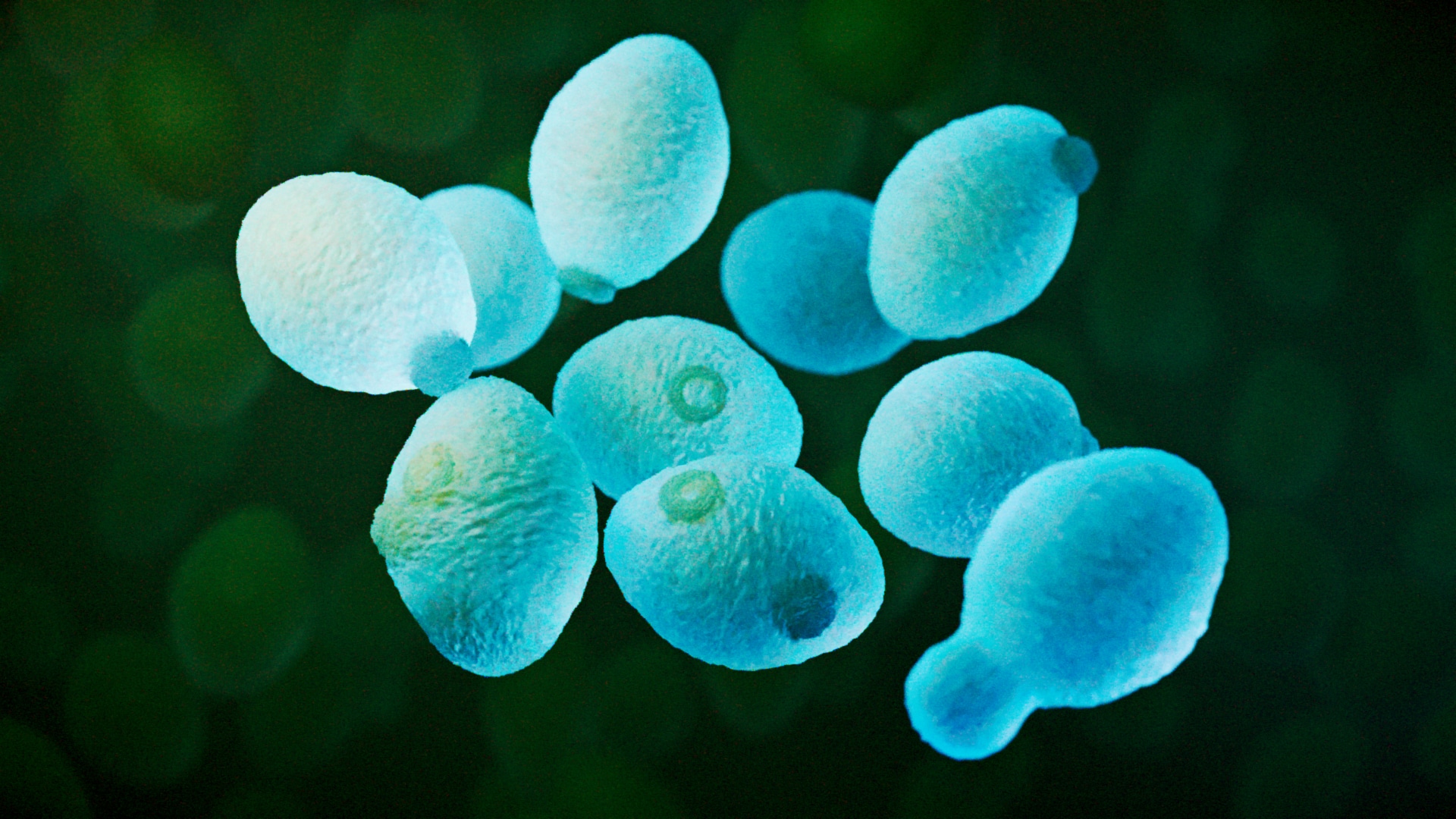
Why don’t cells grow as big as tennis balls? Why can’t they shrink down to infinity? Science can suggest functional explanations to answer these questions. A tennis-ball sized cell would have too much volume and too many molecules for efficient operation; it would also be more subject to rupture. A nanometer-scale cell could not house the minimum number of enzymes for life. Like a limit on the number of college students able to fit in an old-fashioned telephone booth or a Volkswagen bug, a cell too small would squeeze its genome down too far to operate.
Scientists, therefore, can spin just-so stories about why cells are the way they are: if they were different, they couldn’t function. Functional explanations, however, do not address the reason cells arrived at the optimum size in the first place.
In the 1990s, there was a brief flurry of news about so-called nanobes — possible life forms a tenth the size of the smallest known bacterium. Some of the hype stemmed from tiny structures found in the Mars meteorite ALH84001 that over-eager astrobiologists initially thought might be relics of Martian organisms. Additional structures from rocks in Australia were used to support the claim. By 2001, the hype died down. The Wikipedia page Nanobe relates that “the main criticism of nanobes is that they appear too small to contain the biochemical machinery needed to sustain life.” The page contains links to the original papers and refutations. In short, life as we know it, with its requirements for nucleic acids, proteins, and lipids, has a lower size limit.
Pursuing Scientific Nuance with Evolutionary Clumsiness
A more nuanced investigation into cell size constraints appeared in PNAS this year. “How Small Can a Cell Be?” asked Stanford biologists Shicong Xie and Jan M. Skotheim in a Commentary. They point out that “Enlarged cells can suffer from cytoplasmic dilution, altered proteome composition, replication stress, and increased susceptibility to senescence.” That sets an upper limit on size. “Small cells should face a different set of constraints,” on the other hand. “They must physically fit their genome, ribosomes, organelles, cytoskeletal structures, and the molecular machinery required for growth and division into a smaller space.” To first order, the larger the genome, the larger the cell needs to be. Diploid cells need more room than haploid cells. Nevertheless, “we do not know what goes wrong when cells get too small.”
Xie and Skotheim discuss recent experiments performed at the Gulbenkian Institute for Molecular Medicine in Portugal by Garoña et al. Sadly, both paper and commentary committed the Darwinian fallacy of confusing unguided evolution with artificial evolution (i.e., intelligent design):
Manipulating these pathways produced a sixfold range in cell size without changes in ploidy, with engineered mutations recapitulating the volumes of evolved lines, and loss-of-function mutations yielding enlarged cells. Our results demonstrate the evolutionary plasticity of cell size homeostasis and reveal a putative mechanism for eukaryotic cell size evolution.
Garoña et al. used the e-word evolution and its derivatives 120 times. But this was a breeding experiment. To call it evolution, they would have to put the cells in a flask, walk away, and let stuff happen for a few million years. Hands off. No manipulation. No engineering.
The Lower Size Limit
Setting that fallacy aside, what did their experiments with artificial selection find? They cultivated bacteria, artificially selected the smallest ones, let them regrow, and allowed those to reproduce. They repeated this cycle for 1,500 generations. At the end, the survivors ended up a third the size of the wild type on average. They did not discover a lower size limit. “The long-term continuation of this evolutionary experiment will help determine whether, and how, a physical lower size limit can be reached experimentally,” they say.
Decreased health of oversized and undersized cells was already known, however. Garoña et al. cite earlier studies on defects facing cells out of their normal size range:
Strong evidence for the importance of cell size homeostasis is represented by the severe defects experienced by cells as they leave their narrow range of stereotypical sizes. Excessive cell size has been shown to cause cytoplasm dilution and genetic instability, increasing cells’ propensity to senescence. On the other hand, mutations causing the largest decrease in cell size impair the Target of Rapamycin (TOR) signaling pathway and ribosome biogenesis, imposing severe reductions in cellular biosynthesis and fitness. Furthermore, altered cell size control has been observed in cancers.
Cells somehow “know” to achieve cell size homeostasis within species, even though healthy cells can exist within a narrow range of stereotypical sizes.
It is therefore unclear how evolution achieved changes in cell size [i.e., in nature] spanning many orders of magnitude, when even slight variations [i.e., within species] are associated with severe cellular defects. These detrimental consequences could severely constrain the evolution of the cell size trait, posing an apparent paradox between the broad evolutionary diversity of cell sizes and the limited tolerance observed within species.
That was the reason for their experimentation. Their artificial selection repetitions achieved a fourfold reduction in cell volume “with only marginal fitness tradeoffs.” But what is meant by fitness? The ability to reproduce could be a misleading proxy. Mutations to cell cycle checkpoints, for instance, might lead to more cell divisions among weakened individuals. If reproduction were the measure of fitness, cancer cells would be the most fit! Like they said, “altered cell size control has been observed in cancers.”
Whole-genome sequencing revealed adaptive mutations in G1 cyclins and TOR pathways, with additional contributions from components of the Greatwall kinase signaling cascade. Reconstruction of these mutations showed that their combined effects generate markedly smaller cells while maintaining a near WT fitness, thereby decoupling cell size from growth rate. Targeted engineering of these pathways substantially altered cell size control and cell cycle dynamics, yielding a sixfold range in cell volume.
One doesn’t tinker with these important pathways willy-nilly. Changing a signaling cascade might compensate for a mutation affecting nutrient starvation, allowing cell division to proceed more rapidly than it might otherwise. If that illustrates “fitness” (a word they use 38 times), then frameshift mutations and premature stop codons should be proxies for overall health. The authors do speak of “minimal fitness cost,” showing that they realize there was a cost after all. The image of Behe’s ship with cargo tossed overboard in a storm comes to mind.
These observations suggest that, rather than simply increasing pathway output, evolution selected for combinations of mutations that tune Greatwall signaling in a context-dependent manner to minimize fitness trade-offs.
Surviving in the Wild
While Garoña et al. observed the mutant cells maintaining their phenotypes and growth rates under controlled conditions, would they survive in the wild? If the mutants were more “fit” (whatever that means), one would have expected “evolution” to already have “achieved” it long ago. We would expect the “narrow range of stereotypical sizes” to be wider than it is.
They claim that “Our work demonstrates the plasticity of the mechanisms governing cell size homeostasis and suggests a putative mechanism for cell size evolution.” The word “putative” means that they don’t know. Here comes the promissory note:
We speculate that this model identifies a simple yet powerful route for evolution to achieve large deviations in volume without altering ploidy. Future studies should test the generality of the principles we identified and determine how broadly it underpins size diversity across the tree of life.
They observed yeast cells surviving despite two mutations. Even so, they don’t know the principles for their yeast cells. They certainly know much less about “cell size evolution” across the millions of unicellular and multicellular organisms on the planet. Xie and Skotheim concur: “cells tend to reach new but stable size distributions, often with accompanying defects in growth or fitness, which we do not understand.”
What Brings Understanding
Advocates of intelligent design, by contrast, do understand that “if something works, it’s not happening by accident.” Mutations are not bringers of blessings, “achieving” progress by making unguided changes to finely tuned systems.
Within our bodies, each of the more than 200 cell types have the proper size for both internal and external homeostasis. Without our cells growing within prescribed tolerances, we would be dead. Like Glicksman and Laufmann say, “there are billions and billions of ways to be dead and a very, very few ways to be alive. And the very few ways to be alive require some special properties of the body,” including optimal cell sizes. “Without all those properties in place you’re not going to make it.” Neither will yeast cells in the wild.