




































Editor’s note: We are delighted to present a new series by William Dembski, adapted from his Substack. This is the 15th post. Find the full series so far here, “My Personal History with Information.”
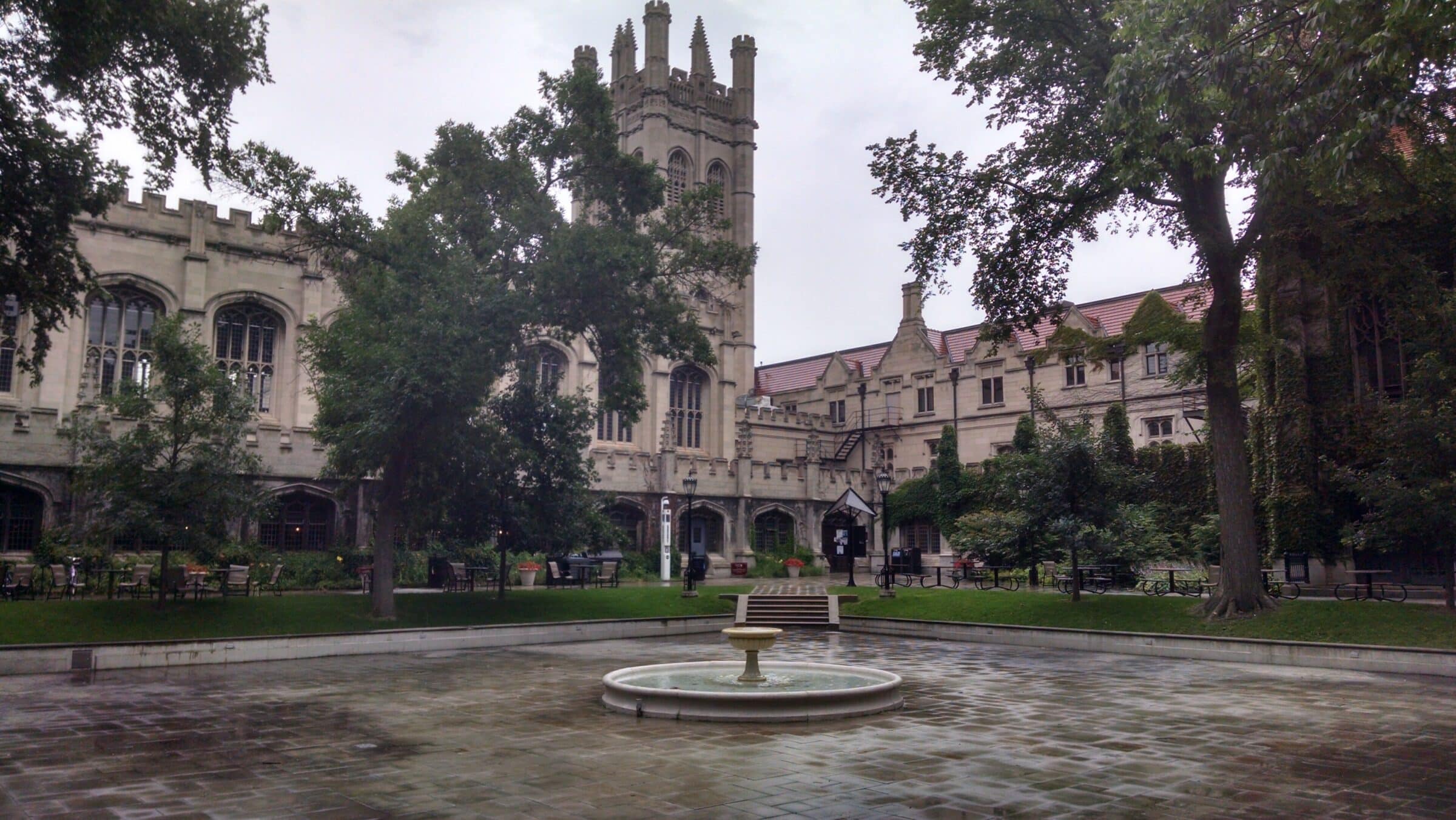
What I’ve recounted so far in this series brings my history with information to about 2013. In 2014, my former physics supervisor Leo Kadanoff invited me to lecture on conservation of information at the University of Chicago’s Computations in Science Seminars. You can see the schedule for the seminars given in 2014 by clicking here — scroll down to August 13, 2014, to see my seminar, titled “Conservation of Information in Evolutionary Search.”
Although my talk that August day didn’t break any new conceptual ground, instead recapping previous work by colleagues and me, it did provide a suitable capstone for that work up to that date. Leo’s people arranged everything, including travel and lodging. At the talk itself, I was happy to see Paul Nelson in the audience, who used his Mac laptop to record the talk — which is available on YouTube and is given at the end of this post. At the talk also was James Shapiro, a key figure in the Third Way of Evolution. He and I visited in his office after the talk. We had some history before this meeting, going back to 1997 when he and Mike Behe were speaking at Wheaton College together. In any case, it was refreshing to hear in his office his skepticism of Darwinism.
Failed Cancelation by Coyne
Leo himself was never an ID guy, but he was sympathetic, if not for the actual ideas of ID, then at least for the right of academics to engage the topic and what he also took to be the benefit to the academy of doing so. In the lead-up to my talk, after it had been announced on campus, Jerry Coyne, a prominent Darwinian biologist at the University of Chicago, tried to talk Leo into disinviting me. Leo shared the entire correspondence with me. The thing that Leo stressed to Jerry is that he thought members of the seminar would profit from hearing me. That for him settled the matter, and all Jerry’s efforts to disinvite me thus failed.
As I write this, I recall an exchange with Leo as I was graduating from the University of Chicago with my math PhD to take an NSF postdoc at MIT. He remarked, and it seemed almost cryptic at the time, that I needed to be prepared that the recognition of my work might fail to keep pace with the quality of my work. He said it differently, but that was the gist. I wondered at the time (1988) if his words might be prophetic.
Regarding my work on information, Leo never formally endorsed it. But in an email to me before the talk, he wrote this:
As you well know, information is the primary topic in 21st. Century science. Even my own work on phase transitions is often phrased as how one part of a material communicates with another. Like matter, information flow can in some situations be guided by intelligence and in others can flow without the aid of a guiding thought.
Amen to that.
Evolution as a Search
At my talk, Leo introduced me and also wrapped things up. A question after my talk challenged me by claiming that evolution was not a search. I had argued that it was and that its targets could be identified independently of intelligence and thus didn’t stack the deck for or against intelligent design. I then went on to point out that if evolution was not a search, then evolutionists had no rigorous mathematical model for evolution, in which case they were not doing science but at best hoping to do science (I’m paraphrasing a bit here, but the gist in my answer was to put the onus on the evolutionists to explain exactly how what they are doing can rightly be regarded as scientific). Leo ended the seminar by saying that the burden was on my critics to respond. It was satisfying to hear this from a man for whom I had such enormous respect.
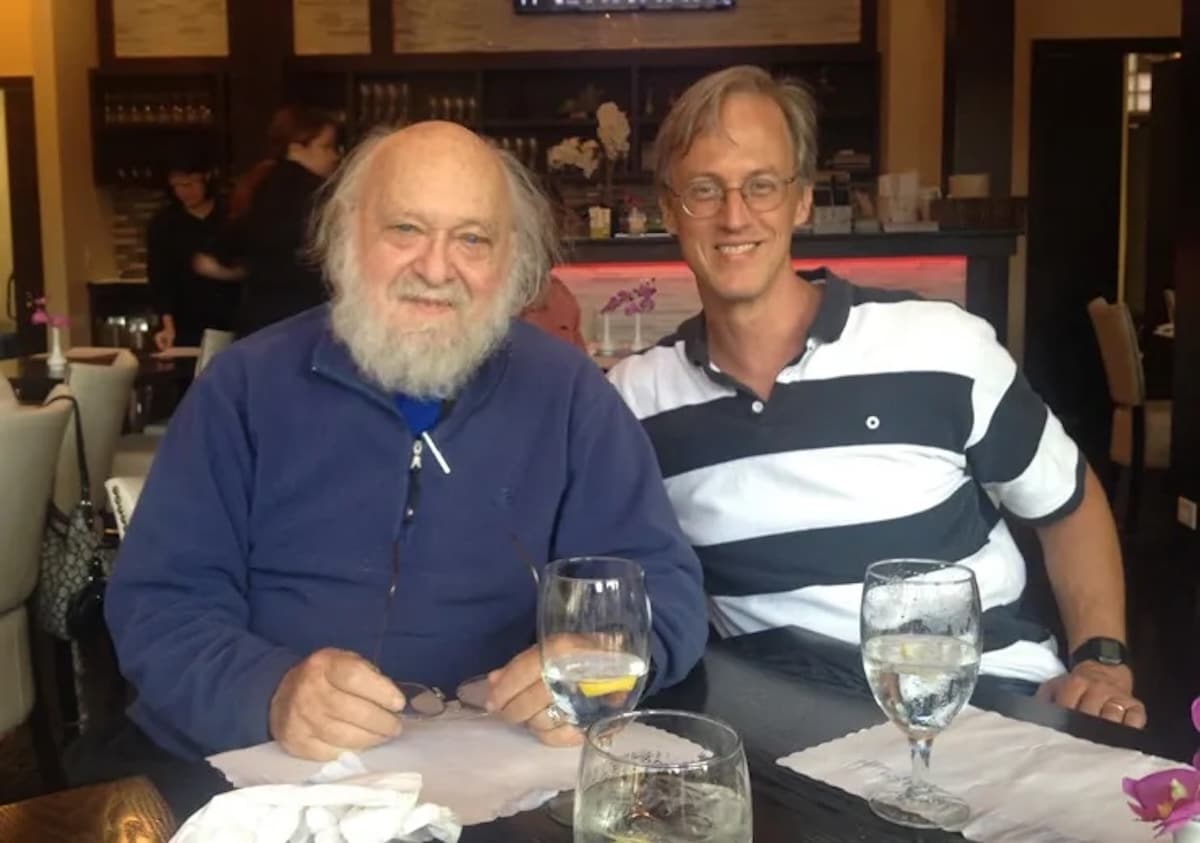
After the talk, Leo, a postdoc (I think it was a postdoc rather than faculty member or grad student), and I went out for a meal at a local Vietnamese restaurant. This was the last time Leo and I saw each other — he passed away the following year. Here is a picture of our time at the restaurant, taken by the postdoc:
As I mentioned, Paul Nelson took a video of my talk with his laptop. He made it available to me and Bob Marks. Bob kindly inserted into Paul’s video my PowerPoint presentation so that my slides could be followed more easily by viewers. The talk, thus enhanced, was then uploaded onto YouTube. You can see it here:
Next, “Being as Communion: The Metaphysics of Information.”