






































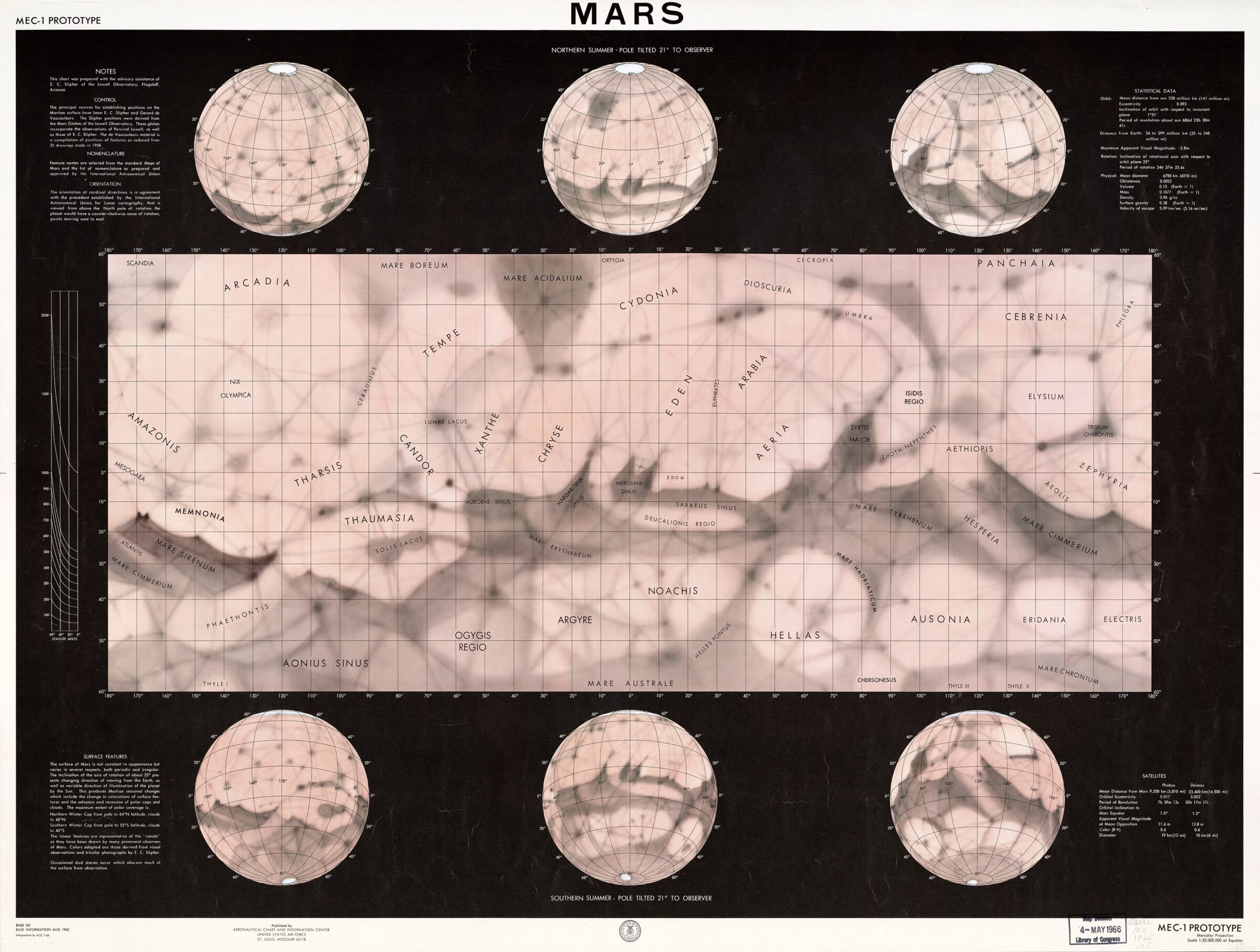
In 1877, the Italian astronomer Giovanni Schiaparelli observed lines on the surface of Mars. They were not consistently visible, but other astronomers reported seeing the same. There appeared to be circles dotted around the Martian surface with straight lines connecting them. What might explain this curious feature?
An American astronomer, Percival Lowell, promoted a particular hypothesis: the lines were an extensive system of canals built by Martians. In Lowell’s telling, Mars was drying up, leaving Martians in a desperate situation. In order to survive they had dug an extensive system of canals to irrigate the planet. He argued that the lines were not actually the canals, but rather the irrigated land near the canals with the circles being oases formed at the junction of canals.
“A Set of Coincidences”?
He wrote three books defending this idea: Mars, Mars and Its Canals, and Mars as the Abode of Life. In Mars, he summarized his argument:
To review, now, the chain of reasoning by which we have been led to regard it probable that upon the surface of Mars we see the effects of local intelligence. We find, in the first place, that the broad physical conditions of the planet are not antagonistic to some form of life; secondly, that there is an apparent dearth of water upon the planet’s surface, and therefore, if beings of sufficient intelligence inhabited it, they would have to resort to irrigation to support life; thirdly, that there turns out to be a network of markings covering the disk precisely counterparting what a system of irrigation would look like; and, lastly, that there is a set of spots placed where we should expect to find the lands thus artificially fertilized, and behaving as such constructed oases should. All this, of course, may be a set of coincidences, signifying nothing; but the probability points the other way.
He points to a specific set of improbable circumstances and argues that the best explanation is alien intelligence. There were alternative explanations. Some proposed that these were cracks on the Martian surface. But Lowell responded that the lines were far too straight and regular to be cracks. Others argued that they were an illusion, but Lowell argued that the lines had been observed under clear enough conditions that an illusion could be ruled out.
A Design Inference
In so doing, Lowell was engaged in the design inference. He identified a specified pattern, a regular system of lines and circles across the Martian surface. He argued that the pattern was highly improbable. He also argued that alternative explanations failed. Thus having shown the lines on Mars exhibit specified complexity and having eliminated all plausible chance hypotheses, he inferred design.
Others disagreed with Lowell. One notable individual who criticized Lowell’s arguments was Alfred Russel Wallace, the co-discoverer of natural selection. He wrote a book, Is Mars Habitable?,that comprehensively rebutted Lowell’s case, arguing that Mars was not habitable. Another was E. Walter Maunder who wrote Are the Planets Inhabited?
Both of these authors were actually concerned about a broader question: Are the conditions necessary for life rare or common? Wallace had previously written a book, Man’s Place in the Universe. His thesis was that the conditions necessary for life were rare, pointing to a purpose and design behind Earth. His book on Mars is explicitly a defense of that against the challenge brought by Lowell. Maunder likewise argued for the rarity of life, although he was not willing to draw a conclusion of design and purpose as strongly as Wallace.
For Lowell, on the other hand, the emergence of life is “as inevitable a phase of planetary evolution as is quartz or feldspar or nitrogenous soil.” Lowell was motivated to find evidence of alien intelligence on Mars because he thought life ought to be common in the universe.
An Optical Illusion
Wallace and Maunder disagreed about how to explain the lines. Wallace proposed a speculative theory about a hot shell of meteorites contracting onto a cold Martian surface. Maunder argued that the lines were an optical illusion.
For most astronomers, the question was settled by the observations of E. M. Antoniadi. He had originally believed that there were canals on Mars. But after utilizing a better telescope, he came to the conclusion that they were simply optical illusions. Lowell and a minority of other astronomers remained convinced that the canals were real. Any remaining doubts were settled by Mariner 4 which flew by Mars in 1965 and took pictures demonstrating that there were no canals.
What does all this tell us about design inferences? It underscores the important point that drawing a design inference requires eliminating all chance hypotheses. Lowell drew an incorrect design inference because he incorrectly rejected the illusion explanation. In this, he seems to have allowed his bias in thinking that Mars should have had life to prematurely discount that possibility. Others, who thought that life was rare, turned out to be correct.