






































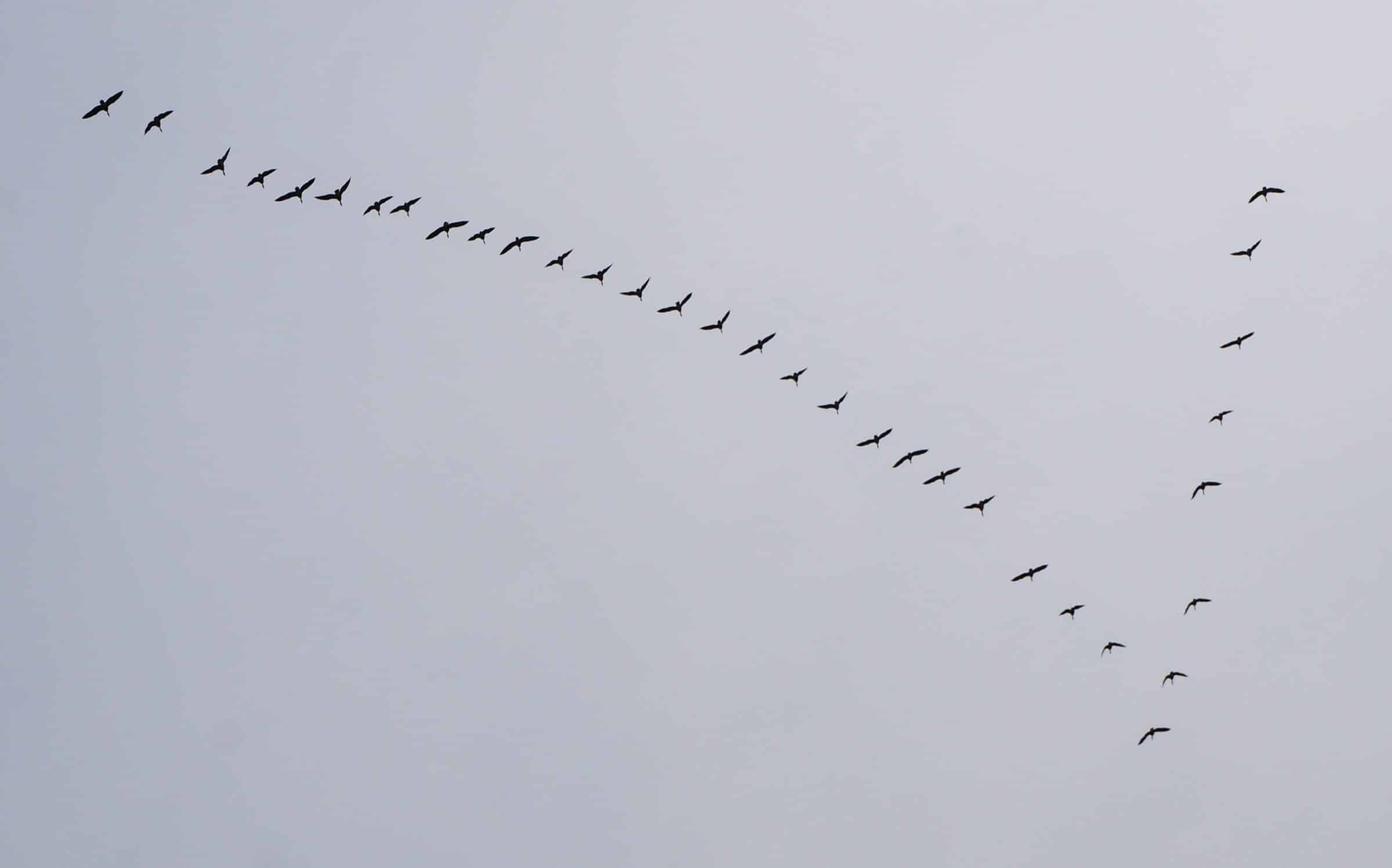
Scientists continue to learn new things about the physics of bird flight and the strategies they use for migrating long distances. These discoveries owe much to engineering and little to evolution.
V is for Efficiency
Migrating birds like geese and ibises often fly in a V formation. It’s a memorable sight for birdwatchers looking up into the sky. Scientists have known that the V formation confers advantages for the trailing birds, but some details of the physical benefits have been lacking. Previous studies have oversimplified or overcomplicated the explanation. The difficulty arises from accounting for wingtip vortices that are constantly changing during flapping flight.
A new study seeks a middle ground to help visualize and quantify the advantages by focusing on one lead bird and one trailing bird. Olivia Pomerenck and Kenneth S. Breur from Brown University, using wind tunnel experiments, measured an 11 percent reduction in mechanical power required for the trailing bird. This advantage comes entirely by reducing wing amplitude (the flapping distance up and down), conferring an overall advantage of 25 percent in efficiency for the trailing bird. Presumably these advantages propagate down the line on both arms of the V formation.
Breuer, a professor of engineering and of ecology, evolution and organismal biology at Brown, has long been interested in animal flight. His lab at Brown, which is equipped with a custom-made wind tunnel festooned with high-speed cameras, has made numerous discoveries about the flight dynamics of both bats and birds. Experiments done with starlings in the wind tunnel a few years ago helped to confirm that the V formation does help trailing birds save energy — reducing the energetic cost of flight by 25% in wind tunnel flights.
We all hope, I’m sure, that the lead bird gets to trade places occasionally and get some rest. Details of the study were published in PNAS. The only kind of evolution of interest to Breur and Pomerenck was “wake evolution” — i.e., how the vortex behind the lead bird’s wing changes during wing flaps to add thrust for the trailing bird.
G Is for Geolocator
Geolocator technology has been advancing since Illustra’s report about arctic terns in the documentary Flight that confirmed flight paths of their pole-to-pole annual migrations. Smaller multi-sensor devices today can collect more data, including light, barometric pressure, and activity.
A huge team of international researchers from 47 institutions, publishing in Current Biology, put advanced multi-sensor geolocators to good use. They tracked “411 individuals of 56 different species, originating from 83 populations across 25 countries spanning four continents.” The species represented a sample of small or medium-sized migrating land birds.
The main finding was that the vast majority of the birds launch at dusk and land at dawn. The paper lists half a dozen theories about the advantage of nocturnal migration: predator avoidance, less turbulence at night, ability to navigate by the stars, and more. None of the explanations is entirely satisfactory, so the team did not prefer one.
Nothing to Darwinize
Speculation about the “evolution” of nocturnal migration in the paper sounded weak at best:
The overall consistency across all indices and the strengthened signal in the expanded dataset reinforce the interpretation that nocturnal migration is largely conserved within lineages, though convergent evolution or behavioral plasticity under similar ecological pressures cannot be excluded.
Conserved, as usual, means unevolved. No attempt was made to explain how powered flight originated, or how the urge to migrate with cues from magnetic fields or stars came about. The “phylogenetic signal” of nocturnal migration was also weak, requiring a promissory note:
Expanding taxonomic coverage to currently underrepresented groups would also allow testing whether the phylogenetic conservatism detected here holds across a broader avian tree or whether certain lineages have independently evolved flexible diel strategies.
Advocates of intelligent design are less interested in fitting data to a pre-existing (Darwinian) story than understanding how such small animals are capable of powered flight in the dark. The former might have application to bedtime stories. The latter has potential to improve human engineering, understanding of nature, and awe at the wonders overhead. And they can sing, too.