






































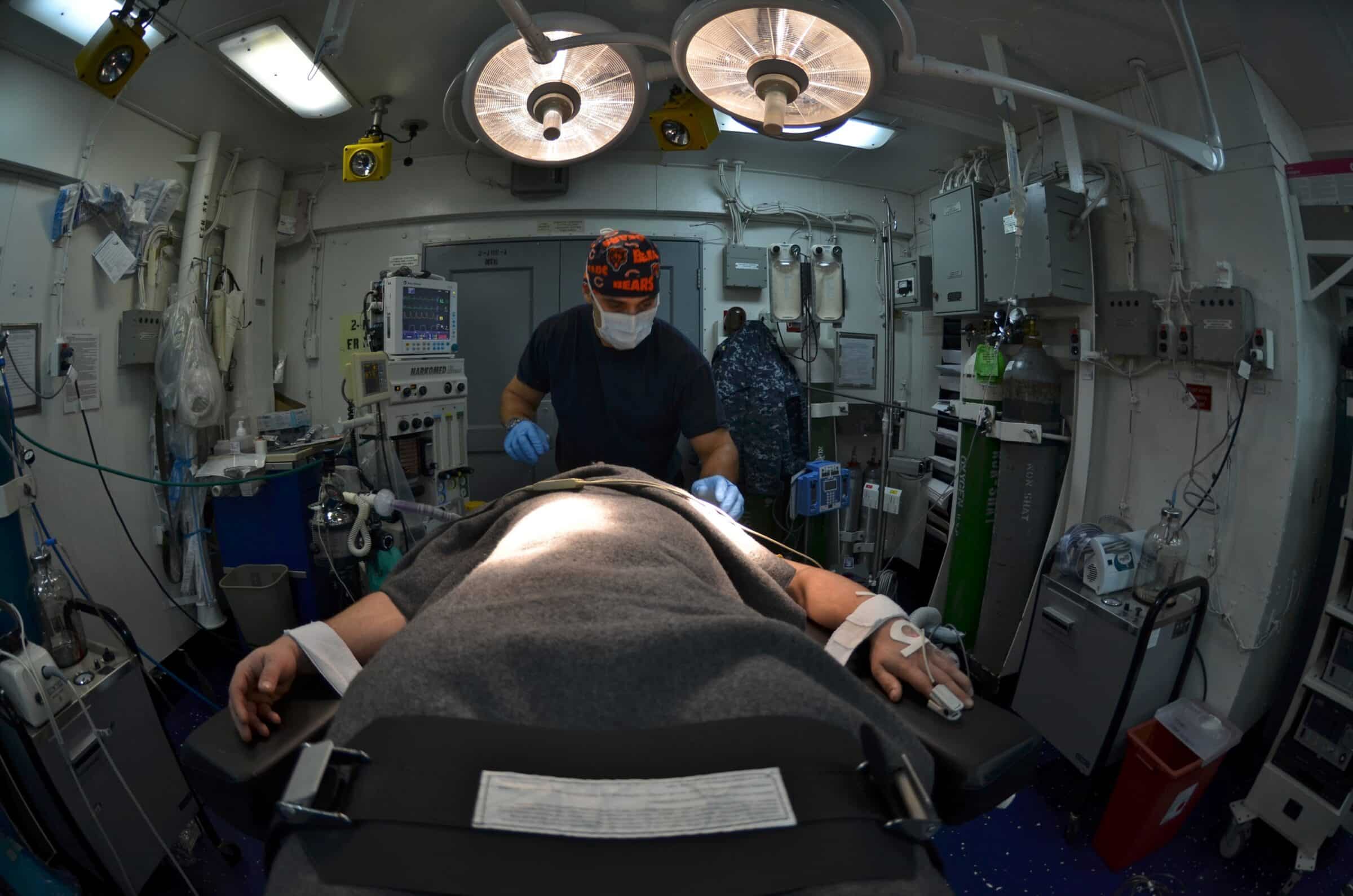
What happens to your brain and mind when you are anesthetized? It’s an interesting question, and at Nautilus, science writer Jackie Rocheleau addressed it a few years ago. From, “Under anesthesia, where do our minds go?”
So far, scientists have learned that, generally speaking, anesthetic drugs render people unconscious by altering how parts of the brain communicate. But they still don’t fully understand why. Although anesthesia works primarily on the brain, anesthesiologists do not regularly monitor the brain when they put patients under. And it is only in the past decade that neuroscientists interested in altered states of consciousness have begun taking advantage of anesthesia as a research tool. “It’s the central irony” of anesthesiology, says George Mashour, a University of Michigan neuroanesthesiologist, whose work entails keeping patients unconscious during neurosurgery and providing appropriate pain management.
Mashour and colleagues track patients’ brain activity under anesthesia, with the goal of reducing unfortunate side-effects like post-operative cognitive issues that are especially a problem in older patients, according to an open access study: “State of the clinical science of perioperative brain health: report from the American Society of Anesthesiologists Brain Health Initiative Summit 2018.”
So What Actually Happens to Our Brains?
EEG records the electrochemical activity between communicating neurons in the brain. As the brain lapses into anesthetic-induced unconsciousness, this activity follows a predictable pattern of sequences. Through electrodes stuck to the scalp, EEG records these sequences, which are then visualized as spiky waves on a monitor. When a patient is under general anesthesia, typically the waves crest more slowly with greater amplitude as the drugs disrupt connections between networks that keep us awake and aware. For example, propofol enhances inhibition of cortical neurons and disrupts communication across the cortex, the hub of complex functions like thinking and making sense of stimuli from the environment. It also dampens communication between the cortex, the brainstem, and the thalamus, an egg-shaped collection of neurons deep within the brain important for sensory information processing and arousal.
Of course, our minds do not really “go” anywhere; the circumstances make dreaming or remembering anything afterward unlikely. But, swiftly or slowly, the mind starts accessing information again as the drugs wear off.
What About Pain Awareness with Light Anesthesia?
It’s a risk but rare, Rocheleau says, maybe 1 or 2 in a thousand. Neurosurgeon Michael Egnor commented recently, “I’ve done 7.000 brain operations and never seen it. Neither have my neurosurgical colleagues, and together we have done 100,000 such procedures. I know of no such awareness reported from brain surgery cases elsewhere.” He went on to say that neurosurgeons must use deep anesthesia, to avoid the patient suddenly moving. But, even with lighter anesthesia, the stuff of nightmares is unlikely.
Either way, your mind is still there, just not taking calls.
Cross-posted at Mind Matters.