






































As America approaches its 250th birthday, a look back at the past century — what Americans have witnessed in the world — seems in order. What have we observed and what can be learned from it? What, it’s worth wondering, are our prospects for the coming fifty years that will lead up to our country’s 300th anniversary?
The 20th century saw an unprecedented expansion of scientific knowledge. It also saw episodes of human rights abuse— to put it mildly — unparalleled both in magnitude and cruelty. Even as the double helix discovery, quantum theory, and the development of the polio vaccine manifested some of man’s most ennobling capabilities, the gulags and gas chambers demonstrated with equal force that scientific prowess alone does not confirm the existence of civilization — if civilization is to be measured by a commitment to protecting what the Declaration of Independence calls our “unalienable rights.”
What Cultures and Governments Think
In a great many places, human rights have been an imperiled commodity. Yet in every situation, protections accorded human rights have reflected what cultures and governments think about the value and dignity of man. The scientific disciplines, which have increasingly helped to define our view of mankind, have indirectly played an important role in the discussion about human rights, precisely because man’s idea of man ultimately decides the respect that human rights receive.
Human rights might be defined as the legal and political manifestation of a culture’s perception of human dignity. Yet cultures do not create human dignity any more than governments create human rights; at best, societies will acknowledge dignity by preserving rights. Harvard Law professor Harold J. Berman detected this assumption at the heart of Western democracy. In the West, he noted, “the fundamental rights of individual persons exist independently of the state.” While by contrast under Marxist and other totalitarian governments, “all rights are granted by the state and are inevitably subordinate to [its] power.”
But Which Way Should It Be?
Do human rights have validity apart from government decree or are they merely granted by it?
In the Western tradition human rights have been said to exist independently of the state because they have been based upon human dignity. The American Bill of Rights, for example, offers what Supreme Court Justice William J. Brennan called “a sublime oration on the dignity of man.”
The word dignity comes from the Latin dignitas meaning “glory.” Historically, Western society has derived its belief in the dignity of man from the Judeo-Christian belief that man is the glory of God, made in His image. According to this view, human rights depend upon the Creator who made man with dignity, not upon the state.
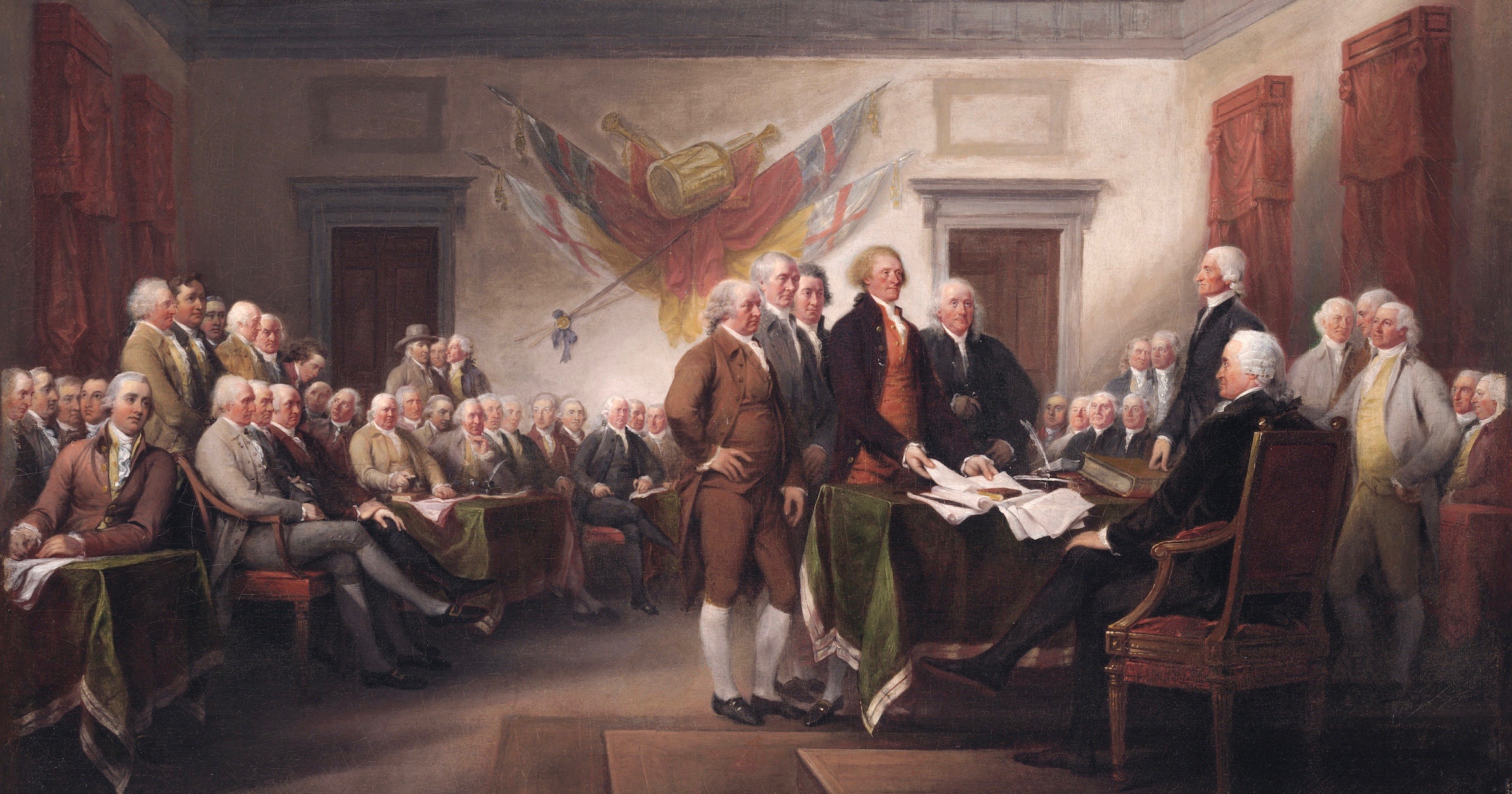
In the formulation of the Declaration of Independence, “men … are endowed by their Creator with certain unalienable rights.” That has been the theme of the Center for Science and Culture’s own observation of the Declaration’s 250th anniversary, reflected in the title of John West’s recent book Endowed by Our Creator: The Bible, Science, and the Battle for America’s Soul.
Tomorrow, “On Our 250th Anniversary, There Is a Battle for America’s Soul.”
Editor’s note: This article is adapted from an essay originally published in the Los Angeles Times.