






































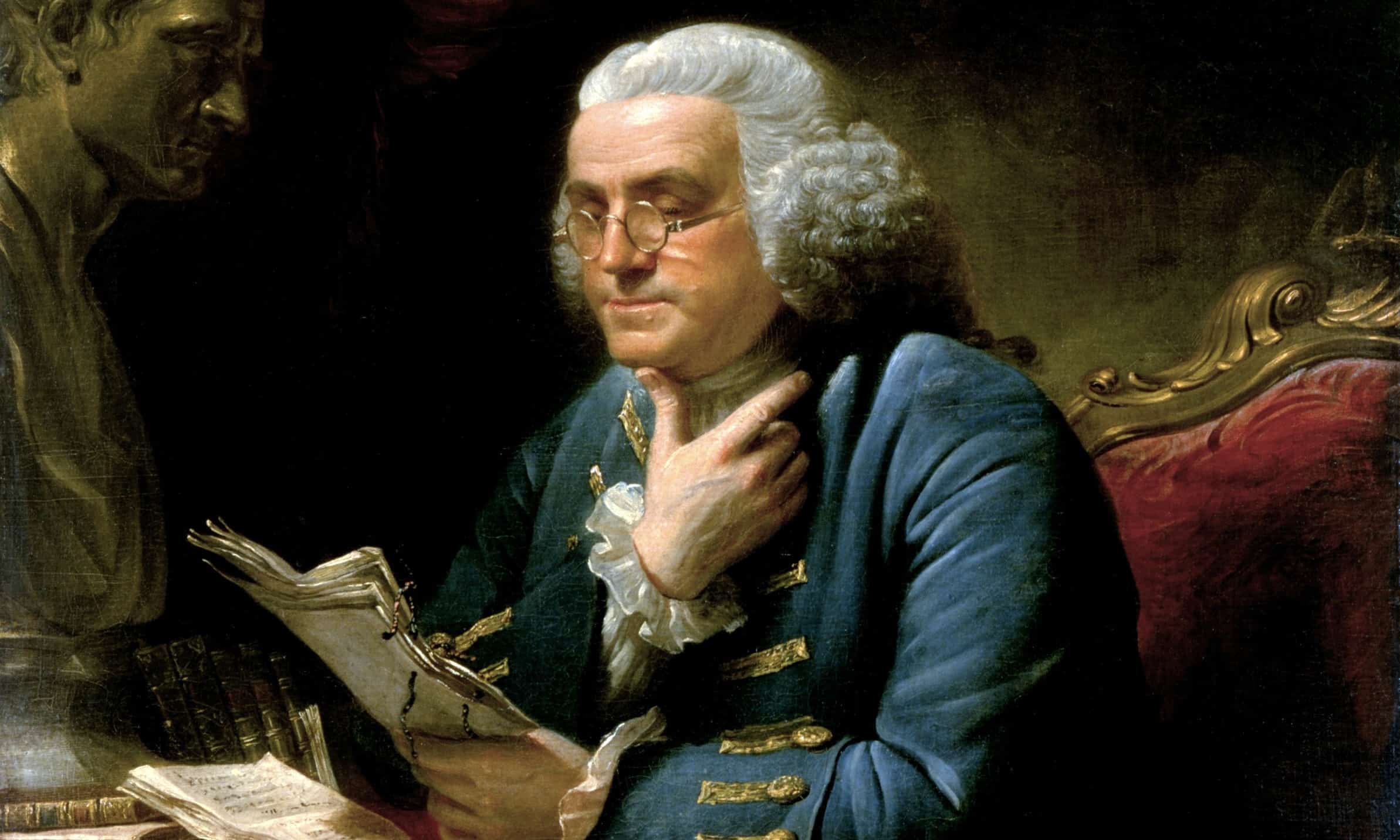
As America celebrates the 250th anniversary of our Declaration of Independence (we’ve got all year, folks!), there has been a renewed pop culture interest in the history of our Founding Fathers. Angel Studios’ Young Washington is a surprise hit in theaters, people are revisiting HBO’s John Adams series, and popular English historians Tom Holland and Dominic Sandbrook have been taking their large podcast audience on a guided history of the Founders’ lives and times. Meanwhile, the New York Times featured a surprisingly friendly review of Sight & Sound’s film A Great Awakening, which introduces the previously little-remembered story of Benjamin Franklin’s friendship with the great revivalist preacher George Whitefield.
Franklin is famous for his aphorisms and science experiments, but fewer people know he also had a keen interest in theology. Like many of the Founders, he had a complicated relationship with orthodox Christianity, neither fully an atheist nor fully a believer. In his younger years, he ruffled feathers by taking aim at some sacred cows, but he mellowed with age. Meeting and befriending Whitefield gave him a healthy respect for sincere evangelism, along with lots of juicy content for his newspaper. The preacher would spend decades gently trying to coax Franklin into a deeper relationship with the Almighty, but the polymath remained implacably his own man.
However, one thing Franklin was always quite sure of: The universe had a divine Designer.
The Providence of God
Even in his most provocative “Young Turk” phase as an upstart twentysomething, Franklin was completely convinced of the theistic argument from design. As John West notes in his recent book, Endowed by Our Creator: The Bible, Science, and the Battle for America’s Soul, Franklin created his own private “liturgy” of sorts, which included a section on the adoration of God, declaring, “Thy Wisdom, thy Power, and thy GOODNESS [sic] are every where clearly seen.” His 1730 reflection “On the Providence of God in the Government of the World” methodically lays out the case for these assertions.
Franklin argues for God’s wisdom from how precisely situated each element of the creation appears to be and how perfectly adapted each animal is to its place in nature,
whether on Earth, in the Air or in the Waters, and so exactly that the highest and most exquisite human Reason, cannot find a fault and say this would have been better so or in another Manner, which whoever considers attentively and thoroughly will be astonish’d and swallow’d up in Admiration.
Similarly, he argues that the designer’s goodness is evident in the provision of everything needful to survive for creatures at each level of existence. This foreshadows William Paley’s thought in the 18th century.
Franklin’s argument for God’s power proceeds by observing that even we puny humans are capable of wielding natural resources in powerful ways — having, for example, cracked the chemical formula that produces gunpowder. How much more awesome must God’s power be, if He can form and govern entire planets?
From here Franklin proceeds to argue for a position beyond simple deism, which envisions an uninvolved creator who never intervenes. To the contrary, Franklin insists that a sometimes intervening God is the only reasonable variety of theism. “I say there can be no Reason to imagine he would make so glorious a Universe meerly [sic] to abandon it.” Theistic evolutionists hardest hit.
The Body of an Infant
Perhaps Franklin’s most moving piece of theological writing is on infant mortality. He was still a young man, at the time considering the death of a friend’s child, but he would suffer his own loss of a son to smallpox two years later. You can feel the passion in his writing as he marvels at the human body’s intricate design in miniature form. Like Whittaker Chambers staring at his daughter’s ear in the famous scene in Witness, Franklin lingers over the beautiful complexity of every biological system: “What a rich and artful Structure of Flesh upon the solid and well compacted Foundation of Bones! What curious Joints and Hinges, on which the Limbs are moved to and fro! What an inconceivable Variety of Nerves, Veins, Arteries, Fibres and little invisible parts are found in every Member!”
It’s inconceivable to Franklin that God could craft something so awe-inspiring, like an “expert Artificer” laboring over a beautiful clock, only to “suddenly dash it to pieces” when the baby’s life ends. Franklin peers over the edge into this abyss, but his deepest intuition says “No!”
The Shadows of a long Evening are stretch’d over them, the Curtains of a deep Midnight are drawn around them, The Worm lies under them, and the Worm covers them. No! the Notion of Annihilation has in it something so shocking and absurd, Reason should despise it; rather let us believe, that when they drop this earthly Vehicle they assume an Aetherial one, and become the Inhabitants of some more glorious Region.
From here Franklin’s reflections wander into more speculative and less orthodox territory, not unlike contemporary muddled ideas of infants turning into angels and guiding us from above. But there is still power in his emphatic refusal to accept that a loving Creator has no heavenly plan for His embodied creatures when their earthly bodies die. He hopes this will bring comfort to grieving parents, closing in deeply eloquent fashion:
When Nature gave us Tears, she gave us leave to weep. A long Separation from those who are so near a-kin to us in Flesh and Blood, will touch the Heart in a painful Place, and awaken the tenderest Springs of Sorrow. The Sluices must be allowed to be held open a little; Nature seems to demand it as a Debt to Love. When Lazarus died, Jesus groaned and wept.
Franklin’s Jesus remained no more than a good man, less than divine. But to his good friend Reverend Whitefield, it was in Jesus that all God’s power, goodness, and wisdom were most fully revealed, in an incarnate body whose resurrection foreshadowed a grand resurrection plan — not just for the body of an infant, but for all of our bodies, for all time.