






































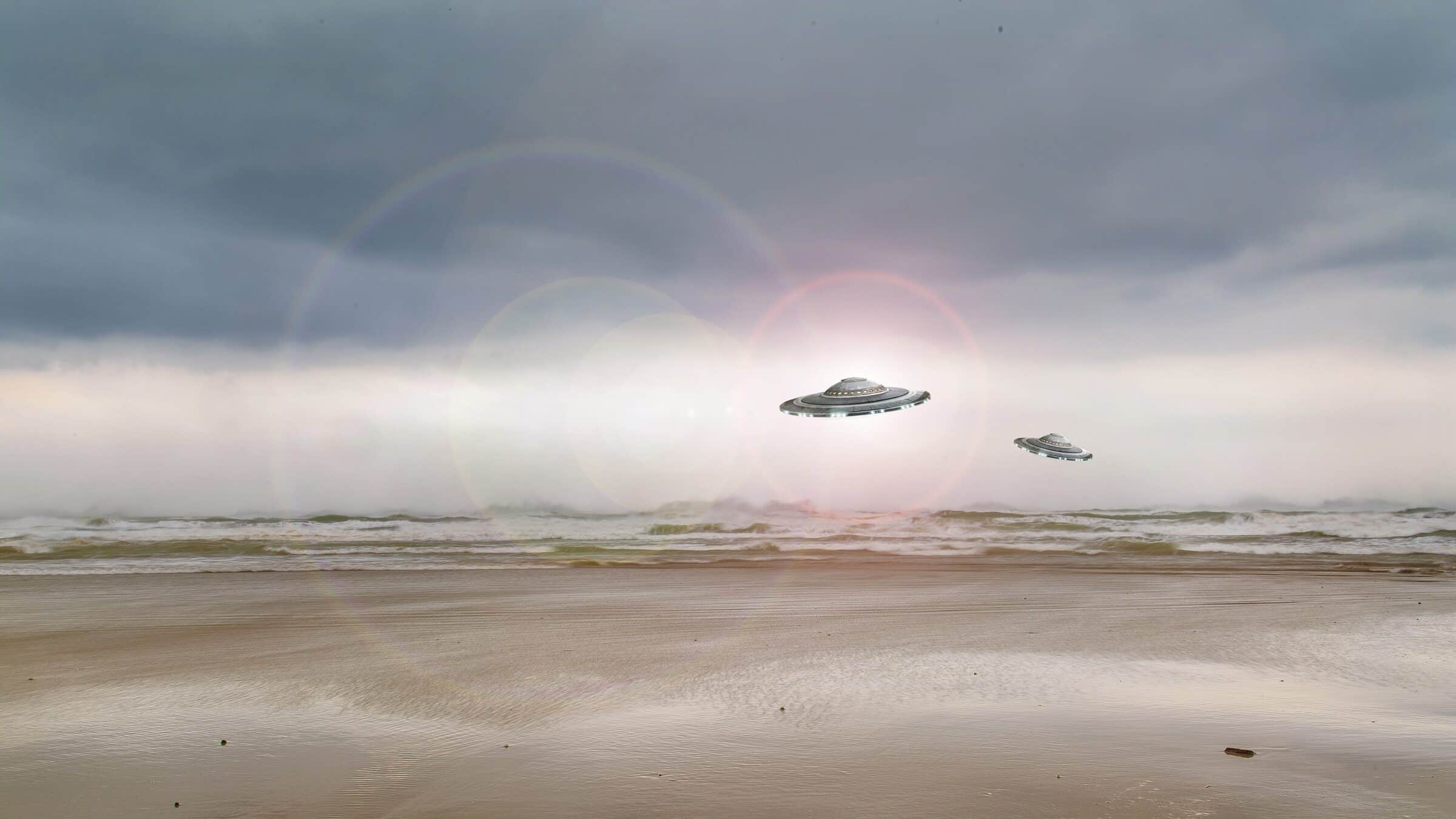
I among many others anticipated that Steven Spielberg’s Disclosure Day, which opened last week, would be a “blockbuster.” But when I saw it over the weekend, the theater was not empty though it was far from full. Variety reports that “ticket sales were above estimates of $35 million, though below the $50 million that rival studios argue a film of this scale should earn.” We’ll see.
At Science and Culture Today, we’ve been talking a lot about purported aliens. That’s for two reasons: because of the ongoing supposed government disclosure about ET visitors, which has so far turned out to be a major let-down, and because of the Spielberg film.
Objects in the Sky
There could be intelligent life forms visiting Earth from elsewhere — who knows? Strange objects seen is in the sky are a phenomenon that goes back decades if not centuries. Our colleague Casey Luskin has made a fascinating and solid case that if technological ETs exist — especially if they are humanoid, which they would almost certainly have to be — that would add evidence to the case for intelligent design.
Well, I won’t hide my disappointment that Spielberg’s latest is fun as light entertainment, but overall, underwhelming. It’s like a retread of his E.T. the Extraterrestrial, but without the humor or charm. Like that adorable 1982 film, it’s got a humanoid alien (this one wearing what looks to be a V-neck sweater, and not adorable). It’s got chase scenes. It’s got shadowy U.S. government figures unfeelingly experimenting on or interrogating aliens.
And it’s got a moral message that nobody who’s not a psychopath could argue with. The previous movie had ET saying farewell to the little girl, Gertie, with the admonition to “Be good.” In the new film, what exactly the alien’s message might be is withheld at the very end. But we’re led to expect it to have something to do with empathy, which one character says is the “next evolutionary stage” and at which the ETs are apparently more adept than current humans.
I’m not sorry I saw Disclosure Day and any error in looking forward to it as a huge summer hit was an honest one. What quite a few people on social media should feel sorry for is exploiting the film before they saw it as some sort of attack on religion, Christianity in particular. Some of these, in line with the current ugly atmosphere, drew special attention to the fact that Spielberg is a Jew.
One priest warned that the film could possibly have been “consecrated to Satan,” and that demons might attach themselves to you if you saw it. Rod Dreher, an author whose writing I enjoy, has a book coming out about exorcists and the like and characterized the film as “a gnostic re-enchantment tale,” “important,” and “something close to evil.”
On Shaky Ground
No, I’m not buying any of that. Spielberg himself is partly the reason for the characterizations: he teased the supposed spiritual significance of the film, which is now basically revealed as clever marketing. On the other hand, who is entitled to market his own film if not the director? That’s part of his job.
But anyone’s faith that could be shaken by Disclosure Day must have been on very shaky ground to begin with. There is, again, little that’s new here compared with E.T. If the earlier movie left your religious view intact, so will this one. Also, of the two characters in the new film whom Spielberg presents to us as the wisest and most compassionate, one is a Catholic nun! That’s a storytelling choice that an anti-religious movie would be unlikely to make.
The nun at one point ventures into theology, with the statement that God made humans as the apex of creation “on Earth” — meaning, maybe in some other world there are creatures that form the apex there. Maybe there are. The Bible doesn’t address the question.
Lewis’s Space Trilogy
But as Bethel McGrew has pointed out here, no less revered a Christian writer than C. S. Lewis imagined in his Space Trilogy (1938-1945) that intelligent extraterrestrials exist and face moral dilemmas like ours. The idea, intriguing but not new, can hardly be called heresy.
Neither can anything — not that I’m an expert on theology — onscreen here. Maybe it would be more exciting if the case were otherwise. But of Spielberg’s own Space Trilogy (this film, E.T., and Close Encounters of the Third Kind), Disclosure Day will, I predict, go down as the most hyped and least memorable.